
- Search Popular SearchesCritical thinkingPhilosophyEmotional IntelligenceFree Will Latest Videos Latest Articles
-
Topics
Philosophy
- Ethics
- Religion
- Flourishing
- Knowledge
- Philosophy of Science
- Philosophy of Art
- Language
- Political Theory
- Identity
- Meaning & Purpose
Science & Tech
- Physics
- Biology
- Aerospace
- Health
- Geology
- Computing
- Engineering
- Energy
- Biotechnology
Mind & Behavior
- Psychology
- Neuroscience
- Decision-Making
- Mental Health
- Consciousness
- Emotional Intelligence
- Personality
- Relationships
- Parenting
Business
- Entrepreneurship
- Leadership
- Finance
- Marketing
- Innovation
- Strategy
- Management
- Artificial Intelligence
- Startups
- Economics
History & Society
- History
- Literature
- Art
- Music
- Film
- Progress
- Culture
- Sociology
- Policy
- Geopolitics
-
Videos
Latest Videos
 Why the search for alien life is about patience, not belief
with
Jill Tarter
Why the search for alien life is about patience, not belief
with
Jill Tarter
 Thinking too logically can actually hold you back
with
Dan Shipper
Thinking too logically can actually hold you back
with
Dan Shipper
 Is there a Planet B? An astrophysicist answers.
with
Sara Seager
Is there a Planet B? An astrophysicist answers.
with
Sara Seager
 What nihilism acknowledges that other philosophies don’t
with
Alex O’Connor
What nihilism acknowledges that other philosophies don’t
with
Alex O’Connor
 The terrifying ways that social media is altering teenage brains
with
Clare Morell
The terrifying ways that social media is altering teenage brains
with
Clare Morell
 The computing revolution that secretly began in 1776
with
David Alan Grier
See All
The computing revolution that secretly began in 1776
with
David Alan Grier
See All
-
Columns
 Mini Philosophy
A philosophy column for personal reflection.
Mini Philosophy
A philosophy column for personal reflection.
 Starts With A Bang
An astrophysics column on big questions and our universe.
Starts With A Bang
An astrophysics column on big questions and our universe.
 Books
A literature column to feed your curiosity.
Books
A literature column to feed your curiosity.
 The Long Game
A business column on long-term thinking.
The Long Game
A business column on long-term thinking.
 Strange Maps
A geography column on history and society.
Strange Maps
A geography column on history and society.
 The Well
A collection of essays and videos on life’s biggest questions.
The Well
A collection of essays and videos on life’s biggest questions.
 13.8
A column at the intersection of science and culture.
13.8
A column at the intersection of science and culture.
-
Classes
Featured Classes
 Members
7 videos
How to Lead With Integrity
Steve Stoute
Founder and CEO, UnitedMasters and Translation
Members
7 videos
How to Lead With Integrity
Steve Stoute
Founder and CEO, UnitedMasters and Translation
 Members
6 videos
Transform Your Organization with AI
Daphne Koller
Founder and CEO of insitro.
Members
6 videos
Transform Your Organization with AI
Daphne Koller
Founder and CEO of insitro.
 Members
10 videos
Unlocking Your Team’s Hidden Potential
Adam Grant
Organizational psychologist and author
Members
10 videos
Unlocking Your Team’s Hidden Potential
Adam Grant
Organizational psychologist and author
 Members
6 videos
The Secrets of Unreasonable Hospitality
Will Guidara
Restaurateur and Author, Unreasonable Hospitality
Members
6 videos
The Secrets of Unreasonable Hospitality
Will Guidara
Restaurateur and Author, Unreasonable Hospitality
 Members
12 videos
How to Afford Anything
Paula Pant
Host, Afford Anything Podcast, Afford Anything
Members
12 videos
How to Afford Anything
Paula Pant
Host, Afford Anything Podcast, Afford Anything
 Members
7 videos
True Ingredients of Successful Leadership
Atul Gawande
Professor and author
Browse
Members
7 videos
True Ingredients of Successful Leadership
Atul Gawande
Professor and author
Browse
-
More
- About Big Think
- Work with Us
- Newsletters
- Monthly Issues
- Events
- Careers
- Our Mission
- Get Big Think+ for Business
- Freethink Media
- View our Twitter (X) feed View our Youtube channel View our Instagram feed View our Substack feed
-
My account
- My Classes
- My Account
- My List
- BT+ for my Business
- Early Releases
- Sign Out
- Membership
-
Topics
Back
Philosophy
- Ethics
- Religion
- Flourishing
- Knowledge
- Philosophy of Science
- Philosophy of Art
- Language
- Political Theory
- Identity
- Meaning & Purpose
Science & Tech
- Physics
- Biology
- Aerospace
- Health
- Geology
- Computing
- Engineering
- Energy
- Biotechnology
Mind & Behavior
- Psychology
- Neuroscience
- Decision-Making
- Mental Health
- Consciousness
- Emotional Intelligence
- Personality
- Relationships
- Parenting
Business
- Entrepreneurship
- Leadership
- Finance
- Marketing
- Innovation
- Strategy
- Management
- Artificial Intelligence
- Startups
- Economics
History & Society
- History
- Literature
- Art
- Music
- Film
- Progress
- Culture
- Sociology
- Policy
- Geopolitics
-
Videos
Back
Latest Videos
Why the search for alien life is about patience, not belief
Thinking too logically can actually hold you back
"Rationalism is the idea that, in order to truly know something, you have to be able to describe it explicitly."
Is there a Planet B? An astrophysicist answers.
30 years ago, we didn’t know other stars had planets orbiting them. Now, we may be on the verge of...
What nihilism acknowledges that other philosophies don’t
"The thing that the nihilist recognizes is that the values he or she holds are not grounded in anything other...
The terrifying ways that social media is altering teenage brains
Why social media is the perfect recipe for kids to become addicted to their smartphones.
The computing revolution that secretly began in 1776
"In the process of mapping the heavens, it doesn't take long to realize the data problem they generated."
 How the Industrial Revolution invented modern computing
"The process of systematizing, correcting errors, finding approximations, and making them work as civil systems that was what really drove...
How the Industrial Revolution invented modern computing
"The process of systematizing, correcting errors, finding approximations, and making them work as civil systems that was what really drove...
 Why modern fitness culture misunderstands human bodies
"It's this modern idea of doing voluntary discretionary, physical activity for the sake of health and fitness."
Why modern fitness culture misunderstands human bodies
"It's this modern idea of doing voluntary discretionary, physical activity for the sake of health and fitness."
-
Columns
Back
Columns
Mini Philosophy
A philosophy column for personal reflection.
Starts With A Bang
An astrophysics column on big questions and our universe.
Books
A literature column to feed your curiosity.
The Long Game
A business column on long-term thinking.
Strange Maps
A geography column on history and society.
The Well
A collection of essays and videos on life’s biggest questions.
13.8
A column at the intersection of science and culture.
-
Classes
Back
Featured Classes
Members
7 videos
How to Lead With Integrity
Steve Stoute
Founder and CEO, UnitedMasters and Translation
Members
6 videos
Transform Your Organization with AI
Daphne Koller
Founder and CEO of insitro.
Members
10 videos
Unlocking Your Team’s Hidden Potential
Adam Grant
Organizational psychologist and author
Members
6 videos
The Secrets of Unreasonable Hospitality
Will Guidara
Restaurateur and Author, Unreasonable Hospitality
Members
12 videos
How to Afford Anything
Paula Pant
Host, Afford Anything Podcast, Afford Anything
Members
7 videos
True Ingredients of Successful Leadership
Atul Gawande
Professor and author
-
My Account
Back
- My Classes
- My Account
- My List
- BT+ for my Business
- Early Releases
- Sign Out
- Sign In
- Membership
-
More
Back
- About Big Think
- Work with Us
- Newsletters
- Monthly Issues
- Events
- Careers
- Our Mission
- Get Big Think+ for Business
- Freethink Media
- View our Twitter (X) feed View our Youtube channel View our Instagram feed View our Substack feed
Even at its faintest, Venus always outshines every other star and planet that's visible from Earth, and then some!
by Ethan Siegel February 5, 2026 This photograph from March 1, 2023 shows Venus and Jupiter separated by less than 1 degree in the sky: the closest approach they'll make until the year 2039. While some of Jupiter's moons are visible, the relatively much brighter Venus outshines them all. Only the Moon, among all of the night sky objects, shines brighter than Venus does.
Credit: Lorenzo Di Cola/NurPhoto/Shutterstock
Key Takeaways- Although it’s the second planet from the Sun, Venus is not only the hottest planet in the Solar System, it is the most extreme world in our vicinity by many measures.
- If things had gone a little differently on Venus, it might have become an inhabited, Earth-like world, and if Earth had gone a little differently, perhaps we’d have become like Venus.
- Instead, Venus is the brightest planet as seen from an inhabited Earth, and no other star or planet comes close to comparing.

An astrophysics column on big questions and our universe.
Newsletter-
space & astrophysics
As February progresses here in 2026, the brightest planet in the night sky, Venus, will begin to rise in the western skies just after sunset. Later in February, it will be joined by Mercury and Saturn, forming a triple treat for skywatchers to enjoy. Venus, as always, is a spectacular highlight. Brighter than any other star or planet in the night sky, it’s close enough that you can see it exhibit the full suite of phases from crescent to full and back again through a simple pair of binoculars or literally any telescope you can buy. Outshining all other objects in the night sky except for the Moon, every other star and planet pales in comparison to Venus as viewed from Earth, regardless of its current phase.
The above photograph shows Venus next to Jupiter — the second brightest planet, shining brighter than even the brightest star in the sky — as it appeared during conjunction on March 1, 2023. At that moment, Venus appeared about five-and-a-half times brighter than Jupiter, or nearly two full astronomical magnitudes: more than the brightness difference between Mizar and Alcor in the handle of the Big Dipper. Although its continued brightness is perhaps Venus’s most notable feature, it isn’t merely the brightest planet we can see from Earth, but rather an extreme, remarkable world all unto itself in a number of ways.
Here are eight properties that make Venus the remarkable status of the “most extreme planet” within the entire Solar System.
 Venus’s cloud-rich atmosphere lies high above a dense, thick, extremely hot surface layer. The lower cloud decks don’t begin until you’re already tens of kilometers up, and persist in multiple layers until the highest hazes at ~90 kilometers in altitude. These clouds, composed largely of sulfuric acid, are perhaps the most striking feature of Venus’s atmosphere, with complex chemical reactions occurring within them.
Credit: S. Seager et al., Astrobiology, 2021
Venus’s cloud-rich atmosphere lies high above a dense, thick, extremely hot surface layer. The lower cloud decks don’t begin until you’re already tens of kilometers up, and persist in multiple layers until the highest hazes at ~90 kilometers in altitude. These clouds, composed largely of sulfuric acid, are perhaps the most striking feature of Venus’s atmosphere, with complex chemical reactions occurring within them.
Credit: S. Seager et al., Astrobiology, 2021
1.) Venus’s atmosphere. Every planet within the Solar System is subject to a few different effects: the gravitational pull from the mass within the planet on one hand, and the particles and radiation emitted from the Sun on the other hand. These two phenomena oppose one another when it comes to the planet’s atmosphere, with the solar wind and radiation working to strip the planet’s atmosphere away while the gravitational pull of the planet works to grow the planet during the early, formative stages and hang onto as much of its atmosphere for as long as possible later on.
Although Mercury was close enough to the Sun and small enough that its atmosphere was fully stripped away long ago, Venus was more distant and more massive, and managed to hold onto its more massive molecular species, particularly its carbon dioxide. It’s speculated that a runaway greenhouse effect took place on Venus long ago, leading to its dense, thick, hot atmosphere, dominated by carbon dioxide and sulfuric acid clouds.
The upper layers of Venus’s atmosphere become ionized due to solar radiation, and this ionized layer, and the magnetic field resulting from the motion of the charged particles within it, protects the rest of Venus from the Sun’s stripping effects: similar to how Earth’s magnetic field protects our own planet’s atmosphere. This protection doesn’t cover everything, however; lighter species of gases — including water vapor — are constantly stripped away by the solar wind and seen in Venus’s magnetotail. Venus has the thickest, most substantial atmosphere of any rocky planet known at present.
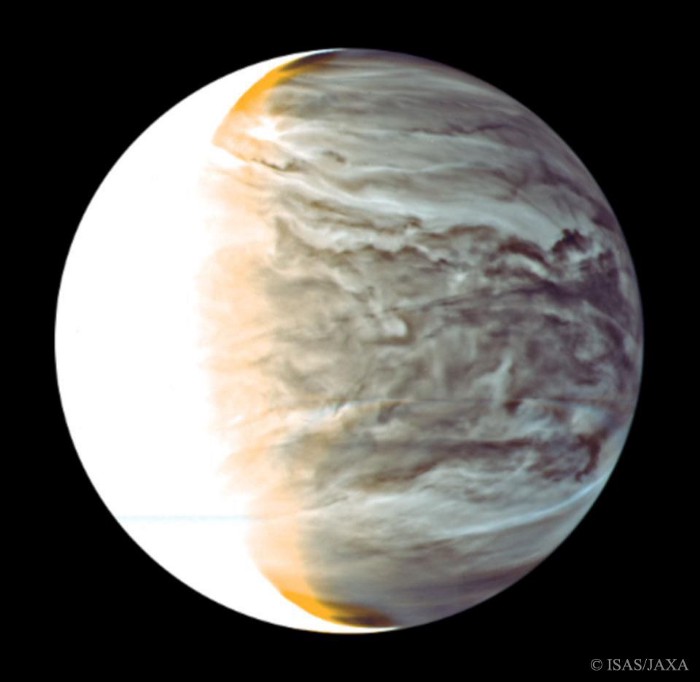 An infrared view of Venus’s night side, by the Akatsuki spacecraft. Its brightness is greater than that of any other planet as seen from Earth, and it approaches our world closer than any other planet does. At its nearest, it appears the largest in the sky of all the planets; at its most distant, numerous other planets can appear larger. However, Venus is always the brightest.
(Credit: ISAS/JAXA)
An infrared view of Venus’s night side, by the Akatsuki spacecraft. Its brightness is greater than that of any other planet as seen from Earth, and it approaches our world closer than any other planet does. At its nearest, it appears the largest in the sky of all the planets; at its most distant, numerous other planets can appear larger. However, Venus is always the brightest.
(Credit: ISAS/JAXA)
2.) Venus’s clouds. The multiple thick layers of sulfuric acid clouds play a tremendous role in pushing Venus to its extremes. Whereas on Earth, it’s primarily the greenhouse gases in our atmosphere that warm our planet — gases like water vapor, carbon dioxide, and methane, which are transparent at optical wavelengths but absorb and re-emit light in the infrared — Venus’s clouds are the primary heat-trapping agent on our sister planet. On Earth, clouds only account for about 25% of the trapped heat on our planet; on Venus, it’s well over 90%, making up by far the majority of Venus’s greenhouse (sometimes called “hothouse” for Venus) effect.
Additionally, the clouds on both Earth and Venus are highly reflective, but Earth is only ever partially covered in clouds, and many of Earth’s clouds are thin, high cirrus clouds that reflect only ~10% of the incoming sunlight, as opposed to the thick, low stratocumulus clouds that can reflect more like ~90% of the light. Venus, by contrast, has multiple layers of cloud-decks spanning something like 20 kilometers in altitude, such that 0% of the surface is typically visible at any time from space, as opposed to more like ~50% for planet Earth. This cloud cover winds up playing a vital role in the brightness of Venus as seen from Earth as well, rendering Venus the most cloud-covered rocky planet presently known.
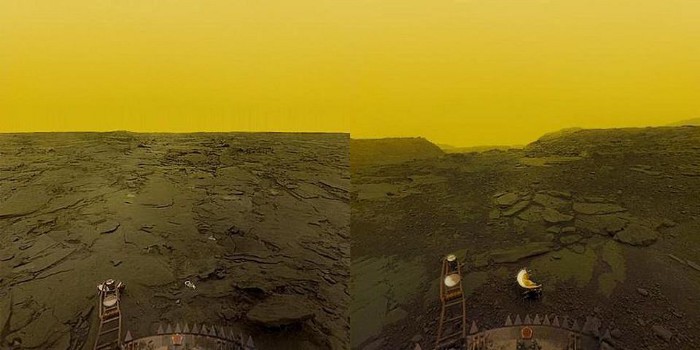 The Soviet Union’s series of Venera landers are the only spacecraft to ever land and transmit data from the surface of Venus. The longest-lived of all the landers exceeded the two-hour mark before the instruments overheated and contact was lost. To date, no spacecraft has survived for longer on the Venusian surface, where temperatures reach 900 degrees Fahrenheit (482 °C).
Credit: Venera landers/USSR
The Soviet Union’s series of Venera landers are the only spacecraft to ever land and transmit data from the surface of Venus. The longest-lived of all the landers exceeded the two-hour mark before the instruments overheated and contact was lost. To date, no spacecraft has survived for longer on the Venusian surface, where temperatures reach 900 degrees Fahrenheit (482 °C).
Credit: Venera landers/USSR
3.) Venus’s temperature. Although Venus is nearly twice the distance from the Sun as Mercury and receives only about 29% of the radiation-per-unit-area that Mercury receives, Venus, not Mercury, is the Solar System’s hottest planet. Whereas Mercury, a practically airless world, achieves temperatures that rise up to 427 °C (800 °F) in full Sun while its night side can plummet to as low as -180 °C (-290 °F), Venus consistently remains between 440–480 °C (820–900 °F). This means that Venus, whether day or night, is always hotter than planet Mercury is, even at Mercury’s absolute hottest.
While Earth’s greenhouse effect only increases our planet’s temperature by about 33 °C (59 °F) over what it would be if it were an atmosphere-free world, Venus’s greenhouse effect is tremendous, increasing its temperature by about 450 °C (810 °F) over the scenario where it’s a completely airless world. Down at the surface of Venus, it’s always hot enough to melt lead, meaning that soldiering any electronics cannot be done by conventional means if such electronics are to be launched to Venus. In fact, humanity’s most long-lived Venusian landers functioned and transmitted data for fewer than 3 hours upon touching down on the surface, before the extreme temperatures rendered them inoperable.
While the surface of Venus might be the most hellish place in our Solar System — in many ways even more extreme than the volcanic surface of Jupiter’s moon Io — about ~60 kilometers up, it’s surprisingly Earth-like. With similar pressures and temperatures to those found at Earth’s surface, Venus, up above its cloud-tops, might already be home to simple but hardy microbial life forms.
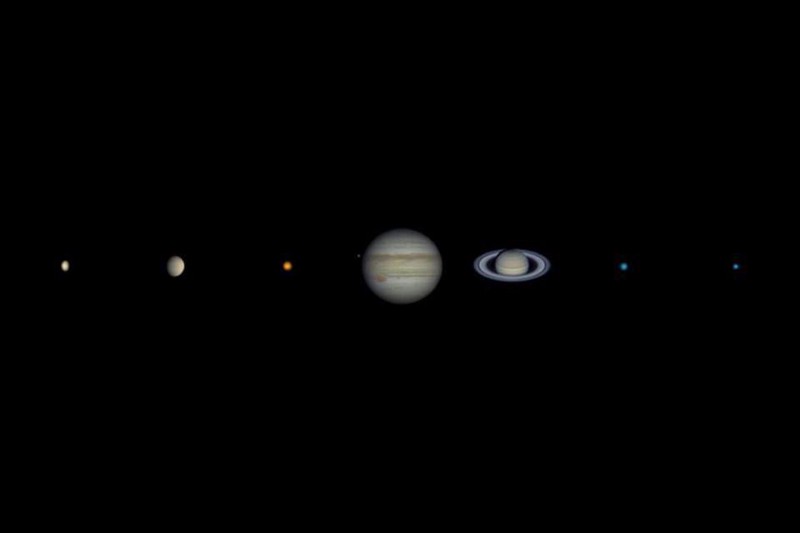 The seven extraterrestrial planets of the solar system: Mercury, Venus, Mars, Jupiter, Saturn, Uranus, and Neptune, with sizes accurate to what’s visible from Earth, but with brightnesses adjusted. Saturn is many times fainter than Jupiter, despite being almost the same size and nearly the same reflectivity: a function of its much greater distance both from the Sun and from Earth. Venus, meanwhile, is 63,000 times brighter than the faintest planet, Neptune.
Credit: Getty Images
The seven extraterrestrial planets of the solar system: Mercury, Venus, Mars, Jupiter, Saturn, Uranus, and Neptune, with sizes accurate to what’s visible from Earth, but with brightnesses adjusted. Saturn is many times fainter than Jupiter, despite being almost the same size and nearly the same reflectivity: a function of its much greater distance both from the Sun and from Earth. Venus, meanwhile, is 63,000 times brighter than the faintest planet, Neptune.
Credit: Getty Images
4.) Venus’s reflectivity. This is where things start to get interesting. Every object in the Solar System has what’s known as an albedo: a measure of how reflective its surface is. There are two types of albedo that scientists talk about:
- Bond albedo, which is the ratio of the total reflected radiation compared to the total incoming (solar) radiation, and
- Geometric albedo, which is how much light actually gets reflected compared to a flat, ideally reflective surface.
By both measures, Venus is by far the most reflective of all the major planets in the Solar System, with albedos that are each more than double the next closest planet. Whereas airless worlds like Mercury or the Moon reflect only about 11–14% of the total incoming light, similar to what Earth would reflect if it were airless and free of icecaps, Venus reflects between 75–84% of the total incoming sunlight, dependent upon which method is used for measuring albedo. This high level of reflectivity helps make it appear intrinsically brighter than any other planet in the Solar System. Overall, there are only a few ice-covered moons, like Saturn’s Enceladus, that possess a higher total albedo than Venus does.
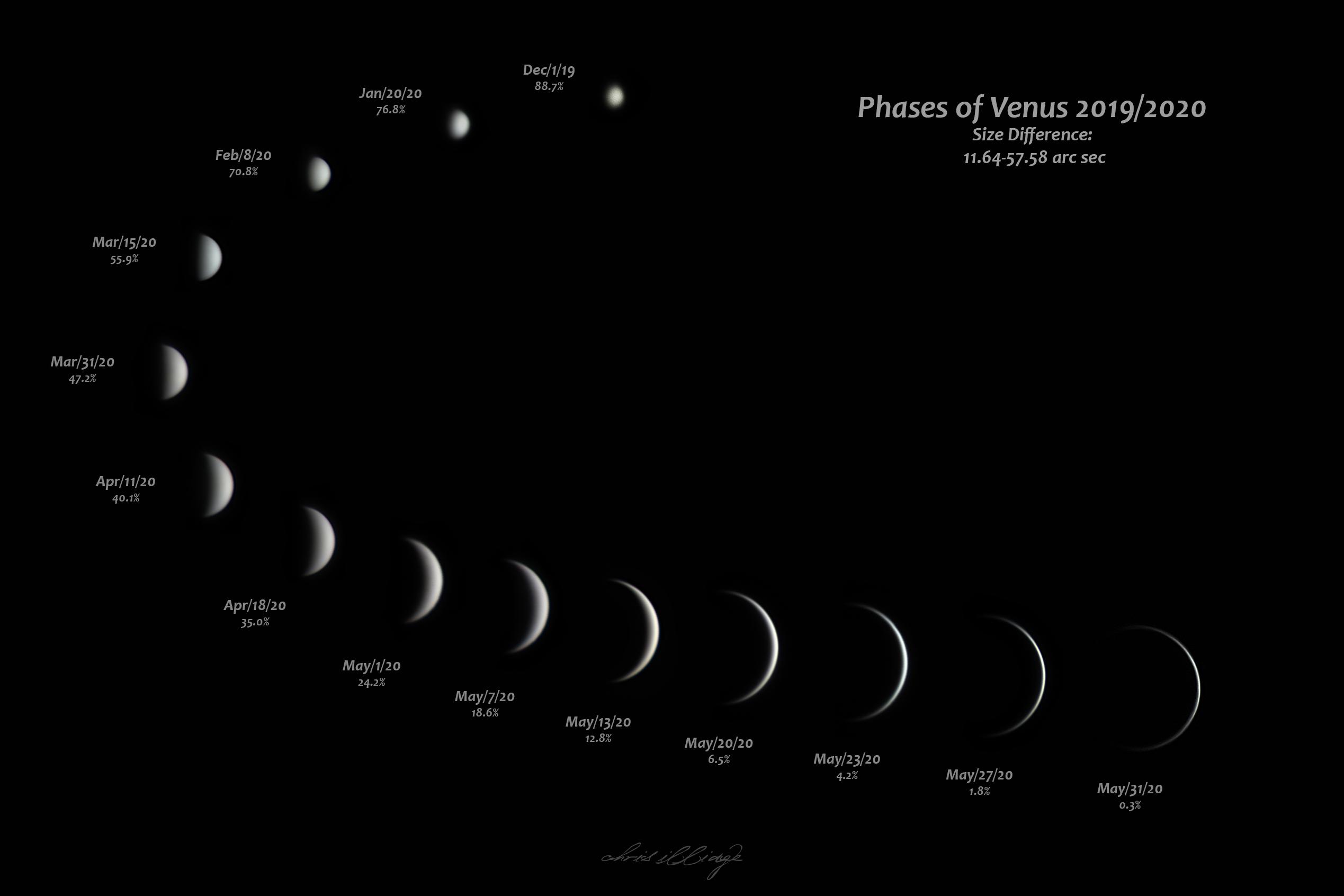 The phases of Venus, as viewed from Earth, can enable us to understand how Venus always appears from the perspective of Earth. Reaching a maximum elongation of 47 degrees away from the Sun, Venus is at its largest and brightest in the thin crescent phase, but when it’s more distant and smaller, it’s fuller, remaining the brightest object, other than the Moon, in Earth’s night sky. These phases were discovered by Galileo over 400 years ago, and strongly supported the heliocentric picture.
Credit: Christopher Illidge
The phases of Venus, as viewed from Earth, can enable us to understand how Venus always appears from the perspective of Earth. Reaching a maximum elongation of 47 degrees away from the Sun, Venus is at its largest and brightest in the thin crescent phase, but when it’s more distant and smaller, it’s fuller, remaining the brightest object, other than the Moon, in Earth’s night sky. These phases were discovered by Galileo over 400 years ago, and strongly supported the heliocentric picture.
Credit: Christopher Illidge
5.) Venus’s appearance from Earth. There are a few different reasons, combined, for why Venus is always the brightest planet in Earth’s night sky. One is that Venus is relatively large (almost the same size as Earth) for a rocky planet as well as relatively close to the Sun; in terms of the total amount of solar radiation incident on its surface, only Jupiter receives more. Two is that Venus is the most reflective planet in the Solar System; the highest percentage of the incoming solar radiation is cast off back into space.
But three is Venus’s proximity to Earth. At its closest, Venus comes within 41 million km (25 million miles) of Earth, closer than any other planet. Even at its most distant, Venus is only 261 million km (162 million miles) from Earth: far closer than Jupiter ever gets to Earth. For comparison, the most recent closest approach of Jupiter to Earth occurred on January 9, 2026, when it came within 393 million miles, or 633 million km, of our world.
Even though Venus exhibits the full suite of phases, its crescent phase near closest approach to Earth is when it’s at its brightest, appearing only slightly fainter when it’s farthest away as it enters its full phase. Even at their brightest, the other bright planets — including Jupiter and Mars — can’t compete with the brightness of Venus, even when Venus is at its faintest.
 While all of the planets in the Solar System orbit the Sun in the same direction, Venus, uniquely, rotates in the opposite direction. For each orbit completed by Venus, although it is the slowest-rotating planet, it experiences roughly two “days” of sunrises and sunsets.
Credit: NASA/JPL
While all of the planets in the Solar System orbit the Sun in the same direction, Venus, uniquely, rotates in the opposite direction. For each orbit completed by Venus, although it is the slowest-rotating planet, it experiences roughly two “days” of sunrises and sunsets.
Credit: NASA/JPL
6.) Venus’s role in general relativity. The first hint we had that something was “wrong” with Newtonian gravity within our Solar System came in the mid-19th century, by observing the orbit of Mercury. Over the past few centuries, we’d been observing Mercury in its elliptical orbit around the Sun, and we saw its perihelion — or its point of closest approach to the Sun — advance in its orbit. The total rate that the perihelion advanced by was 5600 arc-seconds per century, and that rate was a little bit too much for Newtonian gravity.
5025 of those arc-seconds per century was due to the precession of the equinoxes: an effect of Earth’s precessing orbit. However, the next key in understanding the problem was to calculate the effects of all the other planets on the orbit of Mercury. Although each planet makes a contribution that’s essential to calculate, for a total of ~532 arc-seconds per century, the greatest contribution by far comes from Venus: 277 arc-seconds per century, nearly double that of the next-largest contributor, Jupiter (at ~150), and more than triple the contribution of Earth (at ~90).
It was only by precisely accounting for the gravitational effects of all of the planets, Venus foremost among them, that we could determine that there was a mismatch between theory and observation. The “missing” 43 arc-seconds per century was precisely what Einstein’s general relativity was able to account for, but without quantifying the contributions from other planets so precisely, particularly from Venus, understanding the role that general relativity played would have been impossible.
 Transits of Venus (top) and Mercury (bottom) across the edge of the Sun. Note how Venus’s atmosphere diffracts sunlight around it, while Mercury’s lack of atmosphere shows no such effects. An airless planet, like Mercury, will have a completely flat transit spectroscopy spectrum, while a planet like Venus will exhibit absorption and/or emission signatures.
Credit: JAXA/NASA/Hinode (top); NASA/TRACE (bottom)
Transits of Venus (top) and Mercury (bottom) across the edge of the Sun. Note how Venus’s atmosphere diffracts sunlight around it, while Mercury’s lack of atmosphere shows no such effects. An airless planet, like Mercury, will have a completely flat transit spectroscopy spectrum, while a planet like Venus will exhibit absorption and/or emission signatures.
Credit: JAXA/NASA/Hinode (top); NASA/TRACE (bottom)
7.) Venus gave us the birth of transit spectroscopy. Being the second planet from our Sun, Venus is one of two planets (along with Mercury) that’s observed to transit in front of the Sun’s disk from our perspective here on Earth. Unlike transits of Mercury, however, where Mercury simply appears as an opaque disk silhouetted against the Sun, sunlight appears to “curve” around the edge of Venus as the transit both begins and ends. Observations of transits of Venus, which only occur twice per century, on average (most recently in 2012), were humanity’s first indication that Venus possessed — whereas Mercury lacked — a substantial atmosphere.
But we can do so much more than just detect the existence of an atmosphere during transits: we can actually measure what its atmospheric contents are, molecule-by-molecule. First demonstrated during the 2004 transit of Venus, this technique is now a vital part of exoplanet sciences as we attempt to use transit spectroscopy to discern the atmospheric constituents of planets around other stars. Although, in principle, this was a possibility long before, it’s only here in the 21st century that instrumentation technology has caught up to our scientific dreams.
 The TRAPPIST-1 system contains the most terrestrial-like planets of any stellar system presently known, and is shown scaled to temperature equivalents to our own Solar System. These seven known worlds, however, exist around a low-mass, consistently flaring red dwarf star. It’s plausible that exactly none of them have atmospheres any longer, although JWST will have more to say about that in future years.
Credit: NASA/JPL-Caltech
The TRAPPIST-1 system contains the most terrestrial-like planets of any stellar system presently known, and is shown scaled to temperature equivalents to our own Solar System. These seven known worlds, however, exist around a low-mass, consistently flaring red dwarf star. It’s plausible that exactly none of them have atmospheres any longer, although JWST will have more to say about that in future years.
Credit: NASA/JPL-Caltech
8.) Venus’s lessons for exoplanets. Today, we look at Venus and we see it as it is now: hot, bright, and shrouded in a thick, dense, heavy-element-rich atmosphere. But it provides us with one of the four main potential fates for a rocky planet interior to a star’s frost line.
- Get too close to your parent star, and you’ll become tidally locked and/or have your entire atmosphere stripped away, like Mercury on both counts.
- Get too far from your parent star, especially if you’re too small, and you’ll become cold, frozen, and inhospitable to life, like Mars.
- If things work out just right in terms of your atmosphere, your size, and your distance from the Sun, you might have liquid water on your surface and a sustained, long-term shot at life.
- But you could still possess a thin atmosphere, avoid tidal locking, and transition from a world with Earth-like potential to becoming a Venus-like hellhole: if your planet experiences a runaway greenhouse effect, likely driven by volcanic activity.
If things had gone differently on Venus, perhaps it, too, could have become a world with a wet, life-rich, self-sustaining biosphere over the long term. Perhaps, in the distant past, things once were very different on Venus, and perhaps there’s a rich history of ancient, early life on that planet. When we’re considering what could be out there on planets beyond our own Solar System, we need to look not just for “other Earths” that may be out there, but also for other Venuses, as well as any evolutionary steps that it may have underwent along the way.
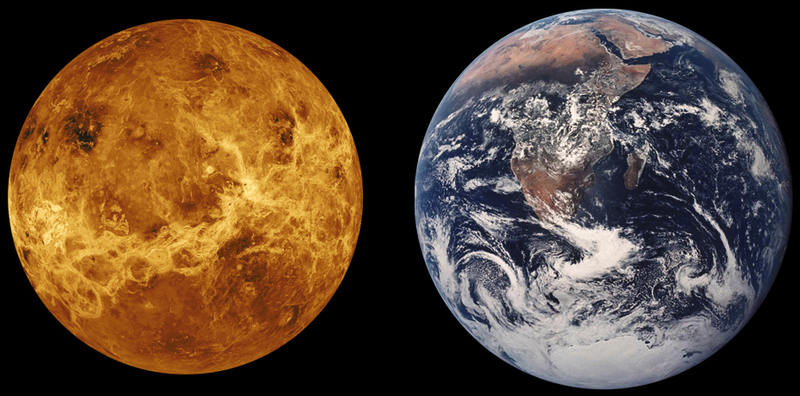 Earth, in visible light at right, and Venus, as seen in infrared at left, have nearly identical radii, with Venus being approximately ~90–95% the physical size of Earth. Despite producing similar amounts of internal heat, Earth exhibits plate tectonic activity while Venus only has one single, non-moving plate. Both worlds, however, are volcanically active.
Credit: NASA/Magellan
Earth, in visible light at right, and Venus, as seen in infrared at left, have nearly identical radii, with Venus being approximately ~90–95% the physical size of Earth. Despite producing similar amounts of internal heat, Earth exhibits plate tectonic activity while Venus only has one single, non-moving plate. Both worlds, however, are volcanically active.
Credit: NASA/Magellan
All told, Venus is a planet full of extremes. It possesses the thickest atmosphere of any rocky, terrestrial world known. It achieves the hottest surface temperatures of any planet in the Solar System. It’s the most reflective planet in the Solar System, outclassing even the gas giants. And — of particular interest to observers on Earth — it’s always the brightest point of light visible in the night sky. Whenever it’s not directly behind the Sun, either in the post-sunset or the pre-dawn skies, no other star or planet ever outshines it. Venus is also the subject of an enormous amount of recent research, including:
- the detection of phosphine in its atmosphere, potentially hinting at biological activity,
- the discovery of plate tectonics on Venus, including recent lava events on its surface,
- the discovery that the cloud-decks on Venus sometimes do part, revealing its surface from space,
- and, for those of you forward-looking, although the next Venus-Jupiter conjunction won’t occur until 2039, an extremely rare planetary occultation will happen on November 22, 2065: when Venus passes directly in front of the disk of Jupiter as seen from Earth, marking the first planet-planet occultation in hundreds of years.
So, with everything we now know, why is it that Venus is the brightest planet in the Solar System?
It’s due to the combination of its large, Earth-like surface area, its relatively close proximity to the Sun, its very reflective, cloud-rich atmosphere, and the fact that even at its most distant, it’s never more than about 1.75 astronomical units from planet Earth. Even when Jupiter and Mars, the next brightest planets, are at their absolute brightest, they still can’t compete with Venus at its faintest. The next time you look up and see an unparalleled bright point of light fixed in the post-sunset or pre-dawn skies, you’ll know precisely why Venus, compared to all the other stars and planets visible from Earth, always appears to outshine them all.
This article was first published in July of 2022. It was updated in February of 2026.
Ethan SiegelTheoretical astrophysicist and science writer
Full Profile
Related Content
Starts With A BangIs there phosphine, and maybe life, on Venus after all?
Earth is the Solar System's only known inhabited planet. Could Venus, if its phosphine signal is real, be our second world with life?
by Ethan Siegel
Starts With A Bang
Surprise: Mercury isn’t the Solar System’s hottest planet
Despite being the closest planet to the Sun, Mercury "only" reaches 800 °F at its hottest. Venus is always hotter, even at night.
by Ethan Siegel Starts With A Bang
Earth is the Solar System’s densest planet. It shouldn’t be.
Based on the atoms that they're made out of, the innermost planet should always be the densest. Here's why Earth beats Mercury, hands down.
by Ethan Siegel Starts With A Bang
How our Solar System will end in the far future
Beyond climate change, ice ages or even the death of our Sun, the cosmic dance continues for ages. Here’s how it will truly end.“The way to love anything is to realize […]
by Ethan Siegel Learn from the world's biggest thinkers.
-
Videos
- Latest
- The Big Think Interview
-
Columns
- Mini Philosophy
- Starts with a Bang
- Big Think Books
- The Long Game
- Strange Maps
- 13.8
- The Well
-
Sections
- Philosophy
- Mind & Behavior
- Science & Tech
- Business
- History & Society
-
Classes
- Class Library
-
Subscribe
- Membership
- Free Newsletters
-
About
- Our Mission
- Work with Us
- Contact
- Privacy Policy
- Terms of Sale
- Accessibility
- Careers


