- Home
Edition
Africa Australia Brasil Canada Canada (français) España Europe France Global Indonesia New Zealand United Kingdom United States Edition:
Global
Edition:
Global
- Africa
- Australia
- Brasil
- Canada
- Canada (français)
- España
- Europe
- France
- Indonesia
- New Zealand
- United Kingdom
- United States
Academic rigour, journalistic flair
 Workers at a rare earth mine in Jiangxi province, China.
Chinatopix/AAP
Australia wants to be a critical minerals superpower - but processing is messy and dangerous
Published: December 8, 2025 3.56am GMT
George Tian, University of Technology Sydney, Jeanne Huang, University of Sydney
Workers at a rare earth mine in Jiangxi province, China.
Chinatopix/AAP
Australia wants to be a critical minerals superpower - but processing is messy and dangerous
Published: December 8, 2025 3.56am GMT
George Tian, University of Technology Sydney, Jeanne Huang, University of Sydney
Authors
-
 George Tian
Senior Lecturer in Law, University of Technology Sydney
-
Jeanne Huang
Associate professor, University of Sydney
Disclosure statement
George Tian currently serves as Co-Chair of the Private International Law Interest Group of the American Society of International Law (ASIL), Washington DC; Deputy Co-Lead, ODR Working Group, Silicon Valley Arbitration & Mediation Center (SVAMC), CA, USA, and as a Domain Name Arbitrator for the World Intellectual Property Organization (WIPO), Geneva, Switzerland.
Jeanne Huang is the UNECE-UN/CEFACT co-lead of the Critical Minerals Traceability and Sustainability Project and Regional Rapporteur for the Pacific.
Partners

University of Technology Sydney provides funding as a founding partner of The Conversation AU.
University of Sydney provides funding as a member of The Conversation AU.
View all partners
DOI
https://doi.org/10.64628/AA.xj5x5ack7
https://theconversation.com/australia-wants-to-be-a-critical-minerals-superpower-but-processing-is-messy-and-dangerous-269799 https://theconversation.com/australia-wants-to-be-a-critical-minerals-superpower-but-processing-is-messy-and-dangerous-269799 Link copied Share articleShare article
Copy link Email Bluesky Facebook WhatsApp Messenger LinkedIn X (Twitter)Print article
In October, Australia signed an A$13 billion rare earths and critical minerals agreement with the United States. This is designed to boost supply of minerals vital to everything from military technology to clean energy.
Australia has large reserves of many of these minerals, while the US is trying to find alternative supplies after China gained a stranglehold on much of the global supply.
But there’s a sting in the tail. To date, Australia hasn’t produced many of these elements domestically, preferring to mine the ores here and do the highly polluting processing overseas. Turning ores into minerals comes with a host of pollution issues, from radioactive waste to dangerous chemicals.
For Australia to become a major rare earths and critical minerals player, it will have to better manage these environmental risks.
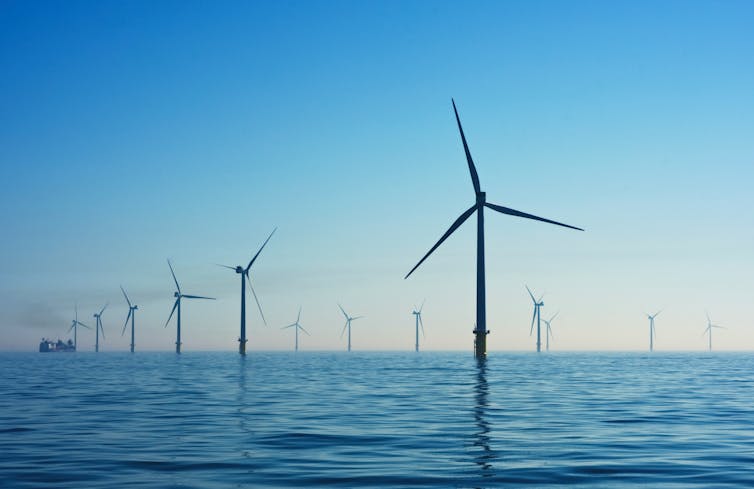 Rare earths and critical minerals are vital for clean energy technologies as well as high tech and military uses.
Nicholas Doherty/Unsplash, CC BY-NC-ND
Rare earths and critical minerals are vital for clean energy technologies as well as high tech and military uses.
Nicholas Doherty/Unsplash, CC BY-NC-ND
Costs unequally shared
In the 1990s, major US rare earth mines such as Mountain Pass scaled down or shut their most polluting processing activities.
As the US and other rich countries retreated, the most hazardous processing shifted to countries under economic pressure or more willing to bear the environmental burden. China ultimately absorbed much of this capacity. This is why it now refines about 80% of the world’s rare earths.
What’s happened in rare earths isn’t unique. There’s a global pattern of rich countries outsourcing pollution, groundwater contamination and other social and environmental costs to poorer and less-regulated nations. Recent media investigations have found significant and ongoing damage done by rare earth mining, ranging from heavy metal pollution to radioactivity to discharges of dangerous chemicals.
Australia has benefited from outsourcing pollution. For more than a decade, Australian rare earths producer Lynas has dug up ores in Western Australia and shipped them to its Malaysian refinery, where the dirtiest processing was done. This may satisfy national environmental regulations. But it can simply relocate the harm. Lynas has vigorously defended its processing plant, saying independent experts have found operations were safe and compliant with regulations.
In 2020, the Malaysian government required Lynas to relocate the processing stage producing low-level radioactive waste.
In response, Lynas opened a new plant in Kalgoorlie to do this processing domestically with muted pushback. Another miner, Iluka, is constructing Australia’s first fully integrated rare-earth refinery north of Perth.
While domestic processing capacity is expanding, Lynas and emerging producers will still depend on overseas facilities for the most hazardous processing for now.
Cleaner processing technologies such as improved solvent extraction and closed-loop systems do exist, but they remain expensive and hard to scale. As a result, producers still rely on overseas facilities where hazardous steps can be performed more cheaply or under lighter regulation.
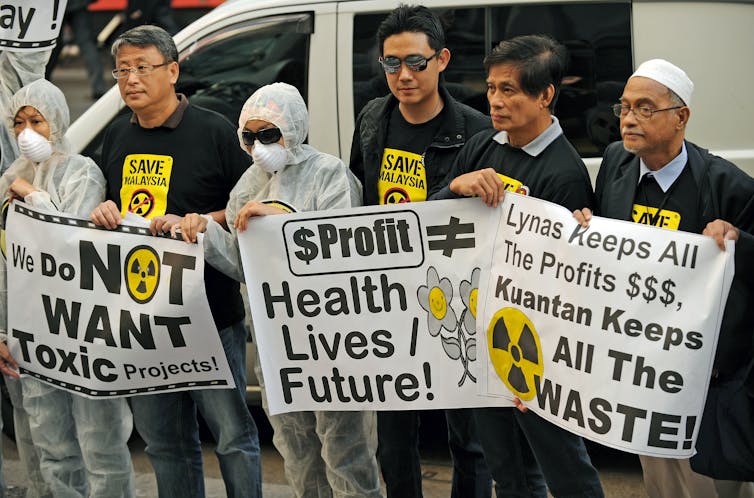 Protestors pictured in 2011 opposing a rare earths refinery set up by Australian miner Lynas in Malaysia.
Greg Wood/AFP via Getty
Protestors pictured in 2011 opposing a rare earths refinery set up by Australian miner Lynas in Malaysia.
Greg Wood/AFP via Getty
The better path: shared and responsible governance
Solving the problem of offshore pollution has to be done by distributing responsibility fairly.
Here is what’s required to make Australia’s rare-earth supply chains sustainable:
- robust environmental standards applying to both mining and processing
- transparent and traceable supply chains
- incentives rewarding cleaner production and penalising polluting practices.
Industry self-regulation — where companies label, report and monitor many of their own environmental practices — has been repeatedly shown to be vulnerable to weak oversight and regulatory gaming. Given the urgency of climate and ecological risks, relying on voluntary standards alone is no longer sufficient.
A better approach is co-regulation, where government, industry and communities collectively design rules, share data and jointly monitor compliance.
European Union frameworks such as Ecodesign for Sustainable Products Regulation and the Digital Services Act were designed in this way, demonstrating how ongoing engagement with multiple actors can work to create adaptive, participatory and enforceable regulations.
This approach could work well for critical minerals by embedding sustainability and social licence throughout supply chains before environmental damage is done.
Green tax incentives or certification schemes can help by rewarding cleaner producers. The EU’s Carbon Border Adjustment Mechanism is already pushing producers outside the EU to improve emissions reporting even before it comes into effect on January 1.
But these tools need careful design to avoid slipping into “green protectionism”, where higher environmental standards end up penalising developing nations that have fewer resources to comply.
The transparency gap
It’s hard to verify whether critical minerals were sustainably produced, as our recent United Nations white paper points out.
One solution we outline is a digital product passport – a verifiable digital identity tracking minerals through mining, extraction, processing, manufacturing, use, recycling and further use. These passports would make it possible to validate green claims, make recycling and transport across borders more secure and efficient and boost trust for consumers and investors. Responsible producers would earn a genuine premium for doing the right thing.
Digital product passports will come into use in the EU next year for products, such as textiles, car batteries and construction materials.
Without transparent traceability, Australian miners – who often meet higher environmental standards – risk losing market share to cheaper but less sustainable alternatives, as seen in the nickel sector.
While digital traceability of critical minerals has many advantages, its implementation will face legal challenges. There’s no standard list of critical minerals for instance. Minerals are often mined in one country, processed in another and sold in a third, making it hard to assess how cleanly they have been produced. Solving these issues will require collective effort between producers and buyers.
Towards a truly clean transition
Australia’s rare earths deal with the US is strategically important. But ramping up production of these metals and minerals risks reproducing environmental inequalities.
The next phase of the clean-energy transition must not simply shift pollution to poorer countries – it must eliminate the problem through cleaner technologies coupled with traceability, shared responsibility and accountability across borders.
- Mining
- Pollution
- Environment
- Critical minerals
Events
Jobs
-
 Case Specialist, Student Information and Regulatory Reporting
-
Analyst, Student Information and Regulatory Reporting
-
Respect and Safety Project Manager
-
Associate Dean, School of Information Technology and Creative Computing | SAE University College
-
Senior Lecturer, Clinical Psychology
 Case Specialist, Student Information and Regulatory Reporting
 Analyst, Student Information and Regulatory Reporting
 Respect and Safety Project Manager
 Associate Dean, School of Information Technology and Creative Computing | SAE University College
 Senior Lecturer, Clinical Psychology
- Editorial Policies
- Community standards
- Republishing guidelines
- Analytics
- Our feeds
- Get newsletter
- Who we are
- Our charter
- Our team
- Partners and funders
- Resource for media
- Contact us
-
-
-
-
Copyright © 2010–2025, The Conversation