Art history departments often fail to embed disability studies into their curricula when engaging with art, politics, and identity.
 Bryan Martin
January 20, 2026
— 4 min read
Bryan Martin
January 20, 2026
— 4 min read
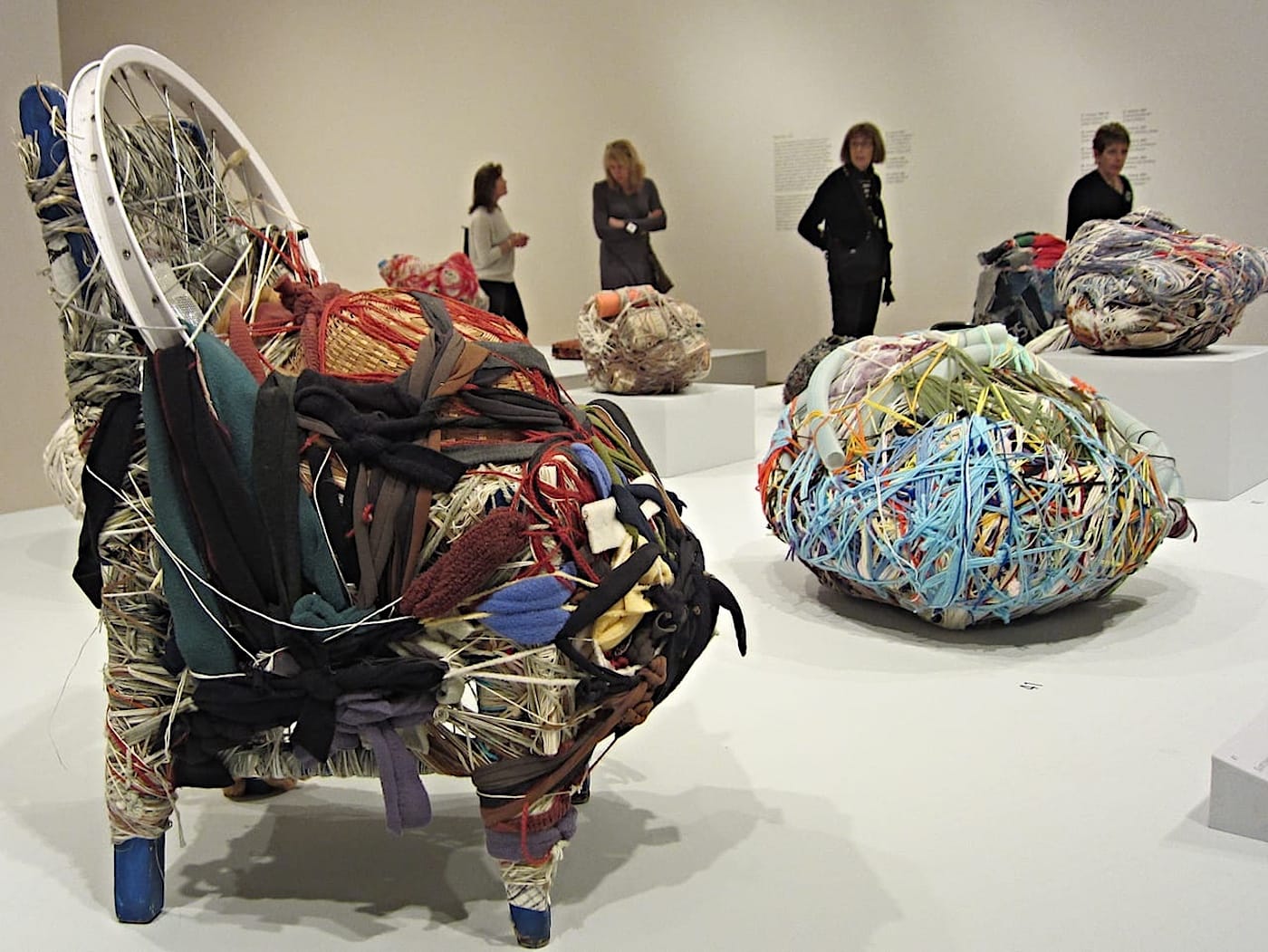
 Installation view of Judith Scott — Bound and Unbound at the Brooklyn Museum in 2014–15 (photo Allison Meier/Hyperallergic)
Education departments in museums have always been a north star for accessibility in the arts. Decades-old programs at major institutions in New York, such as the Metropolitan Museum of Art and the Museum of Modern Art (MoMA), offer robust opportunities for individuals with visual and auditory impairments, children and adults with developmental disabilities, and the families who provide care, to name a few, that foster life-changing moments through art. The Met, where I currently work as an editor, for example, has given tours for Blind and partially sighted visitors since the early 20th century, establishing its touch collection in the 1970s to offer a vital avenue to collection objects that are usually inaccessible. More recently, MoMA has put on Disability Art Chats that support online communal discussions and lectures on art and disability with artists like Johanna Hedva and Jerron Herman.
Although not universally known among museum-goers, these programs are deeply embedded in the fabric of New York City’s institutions. Other departments in art museums are starting to catch up to the work that access teams have been doing for decades, and these programs deserve to be appreciated and centered as part of museum worker education.
 Christine Sun Kim, "Degrees of Deaf Rage in Everyday Situations" (2018), charcoal and oil pastel on paper, on view in Christine Sun Kim: All Day All Night at the Whitney Museum of American Art in 2025 (photo Lisa Yin Zhang/Hyperallergic)
The educators and advocates who facilitate these experiences are underacknowledged heroes and community builders in art museums. As disability is given more credence as an aspect of identity to be discussed through exhibitions, including recent solo exhibitions from Emilie L. Gossiaux, Marlon Mullen, and Christine Sun Kim, museum educators need to be given their due and brought into conversations about how to thoughtfully contextualize disability in art history.
Curatorial departments typically lack the expertise, experience, and theoretical grounding to address the nuances of the field. Disability is not a quota for display: It’s insufficient just to bring an artist with a disability into the gallery or merely highlight it as a fact on a wall label. Many institutional curators and researchers are not embedded in the discourse of disability studies — social versus medical models of disability, the history of disability rights in the United States, or even the work of seminal scholars such as Rosemarie Garland-Thomson and Tobin Siebers.
At its core, this lack of knowledge is a pedagogical issue. University and college art history departments often fail to embed disability studies into their curricula when engaging with art, politics, and identity. In a typical introductory course on modern and contemporary art in the United States, the history of disability rights, from the Civil Rights Movement to the signing of the Americans with Disabilities Act (ADA), must be incorporated in tandem with moments in art history, like the proliferation of art centers for adults with developmental disabilities in the United States. Students will be enriched by opportunities to learn disability theory intersectionally, drawing on frameworks such as critical race theory, gender studies, and queer studies. Any museum studies course needs also emphasize the importance of ADA compliance in art nonprofits — accessible routes to all galleries via ramps and elevators, sufficient seating, large-text print options, accessible display heights for art, optimal web design for screenreaders, and rich alt-text — not just as a chore or afterthought learned on the job, but as an essential part of an institution’s mission to serve the public.
This past semester, I taught a course on postwar art in the United States and Europe at the City College of New York, where we discussed Judith Scott’s mesmerizing sculptures in the context of disability theory. The class instantly grasped the magnitude of this achievement by Scott, a Deaf artist with Down syndrome who faced institutionalization for over three decades, along with the importance of the disability rights legislation that guaranteed her an arts education later in life. Our conversation also led students to further question the underrepresentation of disability in art classes and museums.
 Installation view of Christine Sun Kim and Thomas Mader, "ATTENTION" (2022), nylon, locally sourced rock, two blowers, and control board, on view in Christine Sun Kim: All Day All Night at the Whitney Museum of American Art in 2025 (photo Lisa Yin Zhang/Hyperallergic)
By imbuing disability studies at a formative point in the education of future art workers, universities and colleges can establish a clearer understanding of disability in the arts from the outset of students’ careers. Museums can then provide internal resources to continually educate their staff on the importance of disability in the arts and create resources to help workers understand how their institution cultivates inclusivity, internally and externally. In 2024, for instance, the Guggenheim Museum collaborated with New York University’s Center for Disability Studies to host the experimental Alt-Guggenheim: Ramps symposium, which serves as a model of the generative strides that can be made when museum workers collaborate with outside experts in the disability studies field.
Most people will experience mental and bodily differences at some point in their lives and likely care for a person with a disability, making it one of the most relatable subjects a museum can engage with. As the federal government is actively dismantling education and support structures for Americans with disabilities, it’s imperative for art museums in New York to examine how disability manifests in art history and ensure accessibility for its visitors — not as a tokenizing gesture but as an affirmation of safety and visibility.