Rose B. Simpson at SFMOMA, historical writers with day jobs, anti-surveillance clothing, the nostalgia of 2016, a day in the life of an art conservator, and more.
 Lakshmi Rivera Amin
January 22, 2026
— 6 min read
Lakshmi Rivera Amin
January 22, 2026
— 6 min read
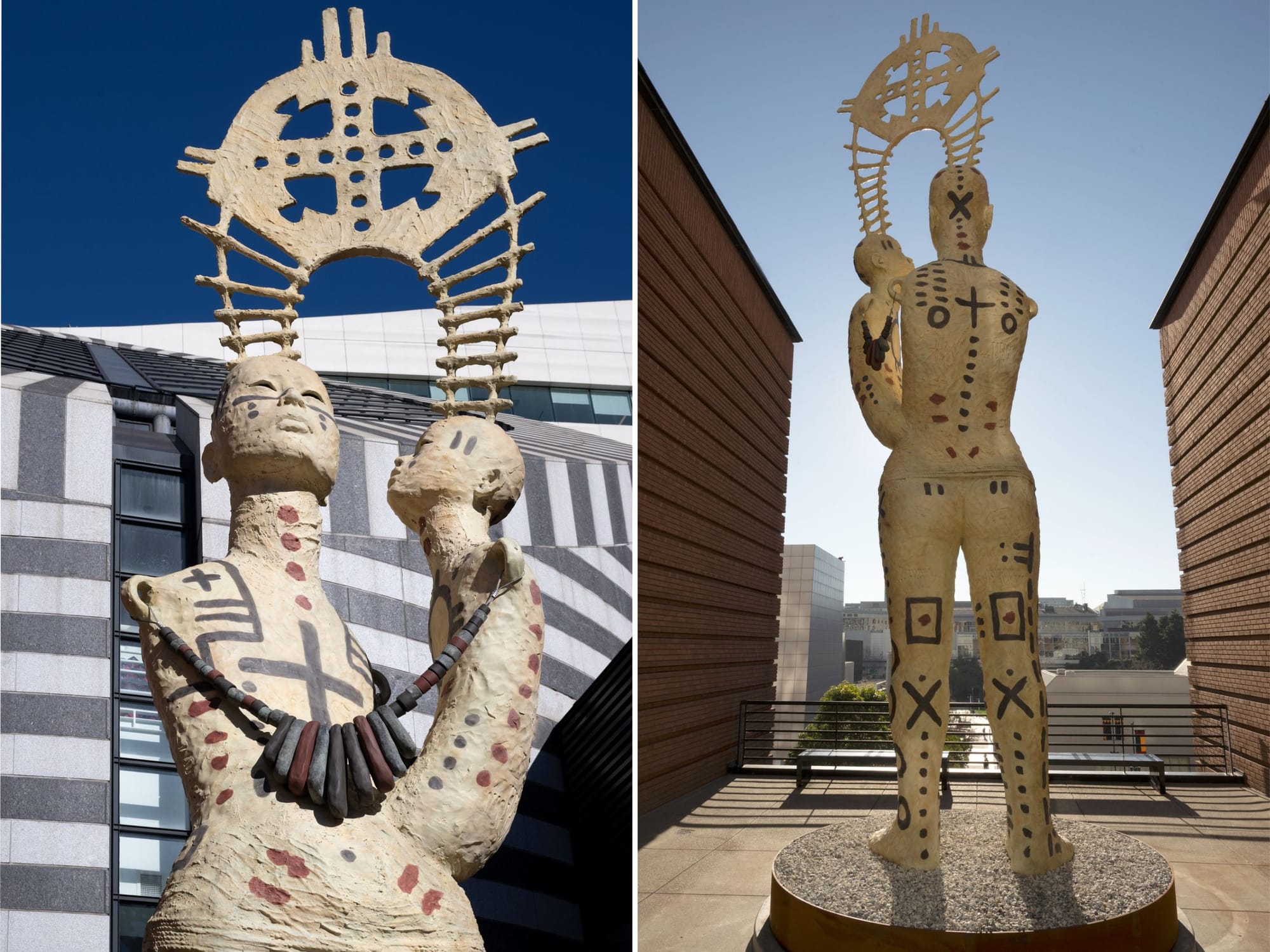
 Sprouting from the roof of the San Francisco Museum of Modern Art, artist Rose B. Simpson's newly installed bronze sculpture "Behold" has its gaze fixed on the cityscape before it. The Tewa of Khaʼpʼoe Ówîngeh artist, herself a mother, crafted a tender portrait of an interconnected parent and child that "asks us to be human with each other, to change our narrative through wonder, witness and a foundation in the soft warmth of our humanity," she said in a statement. (photo by Don Ross, courtesy SFMOMA)
Writers are seldom paid fairly for their work. For LitHub, Ed Simon reflects on writers who've worked day jobs, including himself:
Melville came to this profession was after his most famous books had already been published, albeit to scant acclaim, with The Boston Post appraising Moby-Dick as “not worth the money asked.” Devastated by the criticism, he now rather engaged in the methodical examination of ship manifests, saving his leisure time to poetry, which also went unappreciated. Whatever his contemporaries thought of Melville’s prose, at least his coworkers respected his dedication and honesty, the later a rare commodity in government work during the late nineteenth-century. Despite being respected by his colleagues, the author of Moby-Dick worked for six days a week in the domed and columned Merchant’s Exchange Building at 55 Wall Street and was paid $4 a day, never receiving a raise in two decades.My own time in the federal government was blessedly briefer—rather than nineteen years I only served six months after my January 2020 Constitutional oath delivered at the United States Postal Service headquarters in L’Enfant Plaza. Though I’m no Melville, a not dissimilar professional dissatisfaction both drove us into the writers’ bane of the necessary day job.
The infamous college student who made headlines for chewing up the works in an AI art show talks with Colin Warren in the Nation, and I gotta say, he ate:
CW: So your main problem with it is that it doesn’t process criticism?GG: It’s not the only problem. There’s a whole host of things. It depends on your definition of art. I say AI isn’t art. I know a lot of people who would agree with me. I don’t think there’s any perfect argument that can be made for this, because no matter what you say somebody will come up with a counterpoint because at its core art is subjective.However, the process by which art is made is oftentimes more important than the finished product, and if the process of making your art is just typing a prompt in, it just takes away from the accomplishments of other talented artists. And it really hurts the practice of art by commercializing that finished product.CW: Do you have any qualms about the fact that AI art is made by scraping other artists?GG: Yeah, I mean, that’s part of why I spat it out, because AI chews up and spits out art made by other people.
As 404 Media's Samantha Cole reports, designers are finding ways to skirt surveillance tech using garments and accessories, including some you likely already own:
Every system is different and every scenario is contextual, but adding a few common items to your kit can reduce the likelihood that enough of your biometrics are obscured to get your biometric matching score down. Big sunglasses, covering your chin and mouth, and wearing a baseball cap or brimmed hat that obscures your features from cameras placed above can all bring that score down. “It's kind of almost a linear relationship between how much of your face you hide and your score in that way. It's quite simple,” Harvey said. But the problem is, you never know what your score is, so you’re going out blindly, not knowing if your Jackie Onassis sunglasses are going to cover enough of your face, or if you have to get an extra long turtleneck or something to wear.”
When journalist Laura Jedeed went undercover at an ICE recruitment event, she found that the requirements to join its ranks are almost nonexistent. Becoming an ICE agent and using your power to terrorize everyday people (including five-year-old children) is sickeningly easy, she explains for Slate:
There’s a temptation to take some comfort in ICE’s sloppiness. There’s a real argument here that an agency so inept in its recruitment will also be inept at training people and carrying out its mission. We’re seeing some very sloppy police work from ICE, including an inability to do basic things like throw someone down and cuff them. On some level, all of this is a reminder that their takeover is neither total nor inevitable.But if they missed the fact that I was an anti-ICE journalist who didn’t fill out her paperwork, what else might they be missing? How many convicted domestic abusers are being given guns and sent into other people’s homes? How many people with ties to white supremacist organizations are indiscriminately targeting minorities on principle, regardless of immigration status? How many rapists and pedophiles are working in ICE detention centers with direct and unsupervised access to a population that will be neither believed nor missed? How are we to trust ICE’s allegedly thorough investigations of the people they detain and deport when they can’t even keep their HR paperwork straight?
I love mid-2010s nostalgia as much as the next person, but India Roby asks us to consider what the 2016 trend omits about that pivotal year for Fader:
Even as 2016 signaled a plunge into back-to-back crises and civil unrest, people are still insistent on romanticizing it. To Cao, there has always been a sense of “era nostalgia” on the Internet, but she believes 2016 nostalgia has a lot to do with who is online today. “Right now, Zillennials are a key demographic of posters and consumers on social media, and they aren’t immune to the allure of a better time in their formative childhood years, especially as it marked as the last burst of optimism before larger themes of fascism, disease, and economic uncertainty came crashing down over their adult lives,” she says. “I’m personally always saying the last time I felt truly good about the world was when ‘Closer’ was on the radio.”Thelot agrees that the impetus behind the 2016 nostalgia is less of an organic revival and more of a commercial one. “When we think about a specific epoch — say, the Renaissance — [the label] describes a unified yet complex moment in time,” he says. But similar to indie sleaze, “people are trying to hodge-podge it and give it a name.” The commodification of 2016 “only serves as selling that time period in retrospect,” he adds, “but not the validity of what actually took place back then.”
Biologist Helen Pilcher argues in the Guardian that a recent discovery about cows is further proof that we humans aren't that special:
Less dextrous but no less impressive, polar bears are believed to smack walruses round the head with rocks, octopuses take pot shots at each other with shells, while “firehawk” raptors have been spotted picking up burning sticks from wildfires and then dropping them elsewhere to ignite fresh fires. The “firehawks” then feast on the animals that flee.One by one, features that we once thought of as uniquely human, such as tool use, complex communication, the ability to count and culture, topple like dominos.But still, we prefer to maintain the illusion of our supposed superiority. I think the story of Veronika tells us less about the minds of cows, and more about the minds of people. We have become so blind that we fail to see how animals are both smarter and more like us than we give them credit for. My farmer friend, however, has her eyes wide open.
In another win for the natural world, an ethereal "fairy lantern" plant was just discovered in Malaysia, writes Atmos's Willow Defebaugh:
The fairy lantern is shrouded in mystery, especially its otherworldly blooms. It blossoms irregularly, showcasing delicate flowers cloaked by dome-like tops called mitres that may protect it from rainfall (which is common in Kuala Lumpur and can be quite heavy during monsoon season). Accompanying this ornament are equally mysterious and delicate tentacles that may release chemicals to herald the flower’s emergence—a rare unveiling on the forest floor.
"Protect the arts" also means karaoke!
@pineapple.honeydew It caught me off guard but also what a diva #pineapplehoneydew #trans #comedy #explore #dragqueen ♬ original sound - Pineapple Honeydew
This triggered my fight or flight:
@caroline_easom Being a pardoner was honestly such a good grift. #medievaltiktok #medieval #history #historytok #comedy ♬ original sound - Caroline
New year, same shitty Google Gemini:
@tonystatovciFirst video of the year 😎 / links in my bio check me out 😎
♬ original sound - TONY STATOVCI
And finally, a bit of painting restoration to soothe the soul:
@jessiecarter.conservator Blame the blanching #paintingrestoration #artrestoration #artrestorer #baumgartner #cleaningpaintings ♬ Nice To Each Other - Olivia Dean