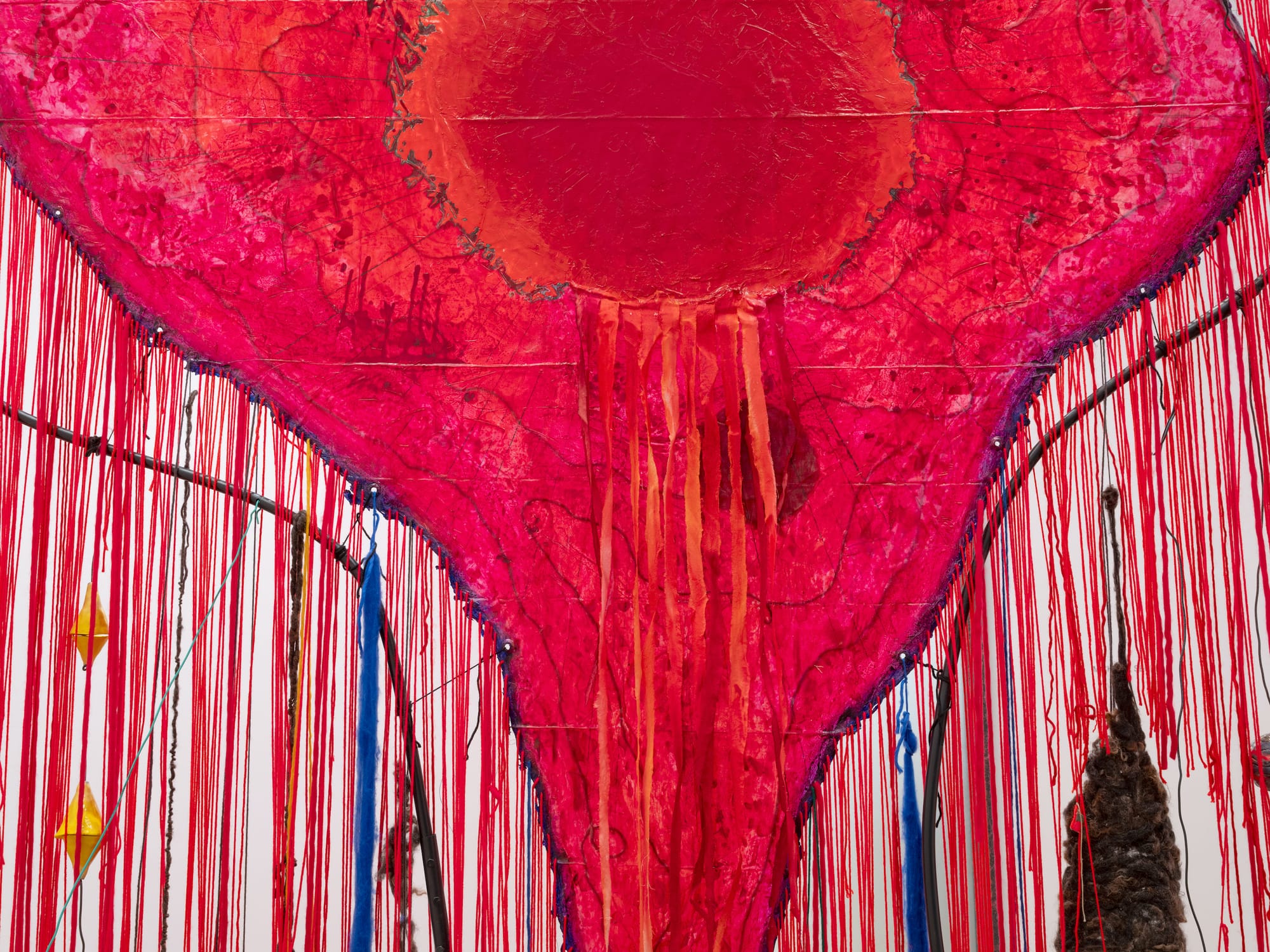
By remaining open to time and its effects, Segre’s art defies the idea of permanence often associated with both sculpture and empire.
 John Yau
January 29, 2026
— 2 min read
John Yau
January 29, 2026
— 2 min read
 Michelle Segre, "Nebula," detail (2025), steel, acrylic polymer, acrylic ink, pastel, concrete, yarn, wool, ceramic, cheesecloth, muslin, wire (all images courtesy the artist and Derek Eller Gallery, New York, photos Adam Reich)
Since I first reviewed Michelle Segre’s art in 2014, I have watched her interest in cosmic events, such as a nebula (a term for a diffuse astronomical object), deepen, as she's continued to work with unlikely materials including colored yarn, dried mushrooms, and rotting bread. What I didn’t recognize with enough understanding at that time was the way that her imaginative innovations undermine classic categories dividing objects from pictorial images, sculpture from painting. Collapsing the split between these categories has allowed her to define her own territory, which is as astute philosophically as it is formally.
Segre’s ingenuity at the intersection of the sculptural and pictorial became more apparent to me when I saw her current exhibition, Nebula, at Derek Eller Gallery, which consists of a single, largely bright red object. We have become so used to encountering quantity that sometimes we see what is easiest without looking longer and more carefully. “Nebula” (2025) demands to be viewed and scrutinized closely, as well as from a distance and in the round. Standing alone in the middle of the gallery space, I circled it the way one does a maypole.
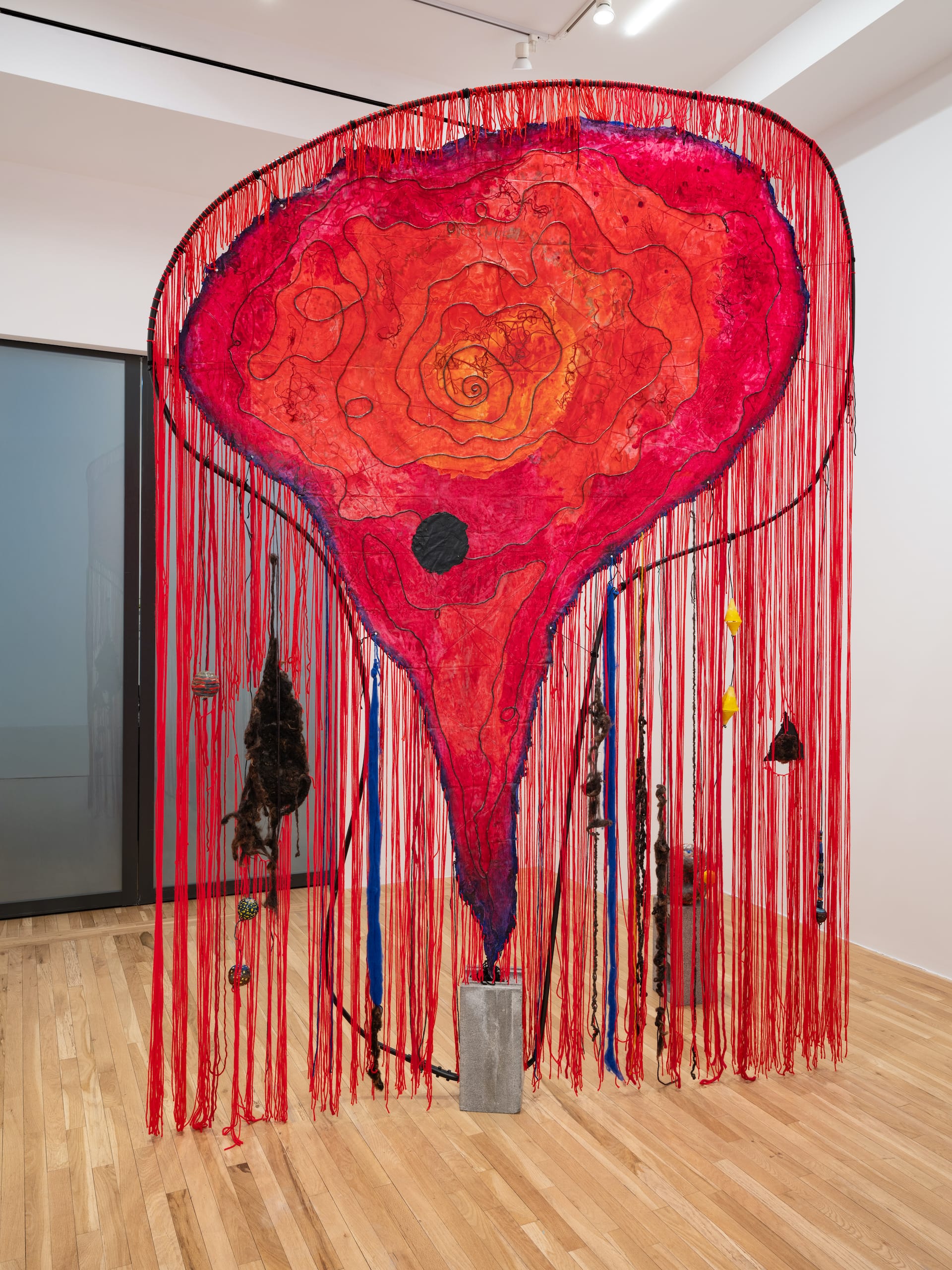 Michelle Segre, "Nebula"
“Nebula” is comprised of a flat form that resembles a thought balloon, an unknown continent, or a fiery plume rising into the sky, emerging from a vertical cement pedestal. Composed of reddish acrylic polymer, the shape is loosely outlined by steel wire, to which a fringe of red yarn reaching down to the floor is attached. The yarn becomes soft and fiery lines, a kind of threshold curtain separating one world from another. A thin spiraling wire is embedded in the central form with long entangled skeins of black thread sliding under the wire to create different linear clusters. We see two and three dimensions at once, an open shape rising from the cement block and a solid, fiery red surface hanging inside, surrounded by the yarn’s palpable lines, a drawing in space.
The luminous hues of the amorphous polymer wafer change from orange to crimson, revealing Segre as a master colorist. One of the strengths of her work is the wild, unexpected associations that come to mind. Just as I was thinking about what this abstract shape looks like, I saw a large clump of brown sheep fleece attached to the yarn. Materially, the fleece is connected to the strands of red yarn attached to the wire frames surrounding and supporting the acrylic polymer. The red’s allusion to fire evokes destruction while the juxtaposition of fleece and yarn conveys transformation and birth.
By bringing impermanent materials into her work, Segre embraces the physical world as a constantly changing site of destruction and potentiality. Her objects are open to time and its effects. They occupy the opposite end of the spectrum from the impermeable objects fabricated by Jeff Koons and his peers, and, by extension, the idea of permanence often associated with both sculpture and empire. Sensitive to ambient air currents, “Nebula” is a witness to change.
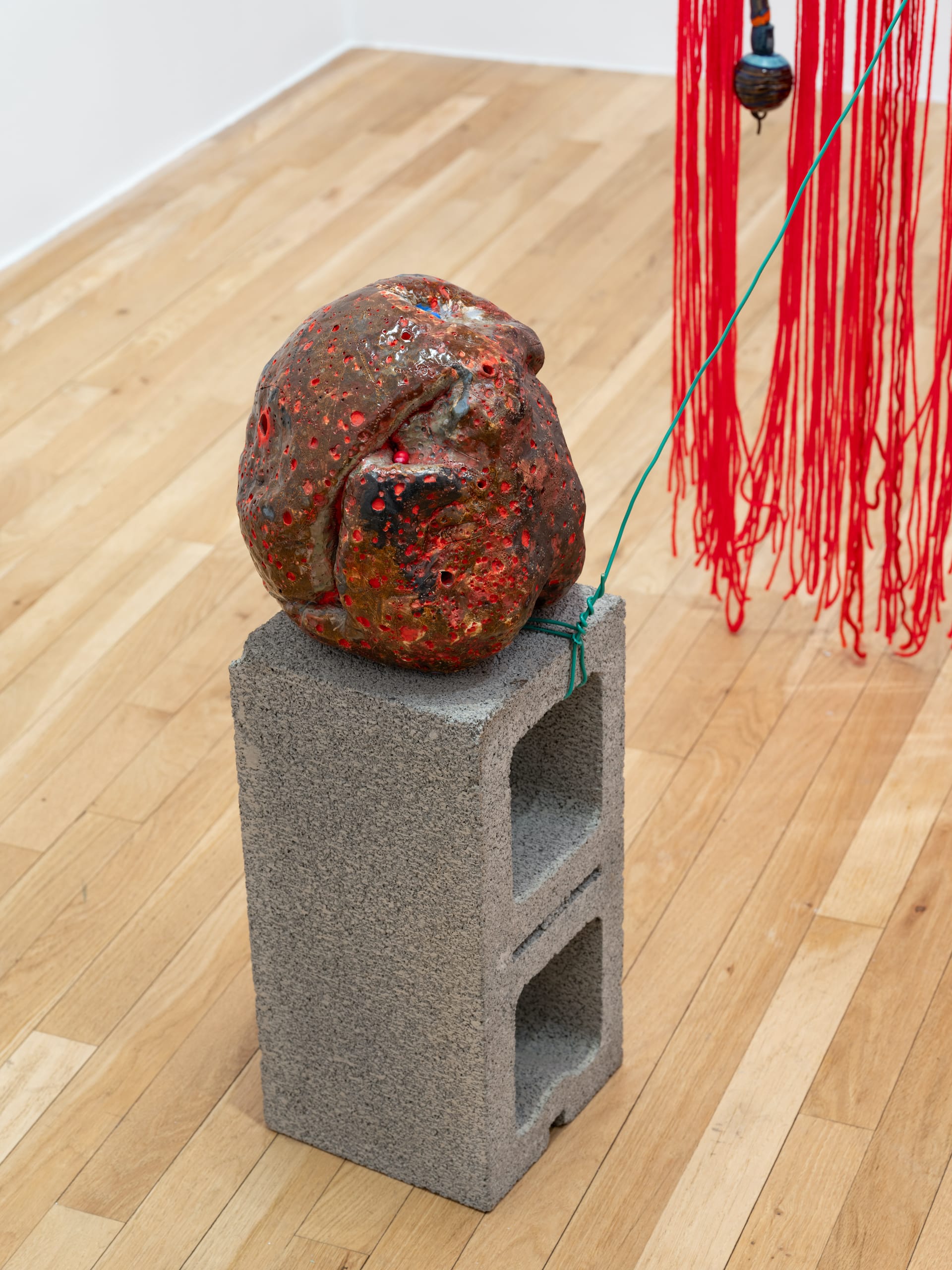 Michelle Segre, "Nebula," detail
Michelle Segre: Nebula continues at Derek Eller Gallery (38 Walker Street, Ground Floor, Tribeca, Manhattan) through February 14. The exhibition was organized by the gallery.