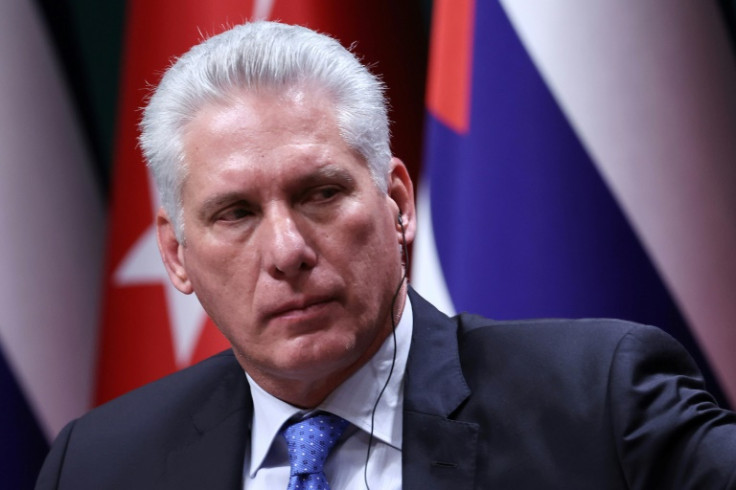
 Cuban President Miguel Diaz-Canel
AFP
Cuban President Miguel Diaz-Canel
AFP
The Cuban regime slammed the U.S. over the executive order signed by President Donald Trump imposing tariffs on goods from countries selling or providing oil to the country, calling it a "brutal act of aggression."
In a social media publication, Cuban Foreign Minister Bruno Rodriguez said Havana "condemns in the strongest terms the U.S.'s new escalation."
"Now it is seeking to impose a total blockade to our country's fuel supplies," Rodriguez added. "The U.S. is also resorting to blackmail and coercion to try to get other countries to join its universally condemned blockade of Cuba and, should they refuse, are threatened with arbitrary and abusive tariffs that violate all free trade rules," he added.
Condenamos en los términos más firmes la nueva escalada de #EEUU contra #Cuba.Ahora se propone imponer un bloqueo total a los suministros de combustible a nuestro país. Para justificarlo, se apoya en una larga lista de mentiras que pretenden presentar a Cuba como una amenaza…
— Bruno Rodríguez P (@BrunoRguezP) January 30, 2026
The development comes as a report from the Financial Times claimed that the country has less than a month worth of oil at current levels of demand and domestic production.
Citing data company Kpler, the outlet noted that the country has oil to last 15 to 20 days unless deliveries resume. "They have a major crisis on their hands" Jorge Piñon, an oil expert at the University of Texas told the outlet.
The country has only received less than 85,000 barrels this year, according to the FT. All came from a shipment on January 9, Kpler detailed. The figure adds to an estimated 460,000 barrels held in inventories at the beginning of the year.
Cuba relied on oil from Venezuela and Mexico, but shipments from the former stopped following the capture of authoritarian President Nicolas Maduro earlier this month, and the latter is seeing an impact as well.
Mexican President Claudia Sheinbaum said this week that her administration intends to continue sending oil to the country on humanitarian grounds. However, the tariffs could deter her administration from moving forward with the policy.
Cuba is already experiencing economic collapse. According to a recent poll, over three in four Cubans intend to flee the country. The survey was conducted by the Social Rights Observatory during the summer and reported by the Wall Street Journal as part of a broader piece about the country's crumbling economy.
The same poll showed that seven in ten respondents go at least without a meal a day and nearly 90% live in extreme poverty. Moreover, for over 70% of Cubans their main concerns are the lack of food and constant blackouts.
Some 2.7 million people have already left Cuba since 2020, a quarter of the population. Hundreds of thousands have gone to the U.S., Havana-based demographer Juan Carlos Albizu-Campos told the outlet back then.
Related-
Congressional Hispanic Caucus Unveils 'Non-Negotiable' Conditions for DHS Funding

-
Shapiro Slams JD Vance Over Holocaust Remembrance Social Media Post: 'Offered Comfort to Antisemites'

© 2025 Latin Times. All rights reserved. Do not reproduce without permission.
Tags: Cuba, United States, Oil, Mexico