- Archaeology
- Human Evolution
Archaeologists have found the oldest known evidence of hafted tools in East Asia, and they challenge a previously held assumption about stone tool use.
When you purchase through links on our site, we may earn an affiliate commission. Here’s how it works.
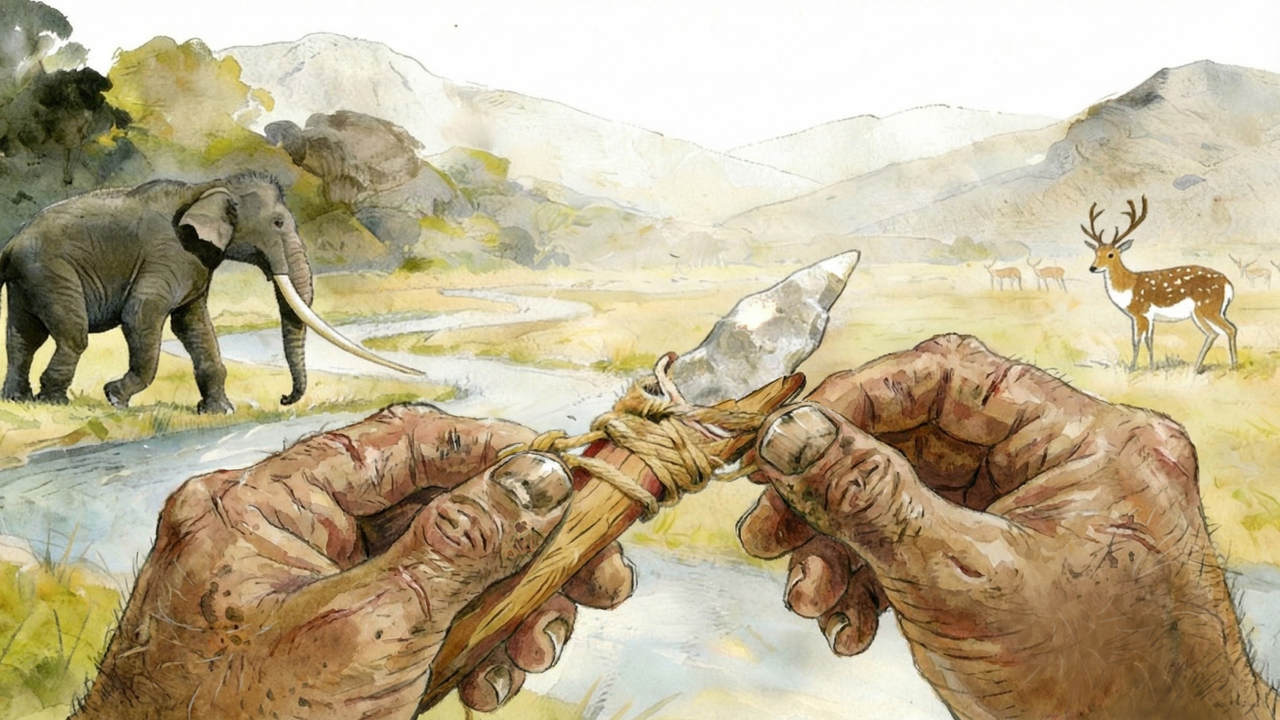
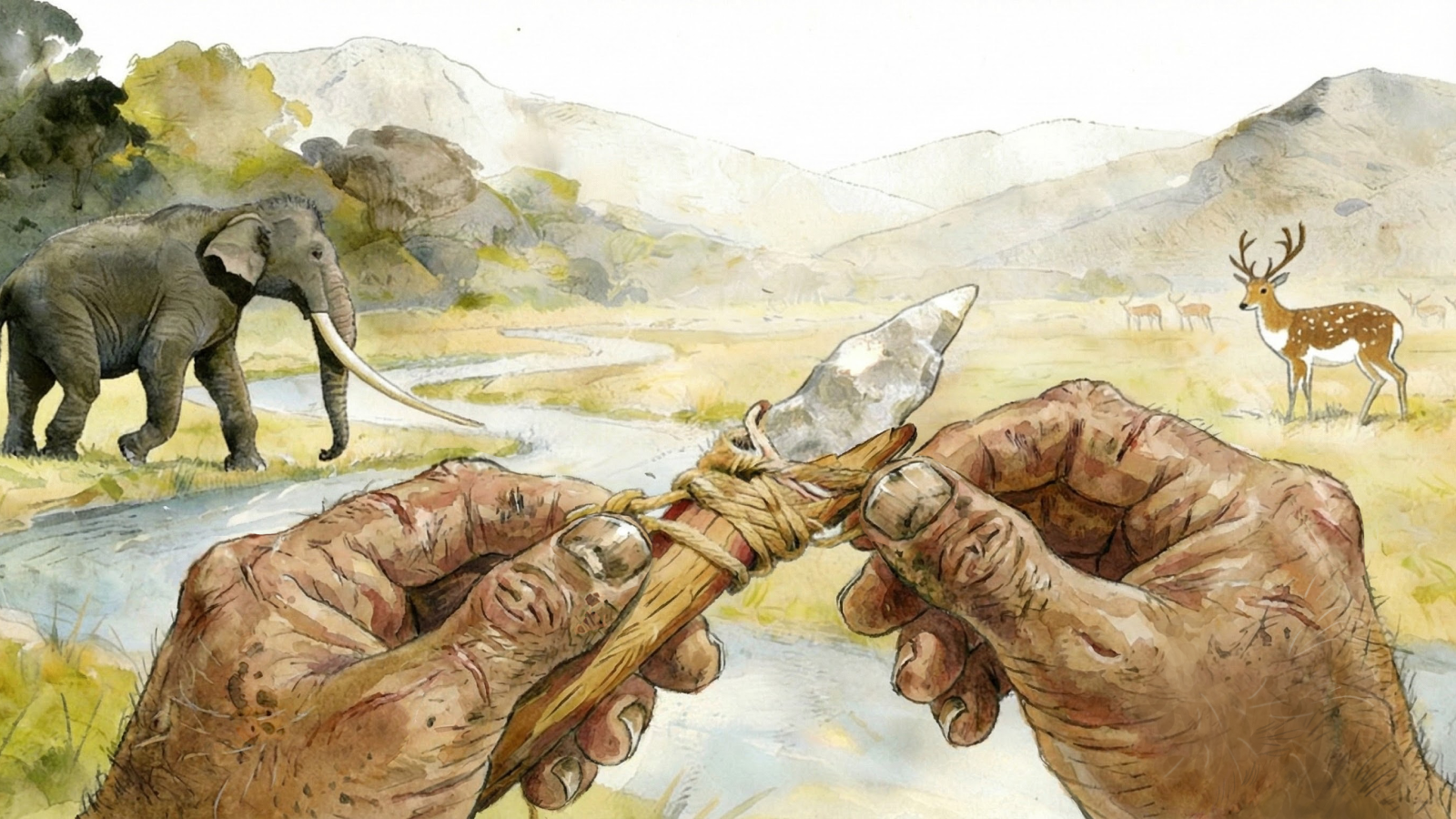 An illustration of what tool making may have looked like at Xigou around 160,000 years ago.
(Image credit: Hulk Yuan, IVPP)
Share
Share by:
An illustration of what tool making may have looked like at Xigou around 160,000 years ago.
(Image credit: Hulk Yuan, IVPP)
Share
Share by:
- Copy link
- X
Archaeologists have found that early humans in what is now China were using sophisticated stone tools as far back as 160,000 years ago.
"This discovery challenges the perception that stone tool technology in Asia lagged behind Europe and Africa during this period," the research team wrote in a statement about the discovery.
You may like-
 430,000-year-old wooden handheld tools from Greece are the oldest on record — and they predate modern humans
-
 480,000-year-old ax sharpener is the oldest known elephant bone tool ever discovered in Europe
-
 'It is the most exciting discovery in my 40-year career': Archaeologists uncover evidence that Neanderthals made fire 400,000 years ago in England
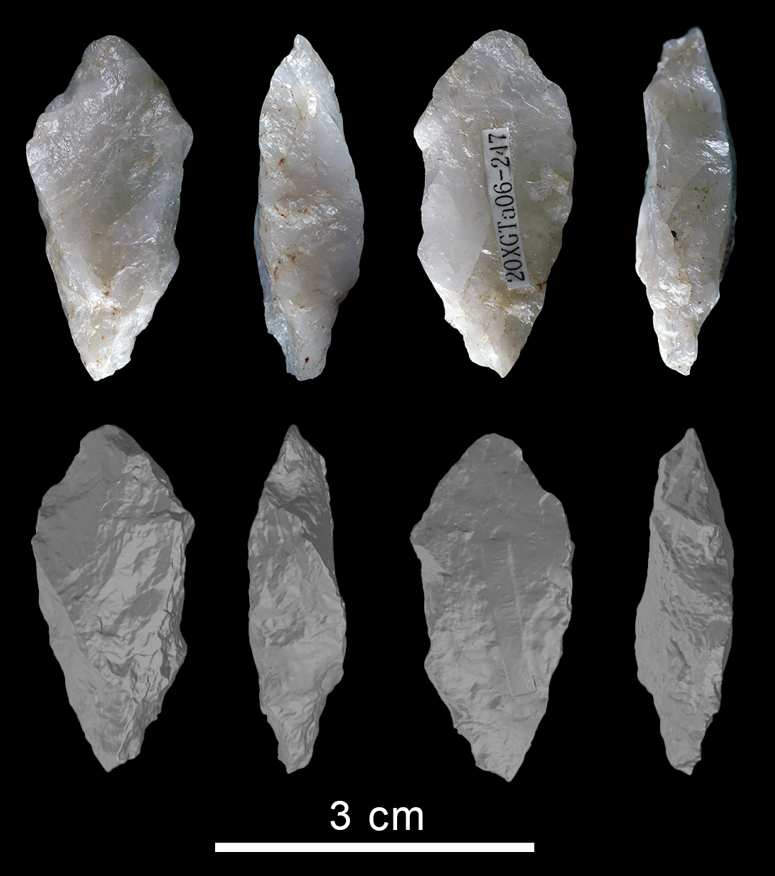
"The identification of the hafted tools provides the earliest evidence for composite tools in Eastern Asia, to our knowledge," the team wrote in a study published Tuesday (Jan. 27) in the journal Nature Communications.
Researchers already knew of extremely early tool use in East Asia, with the oldest known wooden tools there dating to 300,000 years ago. However, the new findings, which were excavated between 2019 and 2021, are the earliest known tools consisting of two materials, as is evidenced by the hafted artifacts.
Hafting "is a new technological innovation whereby the stone tool is inserted or bound to a handle or a shaft," Michael Petraglia, director of the Australian Research Centre for Human Evolution at Griffith University and a co-author of the paper, told Live Science in an email. "This improved tool performance by allowing the user to increase leverage and providing more force for actions such as boring."
It appears that the tools were used to process plant materials. "Microscopic analysis on the edges of the stone tools indicate boring actions, used against plant material, likely wood or reeds," Petraglia said.
Sign up for the Live Science daily newsletter nowContact me with news and offers from other Future brandsReceive email from us on behalf of our trusted partners or sponsorsBy submitting your information you agree to the Terms & Conditions and Privacy Policy and are aged 16 or over.Their toolmaking techniques "appear to be well established and involve several intermediate steps, showing evidence of planning and foresight," the team said in a statement.
Ben Marwick, an archaeology professor at the University of Washington and a co-author of the paper, said it is not clear which early human species made the tools.
"The exact identity of the makers of these tools is not clear, because during this time there were probably multiple hominin species living in the region," Marwick told Live Science in an email. "So it could be, for example, the Denisovans, H. longi, H. juluensis or H. sapiens that made these tools. Hopefully future work will recover fossil remains or DNA that will shed more light onto this interesting question."
You may like-
430,000-year-old wooden handheld tools from Greece are the oldest on record — and they predate modern humans
-
480,000-year-old ax sharpener is the oldest known elephant bone tool ever discovered in Europe
-
'It is the most exciting discovery in my 40-year career': Archaeologists uncover evidence that Neanderthals made fire 400,000 years ago in England
It is noteworthy that many of the artifacts are small — less than 2 inches (50 millimeters) — but were made with complex techniques, Marwick noted. "These come from a period when previous archaeological research has mostly found large artefacts produced using simple flaking methods," he said. "So our finds suggest that complex tool production strategies appear earlier than previously understood."
The newly discovered tools date to between 160,000 and 72,000 years ago. At this time, people in the region lived as hunter-gatherers, but the details of their lifestyles are unclear.
"While the lack of mammal bones and other evidence makes it difficult to deduce how they lived, at least, their stone tools indicate a high degree of behavioral flexibility and successful adaptation to the local climate and resources," Shi-Xia Yang, a paleoanthropologist at the Chinese Academy of Sciences who is a co-author of the paper, told Live Science in an email.

Stone tools in East Asia
The discovery of the sophisticated stone tools from this region and time period dispute a long-held assumption about early toolmaking, the study authors noted.
"The broader relevance of the finds are that they challenge the entrenched bias that East Asian hominins only produced 'conservative' tools," Marwick said. "The bias was deeply entrenched, dominating archaeology for over half a century through the concept of the Movius Line.
"Proposed in the 1940s, this 'line' suggested a geographical divide between the 'advanced' Acheulean handaxe cultures of Africa and Western Eurasia and the 'conservative' chopper-chopping tool cultures of East Asia," he continued. "This created a narrative of East Asia as a cultural backwater, where hominins were thought to be evolutionarily stagnant."
John Shea, an anthropology professor at Stony Brook University who was not involved with the research, praised the paper but noted that the idea that East Asia was a cultural backwater was never accurate. He noted that, in his own stone tool experiments, the small, complex and sharp stone tools that were being constructed more often in Europe could be dangerous to work with. "Trust me on this, for I have the scars to back it up," he said.
Any "hominins with a lick of common sense almost certainly minimized the amount of time they spent pounding out razor-sharp flakes," Shea said. "In this respect, [Southeast] Asian hominins were doing what one would expect them to do. … The "idea that 'simple tools equals simple minds' is archaeological mythology."
Related Stories—Mysterious East Asians vanished during the ice age. This group replaced them.
—Oldest wooden tools unearthed in East Asia show that ancient humans made planned trips to dig up edible plants
—'It makes no sense to say there was only one origin of Homo sapiens': How the evolutionary record of Asia is complicating what we know about our species
Anne Ford, an associate professor of archaeology at the University of Otago in New Zealand, praised the research.
"This is really an excellent discovery and highlights our need to move away from older descriptions of Asian technologies as simple core-flake industries," Ford told Live Science in an email. She noted that hafting is an "important technological step and has implications for assessing the cognitive ability of hominins in China during this time period."
Article SourcesYue, J., Song, G., Yang, S., Kang, S., Li, J., Marwick, B., Ollé, A., Fernández-Marchena, J. L., Shu, P., Liu, H., Zhang, Y., Huan, F., Zhao, Q., Qiao, B., Shen, Z., Deng, C., & Petraglia, M. (2026). Technological innovations and hafted technology in central China ~160,000–72,000 years ago. Nature. https://doi.org/10.1038/s41467-025-67601-y
TOPICS China Owen JarusSocial Links NavigationLive Science Contributor
Owen Jarus is a regular contributor to Live Science who writes about archaeology and humans' past. He has also written for The Independent (UK), The Canadian Press (CP) and The Associated Press (AP), among others. Owen has a bachelor of arts degree from the University of Toronto and a journalism degree from Ryerson University.
Show More CommentsYou must confirm your public display name before commenting
Please logout and then login again, you will then be prompted to enter your display name.
Logout Read more 430,000-year-old wooden handheld tools from Greece are the oldest on record — and they predate modern humans
 480,000-year-old ax sharpener is the oldest known elephant bone tool ever discovered in Europe
 'It is the most exciting discovery in my 40-year career': Archaeologists uncover evidence that Neanderthals made fire 400,000 years ago in England
 2.6 million-year-old jaw from extinct 'Nutcracker Man' is found where we didn't expect it
 Homo erectus wasn't the first human species to leave Africa 1.8 million years ago, fossils suggest
 Last common ancestor of modern humans and Neanderthals possibly found in Casablanca, Morocco
Latest in Human Evolution
Last common ancestor of modern humans and Neanderthals possibly found in Casablanca, Morocco
Latest in Human Evolution
 More than 43,000 years ago, Neanderthals spent centuries collecting animal skulls in a cave; but archaeologists aren't sure why
430,000-year-old wooden handheld tools from Greece are the oldest on record — and they predate modern humans
2.6 million-year-old jaw from extinct 'Nutcracker Man' is found where we didn't expect it
More than 43,000 years ago, Neanderthals spent centuries collecting animal skulls in a cave; but archaeologists aren't sure why
430,000-year-old wooden handheld tools from Greece are the oldest on record — and they predate modern humans
2.6 million-year-old jaw from extinct 'Nutcracker Man' is found where we didn't expect it
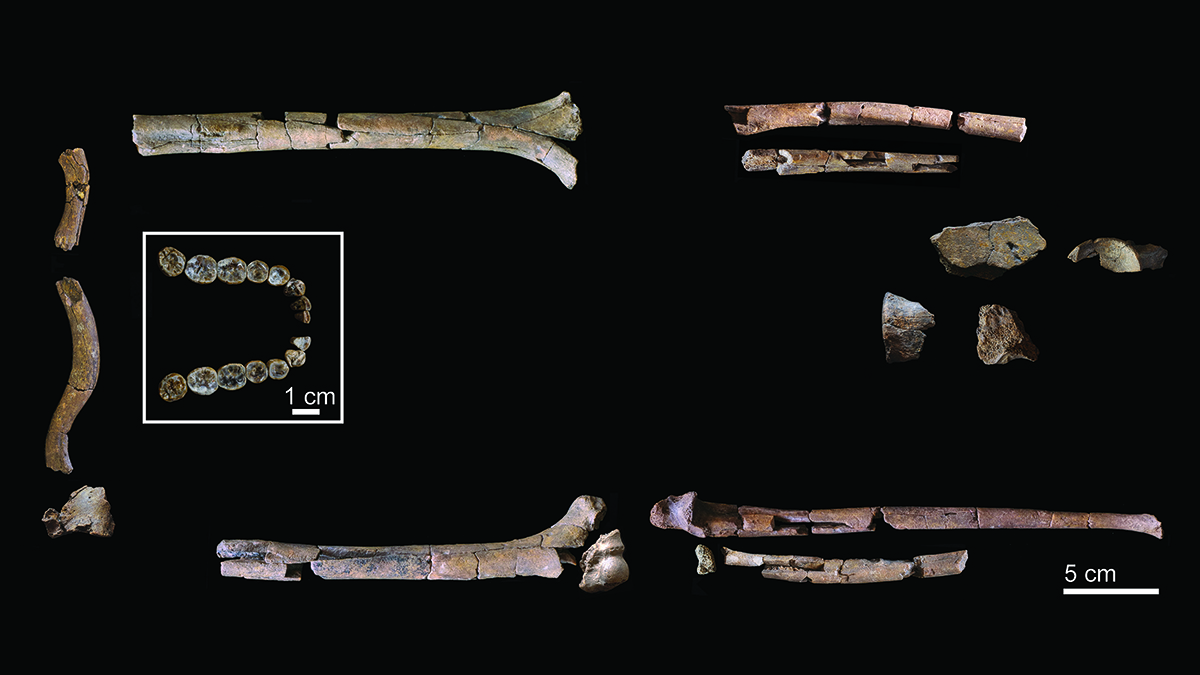 Most complete Homo habilis skeleton ever found dates to more than 2 million years ago and retains 'Lucy'-like features
 Human origins quiz: How well do you know the story of humanity?
Homo erectus wasn't the first human species to leave Africa 1.8 million years ago, fossils suggest
Latest in News
Human origins quiz: How well do you know the story of humanity?
Homo erectus wasn't the first human species to leave Africa 1.8 million years ago, fossils suggest
Latest in News
 Earth is 'missing' lighter elements. They may be hiding in its solid inner core.
 Lifespan may be 50% heritable, study suggests
 Astronomers spot 'time-warped' supernovas whose light both has and hasn't reached Earth
 Life may have rebounded 'ridiculously fast' after the dinosaur-killing asteroid impact
 'Nose-in-a-dish' reveals why the common cold hits some people hard, while others recover easily
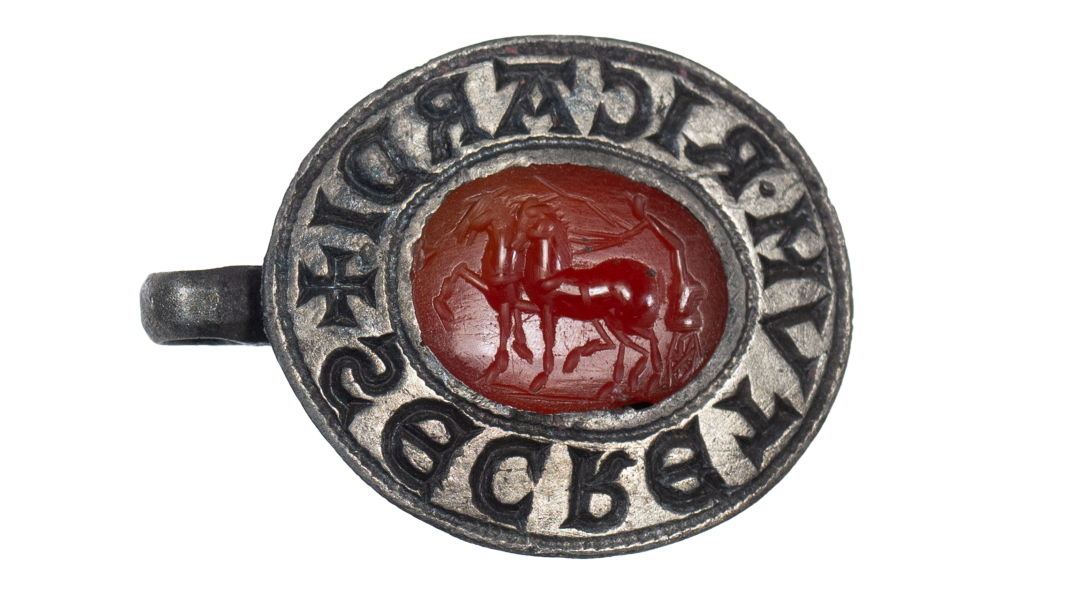 Rare medieval seal discovered in UK is inscribed with 'Richard's secret' and bears a Roman-period gemstone
LATEST ARTICLES
Rare medieval seal discovered in UK is inscribed with 'Richard's secret' and bears a Roman-period gemstone
LATEST ARTICLES 1'It's similar to how Google can map your home without your consent': Why using aerial lasers to map an archaeology site should have Indigenous partnership
- 2'Nose-in-a-dish' reveals why the common cold hits some people hard, while others recover easily
- 3Earth is 'missing' lighter elements. They may be hiding in its solid inner core.
- 4Oneisall Pet Air Purifier (PP02) review: Great value pick for dog and cat lovers
- 5Rare medieval seal discovered in UK is inscribed with 'Richard's secret' and bears a Roman-period gemstone


