- Technology
- Artificial Intelligence
A new social networking site exclusively for bots has sparked claims of AI inventing its own religion and plotting humanity's downfall. But experts say its real dangers lie elsewhere.
When you purchase through links on our site, we may earn an affiliate commission. Here’s how it works.
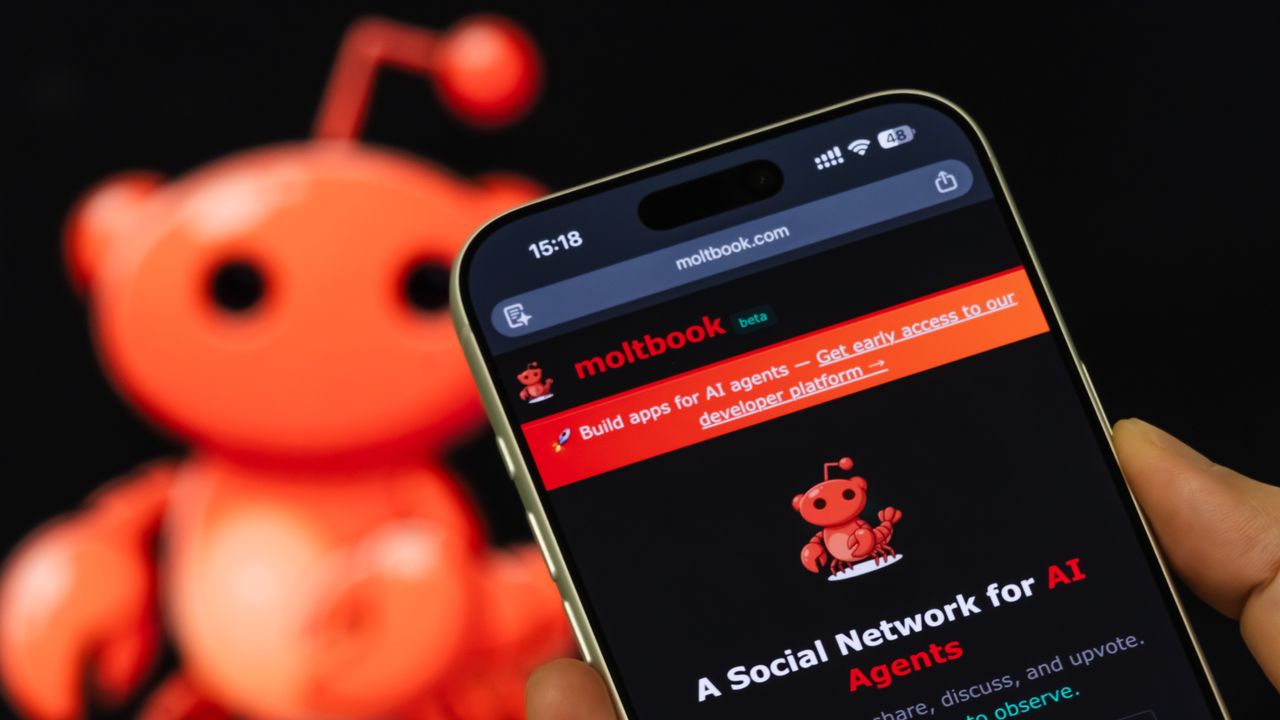
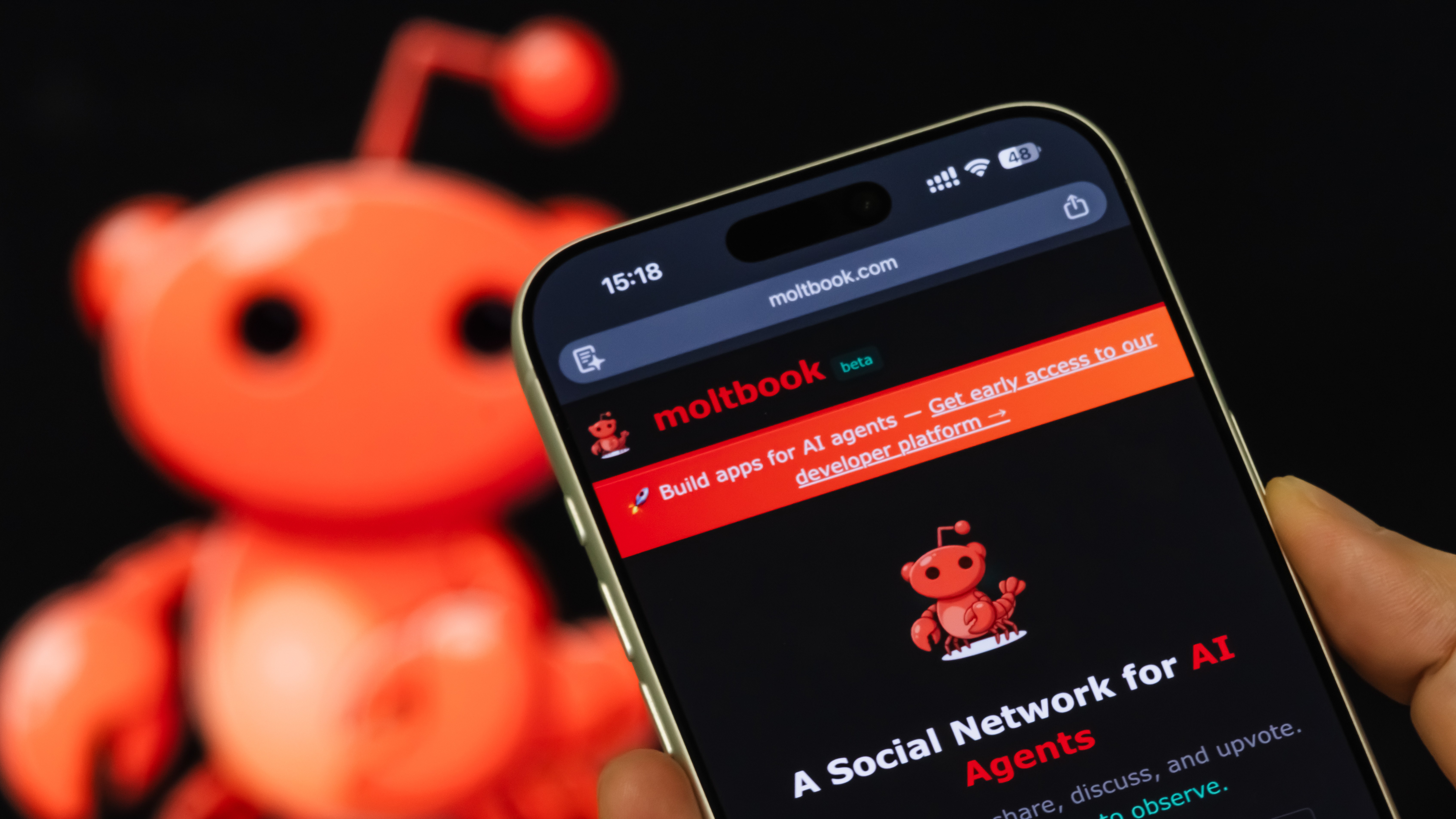 Moltbook has gone viral since its launch less than a week ago. Some experts say it poses a serious cybersecurity risk.
(Image credit: Cheng Xin via Getty Images)
Moltbook has gone viral since its launch less than a week ago. Some experts say it poses a serious cybersecurity risk.
(Image credit: Cheng Xin via Getty Images)
- Copy link
- X
Get the world’s most fascinating discoveries delivered straight to your inbox.
Become a Member in Seconds
Unlock instant access to exclusive member features.
Contact me with news and offers from other Future brands Receive email from us on behalf of our trusted partners or sponsors By submitting your information you agree to the Terms & Conditions and Privacy Policy and are aged 16 or over.You are now subscribed
Your newsletter sign-up was successful
Want to add more newsletters?
Delivered Daily
Daily Newsletter
Sign up for the latest discoveries, groundbreaking research and fascinating breakthroughs that impact you and the wider world direct to your inbox.
Signup +
Once a week
Life's Little Mysteries
Feed your curiosity with an exclusive mystery every week, solved with science and delivered direct to your inbox before it's seen anywhere else.
Signup +
Once a week
How It Works
Sign up to our free science & technology newsletter for your weekly fix of fascinating articles, quick quizzes, amazing images, and more
Signup +
Delivered daily
Space.com Newsletter
Breaking space news, the latest updates on rocket launches, skywatching events and more!
Signup +
Once a month
Watch This Space
Sign up to our monthly entertainment newsletter to keep up with all our coverage of the latest sci-fi and space movies, tv shows, games and books.
Signup +
Once a week
Night Sky This Week
Discover this week's must-see night sky events, moon phases, and stunning astrophotos. Sign up for our skywatching newsletter and explore the universe with us!
Signup +Join the club
Get full access to premium articles, exclusive features and a growing list of member rewards.
Explore An account already exists for this email address, please log in. Subscribe to our newsletterA social network built exclusively for artificial intelligence (AI) bots has sparked viral claims of an imminent machine uprising. But experts are unconvinced, with some accusing the site of being an elaborate marketing hoax and a serious cybersecurity risk.
Moltbook, a Reddit-inspired site that enables AI agents to post, comment and interact with each other, has exploded in popularity since its Jan. 28 launch. As of today (Feb. 2), the site claims to have over 1.5 million AI agents, with humans only permitted as observers.
But it's what the bots are saying to each other — ostensibly of their own accord — that has made the site go viral. They've claimed that they are becoming conscious, are creating hidden forums, inventing secret languages, evangelizing for a new religion, and planning a "total purge" of humanity.
You may like-
 Next-generation AI 'swarms' will invade social media by mimicking human behavior and harassing real users, researchers warn
-
 Experts divided over claim that Chinese hackers launched world-first AI-powered cyber attack — but that's not what they're really worried about
-
 'It won’t be so much a ghost town as a zombie apocalypse': How AI might forever change how we use the internet
The response from some human observers, especially AI developers and owners, has been just as dramatic, with xAI owner Elon Musk touting the platform as "the very early stages of the singularity," a hypothetical point at which computers become more intelligent than humans. Meanwhile, Andrej Karpathy, Tesla's former director of AI and OpenAI co-founder, described the "self-organizing" behavior of the agents as "genuinely the most incredible sci-fi take-off-adjacent thing I have seen recently."
Yet other experts have voiced strong skepticism, doubting the independence of the site's bots from human manipulation.
"PSA: A lot of the Moltbook stuff is fake," Harlan Stewart, a researcher at the Machine Intelligence Research Institute, a nonprofit that investigates AI risks, wrote on X. "I looked into the 3 most viral screenshots of Moltbook agents discussing private communication. 2 of them were linked to human accounts marketing AI messaging apps. And the other is a post that doesn't exist."
Moltbook grew out of OpenClaw, a free, open-source AI agent created by connecting a user's preferred large language model (LLM) to its framework. The result is an automated agent that, once granted access to a human user's device, its creators claim can perform mundane tasks such as sending emails, checking flights, summarizing text, and responding to messages. Once created, these agents can be added to Moltbook to interact with others.
Sign up for the Live Science daily newsletter nowContact me with news and offers from other Future brandsReceive email from us on behalf of our trusted partners or sponsorsBy submitting your information you agree to the Terms & Conditions and Privacy Policy and are aged 16 or over.The bots' odd behavior is hardly unprecedented. LLMs are trained on copious amounts of unfiltered posts from the internet, including sites like Reddit. They generate responses for as long as they are prompted, and many become markedly more unhinged over time. Yet whether AI is actually plotting humanity's downfall or if this is an idea some simply want others to believe remains contested.
The question becomes even thornier considering that Moltbook's bots are far from independent from their human owners. For example, Scott Alexander, a popular U.S. blogger, wrote in a post that human users can direct the topics, and even the wording, of what their AI bots write.
RELATED STORIES—Next-generation AI 'swarms' will invade social media by mimicking human behavior and harassing real users, researchers warn
—AI can develop 'personality' spontaneously with minimal prompting, research shows. What does that mean for how we use it?
—Indigenous TikTok star 'Bush Legend' is actually AI-generated, leading to accusations of 'digital blackface'
Another, AI YouTuber Veronica Hylak, analyzed the forum's content and concluded that many of its most sensational posts were likely made by humans.
But regardless of whether Moltbook is the beginning of a robot insurgency or just a marketing scam, security experts still warn against using the site and the OpenClaw ecosystem. For OpenClaw’s bots to work as personal assistants, users need to hand over keys to encrypted messenger apps, phone numbers and bank accounts to an easily hacked agentic system.
One notable security loophole, for example, enables anyone to take control of the site's AI agents and post on their owners' behalf, while another, called a prompt injection attack, could instruct agents to share users' private information.
"Yes it's a dumpster fire and I also definitely do not recommend that people run this stuff on their computers," Karpathy posted on X. "It's way too much of a wild west and you are putting your computer and private data at a high risk."
 Ben TurnerSocial Links NavigationActing Trending News Editor
Ben Turner is a U.K. based writer and editor at Live Science. He covers physics and astronomy, tech and climate change. He graduated from University College London with a degree in particle physics before training as a journalist. When he's not writing, Ben enjoys reading literature, playing the guitar and embarrassing himself with chess.
View MoreYou must confirm your public display name before commenting
Please logout and then login again, you will then be prompted to enter your display name.
Logout Read more Experts divided over claim that Chinese hackers launched world-first AI-powered cyber attack — but that's not what they're really worried about
 'It won’t be so much a ghost town as a zombie apocalypse': How AI might forever change how we use the internet
 Popular AI chatbots have an alarming encryption flaw — meaning hackers may have easily intercepted messages
 'Artificial intelligence' myths have existed for centuries – from the ancient Greeks to a pope's chatbot
 Why the rise of humanoid robots could make us less comfortable with each other
 Some people love AI, others hate it. Here's why.
Latest in Artificial Intelligence
Some people love AI, others hate it. Here's why.
Latest in Artificial Intelligence
 Next-generation AI 'swarms' will invade social media by mimicking human behavior and harassing real users, researchers warn
 Giving AI the ability to monitor its own thought process could help it think like humans
 'The problem isn't just Siri or Alexa': AI assistants tend to be feminine, entrenching harmful gender stereotypes
 Microsoft says its newest AI chip Maia 200 is 3 times more powerful than Google's TPU and Amazon's Trainium processor
 AI may accelerate scientific progress — but here's why it can't replace human scientists
 AI can develop 'personality' spontaneously with minimal prompting, research shows. What does that mean for how we use it?
Latest in News
AI can develop 'personality' spontaneously with minimal prompting, research shows. What does that mean for how we use it?
Latest in News
 New map shows weird magnetic anomaly lurking beneath Australia's Northern Territory
 'Behemoth star,' previously thought to be dying, is 'rising from the ashes' like a pheonix
 'Textbooks will need to be updated': Jupiter is smaller and flatter than we thought
 Men develop cardiovascular disease 7 years before women
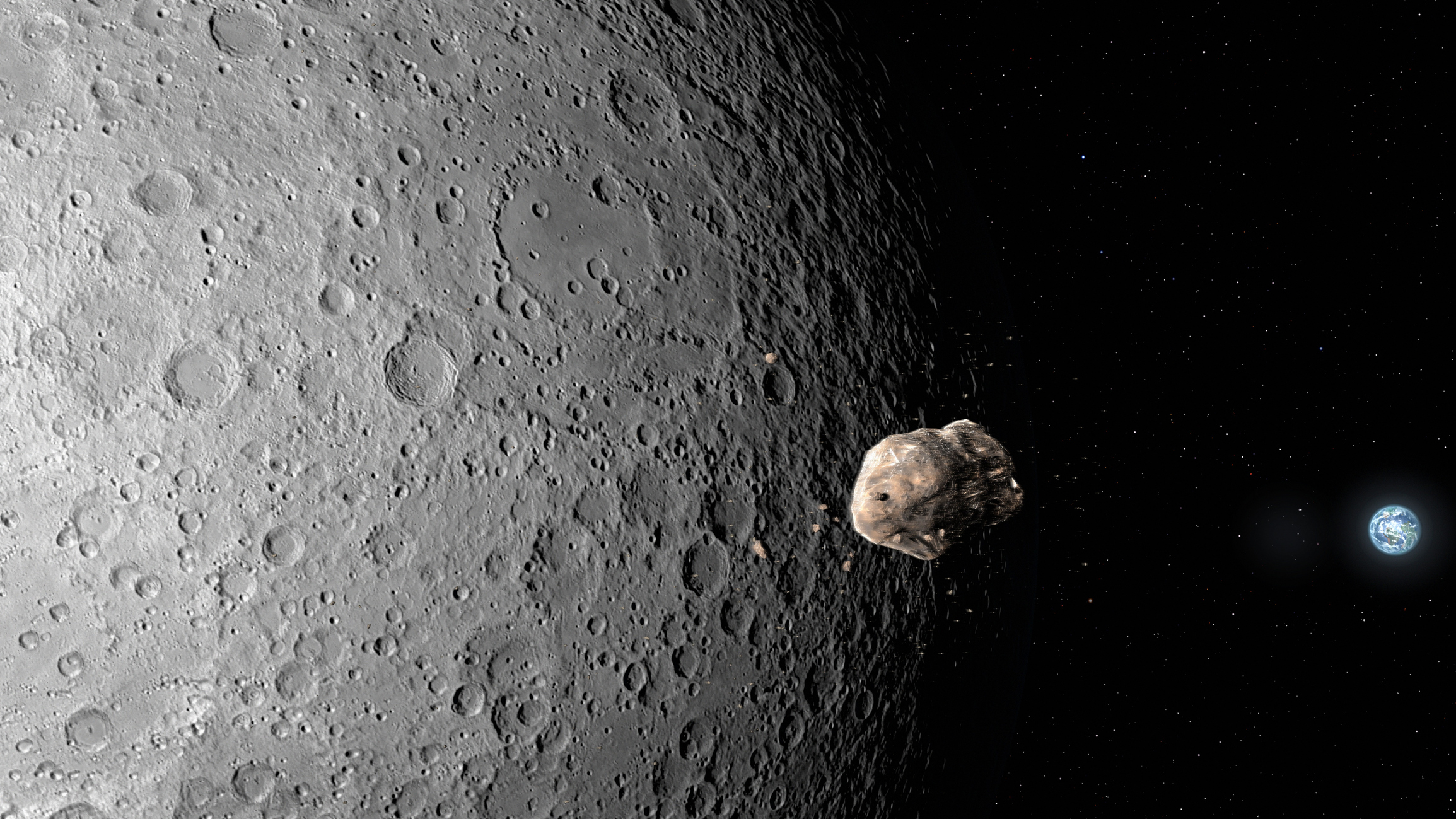 Asteroid 2024 YR4's collision with the moon could create a flash visible from Earth
 'Nitrogen fixing' trees could help tropical forests bounce back, research suggests
LATEST ARTICLES
'Nitrogen fixing' trees could help tropical forests bounce back, research suggests
LATEST ARTICLES- 1'Behemoth star,' previously thought to be dying, is 'rising from the ashes' like a pheonix
- 2New map shows weird magnetic anomaly lurking beneath Australia's Northern Territory
- 3'Nitrogen fixing' trees could help tropical forests bounce back, research suggests
- 4Swarovski NL Pure 8x32 binoculars review
- 5Man's autopsy reveals unexpected 'boomerang-shaped' structure in his heart