- Search Popular SearchesCritical thinkingPhilosophyEmotional IntelligenceFree Will Latest Videos Latest Articles
-
Topics
Philosophy
- Ethics
- Religion
- Flourishing
- Knowledge
- Philosophy of Science
- Philosophy of Art
- Language
- Political Theory
- Identity
- Meaning & Purpose
Science & Tech
- Physics
- Biology
- Aerospace
- Health
- Geology
- Computing
- Engineering
- Energy
- Biotechnology
Mind & Behavior
- Psychology
- Neuroscience
- Decision-Making
- Mental Health
- Consciousness
- Emotional Intelligence
- Personality
- Relationships
- Parenting
Business
- Entrepreneurship
- Leadership
- Finance
- Marketing
- Innovation
- Strategy
- Management
- Artificial Intelligence
- Startups
- Economics
History & Society
- History
- Literature
- Art
- Music
- Film
- Progress
- Culture
- Sociology
- Policy
- Geopolitics
-
Videos
Latest Videos
 The brain-deep emotion that matters more than happiness
with
Kate Bowler
The brain-deep emotion that matters more than happiness
with
Kate Bowler
 The hard problem of consciousness, in 53 minutes
with
Annaka Harris
The hard problem of consciousness, in 53 minutes
with
Annaka Harris
 Why the search for alien life is about patience, not belief
with
Jill Tarter
Why the search for alien life is about patience, not belief
with
Jill Tarter
 Thinking too logically can actually hold you back
with
Dan Shipper
Thinking too logically can actually hold you back
with
Dan Shipper
 Is there a Planet B? An astrophysicist answers.
with
Sara Seager
Is there a Planet B? An astrophysicist answers.
with
Sara Seager
 What nihilism acknowledges that other philosophies don’t
with
Alex O’Connor
See All
What nihilism acknowledges that other philosophies don’t
with
Alex O’Connor
See All
-
Columns
 Mini Philosophy
A philosophy column for personal reflection.
Mini Philosophy
A philosophy column for personal reflection.
 Starts With A Bang
An astrophysics column on big questions and our universe.
Starts With A Bang
An astrophysics column on big questions and our universe.
 Books
A literature column to feed your curiosity.
Books
A literature column to feed your curiosity.
 The Long Game
A business column on long-term thinking.
The Long Game
A business column on long-term thinking.
 Strange Maps
A geography column on history and society.
Strange Maps
A geography column on history and society.
 The Well
A collection of essays and videos on life’s biggest questions.
The Well
A collection of essays and videos on life’s biggest questions.
 13.8
A column at the intersection of science and culture.
13.8
A column at the intersection of science and culture.
-
Classes
Featured Classes
 Members
7 videos
How to Lead With Integrity
Steve Stoute
Founder and CEO, UnitedMasters and Translation
Members
7 videos
How to Lead With Integrity
Steve Stoute
Founder and CEO, UnitedMasters and Translation
 Members
6 videos
Transform Your Organization with AI
Daphne Koller
Founder and CEO of insitro.
Members
6 videos
Transform Your Organization with AI
Daphne Koller
Founder and CEO of insitro.
 Members
10 videos
Unlocking Your Team’s Hidden Potential
Adam Grant
Organizational psychologist and author
Members
10 videos
Unlocking Your Team’s Hidden Potential
Adam Grant
Organizational psychologist and author
 Members
6 videos
The Secrets of Unreasonable Hospitality
Will Guidara
Restaurateur and Author, Unreasonable Hospitality
Members
6 videos
The Secrets of Unreasonable Hospitality
Will Guidara
Restaurateur and Author, Unreasonable Hospitality
 Members
12 videos
How to Afford Anything
Paula Pant
Host, Afford Anything Podcast, Afford Anything
Members
12 videos
How to Afford Anything
Paula Pant
Host, Afford Anything Podcast, Afford Anything
 Members
7 videos
True Ingredients of Successful Leadership
Atul Gawande
Professor and author
Browse
Members
7 videos
True Ingredients of Successful Leadership
Atul Gawande
Professor and author
Browse
-
More
- About Big Think
- Work with Us
- Newsletters
- Monthly Issues
- Events
- Careers
- Our Mission
- Get Big Think+ for Business
- Freethink Media
- View our Twitter (X) feed View our Youtube channel View our Instagram feed View our Substack feed
-
My account
- My Classes
- My Account
- My List
- BT+ for my Business
- Early Releases
- Sign Out
- Membership
-
Topics
Back
Philosophy
- Ethics
- Religion
- Flourishing
- Knowledge
- Philosophy of Science
- Philosophy of Art
- Language
- Political Theory
- Identity
- Meaning & Purpose
Science & Tech
- Physics
- Biology
- Aerospace
- Health
- Geology
- Computing
- Engineering
- Energy
- Biotechnology
Mind & Behavior
- Psychology
- Neuroscience
- Decision-Making
- Mental Health
- Consciousness
- Emotional Intelligence
- Personality
- Relationships
- Parenting
Business
- Entrepreneurship
- Leadership
- Finance
- Marketing
- Innovation
- Strategy
- Management
- Artificial Intelligence
- Startups
- Economics
History & Society
- History
- Literature
- Art
- Music
- Film
- Progress
- Culture
- Sociology
- Policy
- Geopolitics
-
Videos
Back
Latest Videos
The brain-deep emotion that matters more than happiness
Happiness collapses the moment hardship arrives. Joy doesn’t. Historian Kate Bowler explains why joy can coexist with pain — and...
The hard problem of consciousness, in 53 minutes
“Our conscious awareness is everything. And the fact that it's still so mysterious to scientists and to all of humanity,...
Why the search for alien life is about patience, not belief
Thinking too logically can actually hold you back
"Rationalism is the idea that, in order to truly know something, you have to be able to describe it explicitly."
Is there a Planet B? An astrophysicist answers.
30 years ago, we didn’t know other stars had planets orbiting them. Now, we may be on the verge of...
What nihilism acknowledges that other philosophies don’t
"The thing that the nihilist recognizes is that the values he or she holds are not grounded in anything other...
 The terrifying ways that social media is altering teenage brains
Why social media is the perfect recipe for kids to become addicted to their smartphones.
The terrifying ways that social media is altering teenage brains
Why social media is the perfect recipe for kids to become addicted to their smartphones.
 The computing revolution that secretly began in 1776
"In the process of mapping the heavens, it doesn't take long to realize the data problem they generated."
The computing revolution that secretly began in 1776
"In the process of mapping the heavens, it doesn't take long to realize the data problem they generated."
-
Columns
Back
Columns
Mini Philosophy
A philosophy column for personal reflection.
Starts With A Bang
An astrophysics column on big questions and our universe.
Books
A literature column to feed your curiosity.
The Long Game
A business column on long-term thinking.
Strange Maps
A geography column on history and society.
The Well
A collection of essays and videos on life’s biggest questions.
13.8
A column at the intersection of science and culture.
-
Classes
Back
Featured Classes
Members
7 videos
How to Lead With Integrity
Steve Stoute
Founder and CEO, UnitedMasters and Translation
Members
6 videos
Transform Your Organization with AI
Daphne Koller
Founder and CEO of insitro.
Members
10 videos
Unlocking Your Team’s Hidden Potential
Adam Grant
Organizational psychologist and author
Members
6 videos
The Secrets of Unreasonable Hospitality
Will Guidara
Restaurateur and Author, Unreasonable Hospitality
Members
12 videos
How to Afford Anything
Paula Pant
Host, Afford Anything Podcast, Afford Anything
Members
7 videos
True Ingredients of Successful Leadership
Atul Gawande
Professor and author
-
My Account
Back
- My Classes
- My Account
- My List
- BT+ for my Business
- Early Releases
- Sign Out
- Sign In
- Membership
-
More
Back
- About Big Think
- Work with Us
- Newsletters
- Monthly Issues
- Events
- Careers
- Our Mission
- Get Big Think+ for Business
- Freethink Media
- View our Twitter (X) feed View our Youtube channel View our Instagram feed View our Substack feed
Before Sun-like stars die, they transition from AGB red giants into preplanetary nebulae. Here's how Hubble sees the famous Egg Nebula.
by Ethan Siegel February 11, 2026 This visualization shows the three main components of the Egg Nebula, with all of the foreground and background stars removed. The concentric thin rings of material represent pulsed ejecta from the dying star in its post-AGB phase. The twin jets in opposite directions represent light from the central star illuminating the bipolar lobes powered by the central engine. And the dense, dusty disk surrounding the whole nebula represents heavy molecules that haven't traveled very far. This is the most comprehensive model of the Egg Nebula ever constructed.
Credit: NASA, ESA, STScI, Christian Nieves (STScI), Frank Summers (STScI)
Key Takeaways- While the most massive stars die in supernovae and the least massive ones will never make it to the red giant stage, stars of intermediate masses, like the Sun, will die to form planetary nebulae, leaving white dwarf remnants behind.
- In the final stages of a Sun-like star’s life, it enters the asymptotic giant branch (AGB) phase, where it blows off copious amounts of material, before contracting, heating up, and ionizing that material to create that planetary nebula.
- The stage in between the AGB phase and the planetary nebula phase is brief, but one spectacular example exists close by: the Egg Nebula. In this all-new Hubble view, details of its structure are revealed as never before.

An astrophysics column on big questions and our universe.
Newsletter-
Science and TechAstrophysicsUniverse ExpansionAstronomyCosmology
One of the most important lessons we learn from studying the Universe is that none of the sources of light that we see — none of the stars, galaxies, stellar remnants, quasars, or heated matter — will continue to shine forever. After a finite amount of time, anything powered by nuclear fusion or infalling matter will run out of fuel. Anything that emits light because it’s hot will cool, and once it’s cooled enough, it won’t emit detectable light signatures any longer: not only ultraviolet and visible light, but infrared, microwave, and even radio emissions will eventually cease. Every point-like and every extended light source, even though they shine brilliantly and ubiquitously today, will someday be snuffed out.
For stars, there are three main fates that a star can have, all of which are heavily dependent on their mass at birth.
- The most massive stars will burn through their fuel and undergo collapse: either direct collapse to a black hole or core-collapse, leading to a supernova. These stars can leave black holes, neutron stars, or nothing at all behind when they die.
- The least massive stars take an enormous amount of time to burn through their fuel, living as red dwarfs and dying as white dwarfs, before fading away to black after roughly a quadrillion years pass.
- But the intermediate mass stars, including stars like our Sun, most commonly die by becoming red giants, then entering the asymptotic giant branch (AGB) phase, eventually transforming into planetary nebulae alongside a white dwarf, where the planetary nebula fades away after a few ten-thousand years.
However, for intermediate mass stars, there’s an in-between stage: after the AGB phase but before the planetary nebula phase. Known as a preplanetary nebula, we’ve got a spectacular example nearby: the Egg Nebula. Using Hubble, we’ve just imaged it as never before, revealing details not only about this one system, but about all dying Sun-like stars, giving us a novel glimpse of our own future.
 This view from Kitt Peak Observatory in 2014 showcases the Egg Nebula in the constellation of Cygnus. Located approximately 3,000 light-years away, it was the first object discovered that showcases a star in the post-AGB phase with a preplanetary (renamed from a protoplanetary) nebula around it.
Credit: KPNO/NOIRLab/NSF/AURA/Chas Sourek and Diana Hartrampf/Adam Block
This view from Kitt Peak Observatory in 2014 showcases the Egg Nebula in the constellation of Cygnus. Located approximately 3,000 light-years away, it was the first object discovered that showcases a star in the post-AGB phase with a preplanetary (renamed from a protoplanetary) nebula around it.
Credit: KPNO/NOIRLab/NSF/AURA/Chas Sourek and Diana Hartrampf/Adam Block
Originally mis-catalogued as a pair of galaxies by Fritz Zwicky, this unusual object is actually located within our Milky Way: just 3000 light-years away. As Sun-like stars — a proxy for all intermediate mass stars, or stars with between about 0.4 and 8 times the mass of the Sun — age, they burn through their fuel and evolve. They’ll then encounter the following evolutionary stages.
- First, the core will run out of hydrogen fuel, causing the inner core of the star to become inert while hydrogen fusion continues in a shell surrounding it.
- This causes the outer layers of the star to expand and cool, evolving into a red giant, while the interior of the core heats up, intensifying the rate of fusion within it.
- Eventually, the internal temperatures rise above a critical threshold (somewhere around 100 million K) that initiates the fusion of helium into carbon: the helium flash of the red giant phase.
- When the helium is exhausted, the star enters the asymptotic giant branch (AGB) phase of its life, where the inner core, now primarily composed of carbon and oxygen, undergoes no further fusion reactions, but helium fuses in a shell around it while hydrogen fuses in a shell surrounding the helium fusion layer.
- Later in the AGB phase, the star begins thermally pulsing as the helium shell runs out of fuel, only igniting periodically in 10,000+ year intervals, leading to regular ejections of material.
- Then the star enters what’s known at the post-AGB phase: where the outer layers of the star are shed, while the remaining stellar material contracts and heats up. The more massive the original star is, the shorter the post-AGB lifetime, down to a minimum of just over 1000 years.
- The heating up of the star, as it transitions into a stellar remnant, first illuminates and later ionizes the prior ejecta, creating a preplanetary nebula (renamed from protoplanetary nebula, to avoid confusion with the protoplanetary disks that form around protostars and newly ignited stars) during the illumination stage and becoming a full-fledged planetary nebula once ionization commences.
- Finally, the nebula fades away and only a white dwarf is left behind.
Those are the stages of how a Sun-like star evolves and dies. Even though the details vary, this story applies to practically all intermediate mass stars that are born all throughout the cosmos.
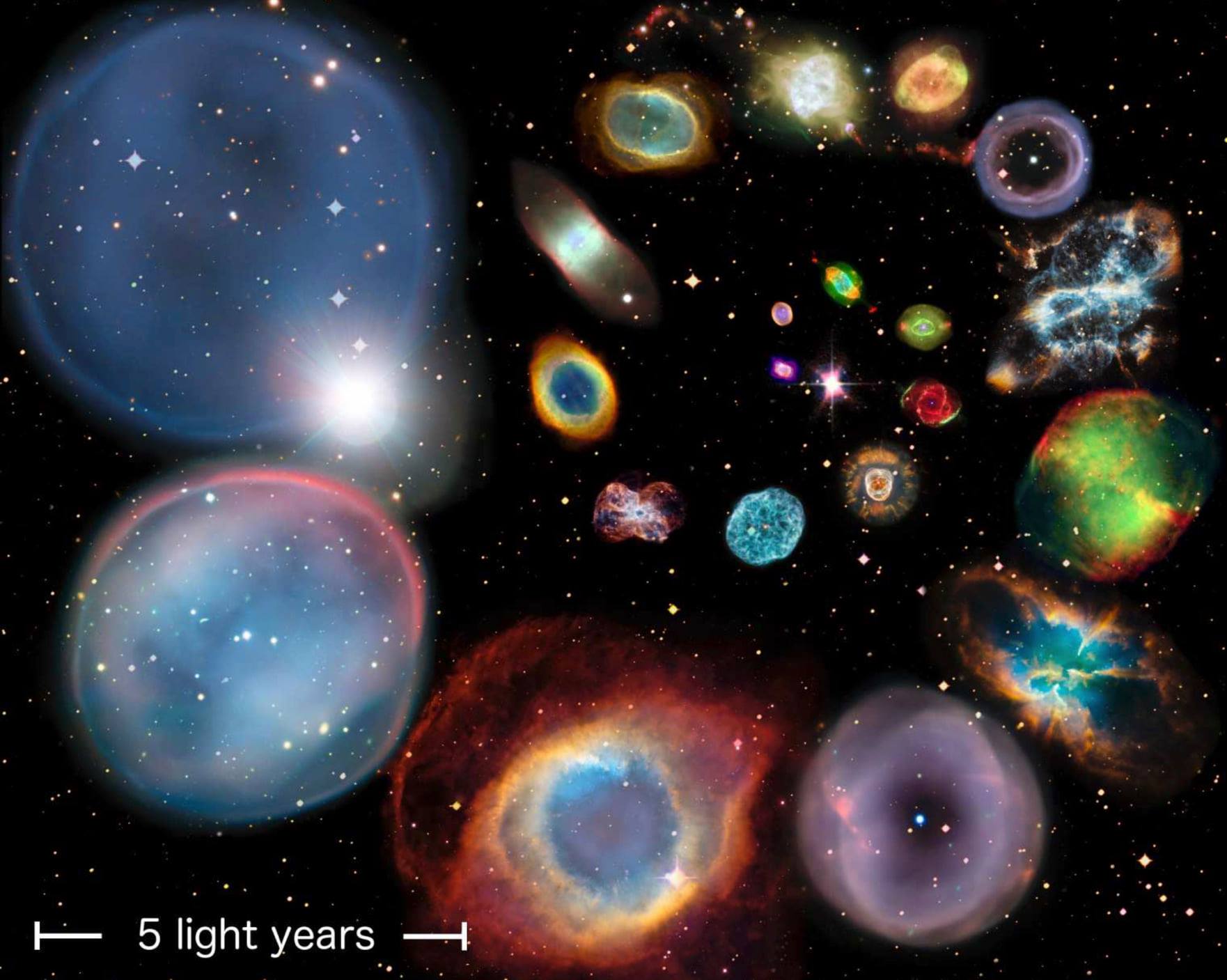 From their earliest beginnings to their final extent before fading away, Sun-like stars will grow from their present size to the size of a red giant (~the Earth’s orbit) to up to ~5 light-years in diameter, typically. The largest known planetary nebulae can reach approximately double that size, up to ~10 light-years across, but none of this necessarily means that the Sun is a typical, average star.
Credit: Ivan Bojičić, Quentin Parker, and David Frew, Laboratory for Space Research, HKU
From their earliest beginnings to their final extent before fading away, Sun-like stars will grow from their present size to the size of a red giant (~the Earth’s orbit) to up to ~5 light-years in diameter, typically. The largest known planetary nebulae can reach approximately double that size, up to ~10 light-years across, but none of this necessarily means that the Sun is a typical, average star.
Credit: Ivan Bojičić, Quentin Parker, and David Frew, Laboratory for Space Research, HKU
Because of how bright they are, stars in the red giant phase are easy to identify and are found copiously: both within the Milky Way and beyond. Similarly, AGB stars are easy to find; although they’re rarer and shorter-lived than red giants, they’re also very bright, and the combinations of their brightness and color makes them easy to pick out against the rest of the stars. Later on, as some of the brightest extended objects visible with even the most primitive of telescopes, planetary nebulae are numerous and prominent in the catalogues of astronomers, with the first ones spotted way back in the 1700s.
But that short-lived, in-between phase — the post-AGB phase with a preplanetary nebula around it — is kind of a rarity. The Egg Nebula, in fact, is:
- the first preplanetary nebula ever discovered and identified as such (with its properties first correctly measured in the 1970s),
- the youngest preplanetary nebula ever found, meaning that the least amount of time has passed since it entered its post-AGB phase,
- and is the closest preplanetary nebula ever identified,
with other preplanetary nebulae like the Westbrook Nebula, IRAS 13208-6020, IRAS 20068+4051, and Roberts 22 all being more distant and farther into their evolutionary stages. The central star that illuminates the Egg Nebula is cooler than all the other central stars powering all other known preplanetary nebulae.
 The preplanetary nebula IRAS 2006+84051 is an outstanding example of a post-AGB star that has blown off much of its outer layers and whose central star illuminates those earlier ejecta. The nebula itself is not ionized, but the central star is on a path to contract down to a white dwarf, and is still heating up. Eventually, its emitted light will be hot enough that ionization will commence, transforming this preplanetary nebula into a full-fledged planetary nebula.
(Credit: ESA/Hubble and NASA)
This short-lived stage — of a preplanetary nebula — is one of the most interesting in terms of the evolution of a Sun-like star. An AGB star is a giant ball of plasma and gas, where the star can swell to even larger sizes than the size of Earth’s orbit around the Sun. Slow pulsations near the end of the AGB phase lead to ejecta, but these ejecta are rarely visible directly. Meanwhile, if you look at a planetary nebula (the fate of late AGB stars after just a few thousand years), you’ll see a wide range of shapes, sizes, and ionization levels to the complicated structures surrounding them. But the step from “late AGB star” to “planetary nebula” is only poorly understood, making the few examples of preplanetary nebulae that we know of incredibly important laboratories for filling in the blanks.
The most famous picture of the Egg Nebula, as shown below, showcases a rainbow-like appearance. This isn’t because the Egg Nebula actually has rainbow-like colors to it, but rather because this famous Hubble image was color-coded by the polarization of its emitted (or reflected) light: something observable to our telescopes and instruments, but not directly to human eyes. At this stage in its evolution, the central star, the one that’s contracting down on its way to becoming a white dwarf, is only slightly hotter than the Sun is. None of the illuminated material is ionized; it’s merely lit up by the central star’s light that gets reflected off of all of the ejecta.
 The Egg Nebula, as imaged here by Hubble, is a preplanetary nebula, as its outer layers have not yet been heated to sufficient temperatures by the central, contracting star to become fully ionized. Many of the giant stars visible today will evolve into a nebula like this before shedding their outer layers completely and dying in a white dwarf/planetary nebula combination. Despite its name, neither this nor the more-evolved planetary nebulae have anything to do with planets, nor with protoplanetary disks.
Credit: NASA and the Hubble Heritage Team (STScI/AURA), Hubble Space Telescope/ACS
The Egg Nebula, as imaged here by Hubble, is a preplanetary nebula, as its outer layers have not yet been heated to sufficient temperatures by the central, contracting star to become fully ionized. Many of the giant stars visible today will evolve into a nebula like this before shedding their outer layers completely and dying in a white dwarf/planetary nebula combination. Despite its name, neither this nor the more-evolved planetary nebulae have anything to do with planets, nor with protoplanetary disks.
Credit: NASA and the Hubble Heritage Team (STScI/AURA), Hubble Space Telescope/ACS
There are three clearly identifiable components to this nebula, which you can see for yourself even with a visual inspection.
- First, there are the concentric circle features, which look like wispy shells of ejecta blown off of the star. This makes sense if we think of the late AGB phase as being filled with regular thermal pulses: pulses that blow off material from the outermost layers of the progenitor star.
- Second, there are the dual searchlight-like rays emerging from both sides of this nebula. It’s a little difficult to see, but there are bright, white-colored components closest to the central star, where as you move farther away from the center, the rays extend much farther than the full extent of the optically-revealed concentric rings.
- And third, the center of the nebula is obscure, with what looks like a wispy cloud in the foreground blocking us from seeing the central star itself.
These features both are and aren’t what they seem. There are concentric rings, sure, but they don’t arise from stellar pulsations; their shapes are too regular for that. The searchlight-like rays aren’t intrinsic features of the nebula itself, but rather represent where starlight can escape from the central, dusty region; they are “holes” or “gaps” in the dust. And the center of the nebula doesn’t have a cloud in the foreground; it’s almost certainly a dusty torus.
The polarized-light view, above, is why the nebula is so often seen with a rainbow-like colorization. But that’s not what the nebula would look like to human eyes, as the non-polarized version below clearly shows.
 This multiwavelength view of the Egg Nebula was constructed from three different filters of Hubble observations: blue, green, and infrared. The fact that this is pure light, rather than polarized light, explains why the features seen here appear so different from the rainbow-like features of the polarized light image of the same object.
Credit: NASA/ESA/Hubble; Processing: Judy Schmidt
This multiwavelength view of the Egg Nebula was constructed from three different filters of Hubble observations: blue, green, and infrared. The fact that this is pure light, rather than polarized light, explains why the features seen here appear so different from the rainbow-like features of the polarized light image of the same object.
Credit: NASA/ESA/Hubble; Processing: Judy Schmidt
It’s natural to look at an object like this, note that this is the eventual fate (a preplanetary nebula) of most Sun-like stars, and wonder whether this is what our Sun will look like several billion years into the future. After all, if this system, powered by a star known as V1610 Cygni, represents the final stages of evolution for a Sun-like star, shouldn’t we expect the Sun to look like this when the end of its life arrives?
The answer, quite straightforwardly, is no. The Sun will not look like this nebula, nor like any of the preplanetary nebulae that have been discovered and imaged.
It isn’t immediately obvious, but the reason for this is carved into the ejecta that looks like concentric rings. These features cannot be made by a single star that pulses and ejects material periodically; that would simply lead to a smooth distribution of matter. Instead, these repeating patterns are always the result of an unseen binary companion star: a second mass that orbits the large, dying, post-AGB star. We see this in many systems: the Red Rectangle Nebula, the Wolf-Rayet star WR 140, and the evolved star R Sculptoris, the last of which is shown below.
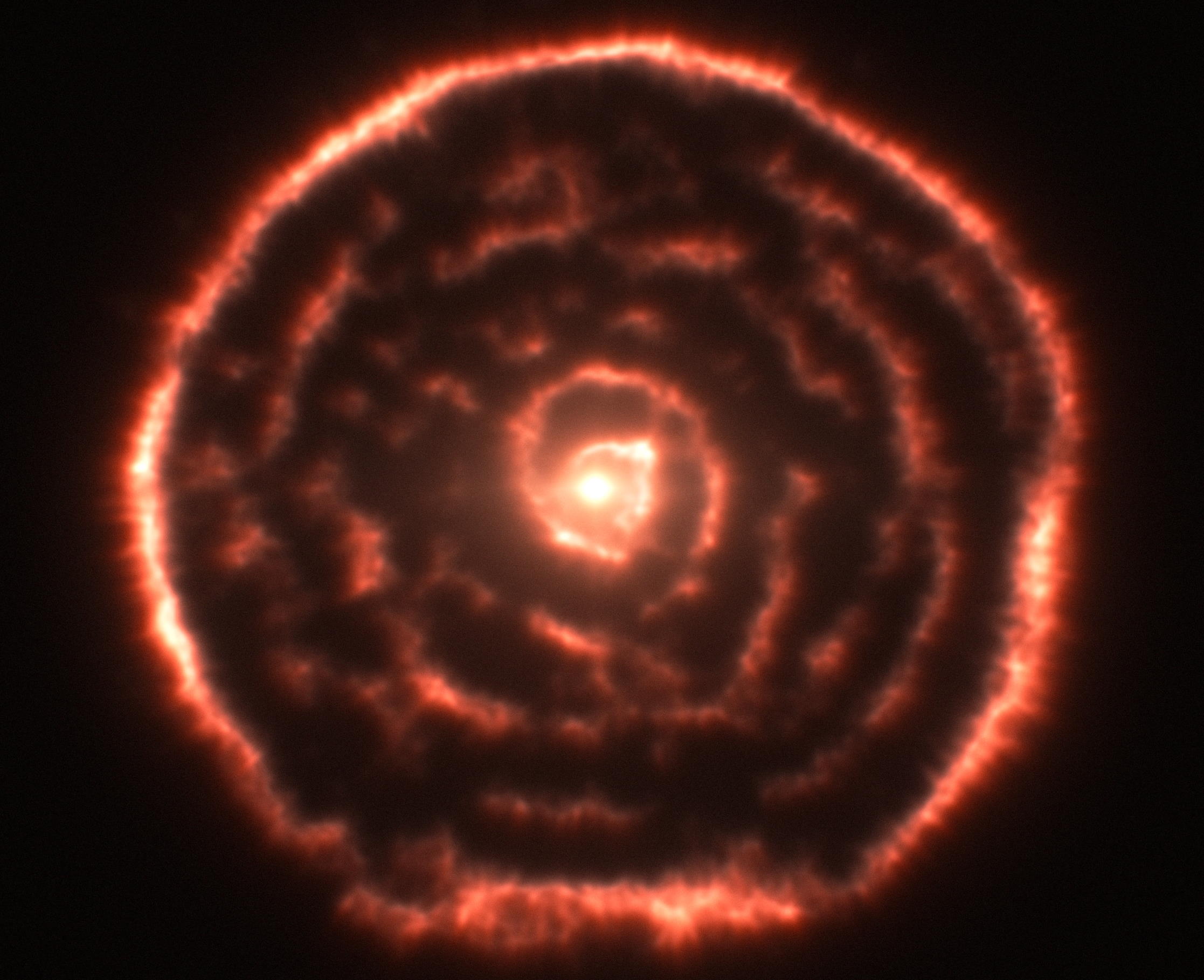 The dying red giant star, R Sculptoris, exhibits a very unusual set of ejecta when viewed in millimeter and submillimeter wavelengths: revealing a spiral structure. This is thought to be due to the presence of a binary companion: something our own Sun lacks but that approximately half of the stars in the universe possess. Stars lose approximately half of their mass — some more, and some less — as they evolve through the red giant and AGB phases and into an eventual planetary nebula/white dwarf combination.
Credit: ALMA (ESO/NAOJ/NRAO)/M. Maercker et al.
The dying red giant star, R Sculptoris, exhibits a very unusual set of ejecta when viewed in millimeter and submillimeter wavelengths: revealing a spiral structure. This is thought to be due to the presence of a binary companion: something our own Sun lacks but that approximately half of the stars in the universe possess. Stars lose approximately half of their mass — some more, and some less — as they evolve through the red giant and AGB phases and into an eventual planetary nebula/white dwarf combination.
Credit: ALMA (ESO/NAOJ/NRAO)/M. Maercker et al.
It’s kind of remarkable, when you think about it, that we can infer so much from just a few images of a dying star in a very short-lived evolutionary phase. But that’s exactly what we’re capable of doing for one main reason: astrophysics is a mature, well-developed scientific field, and the lessons we learn from the full suite of objects we’ve observed can be applied to systems, under the right conditions, that are quite different in detail.
The “concentric ring” features seen are a giveaway of a binary companion. The temperatures we see tell us that this star has only finished the AGB phase (and entered the post-AGB phase) very recently. The dusty ejecta, however, can be best studied in young systems like this. In more mature planetary nebulae — or even in preplanetary nebulae that are closer to the end of their preplanetary stage (with hotter stars powering them) — the ejection process has been muddied by a thousand years or more of earlier ejecta being overtaken by faster-moving, more recent ejecta.
But in the case of the Egg Nebula, the youngest known preplanetary nebula, we’re seeing the earliest stages of dust ejection coming from a post-AGB star even seen in the history of astronomy.
 This image of the Egg Nebula from the Hubble Space Telescope, the newest and most comprehensive one ever assembled, showcases freshly ejected stardust from a post-AGB star that’s then illuminated by a contracting central star whose light pokes out from a dense cloud of dust. Only Hubble has the right resolution, perspective, and wavelength range to reveal these features.
Credit: NASA, ESA, Bruce Balick (UWashington)
This image of the Egg Nebula from the Hubble Space Telescope, the newest and most comprehensive one ever assembled, showcases freshly ejected stardust from a post-AGB star that’s then illuminated by a contracting central star whose light pokes out from a dense cloud of dust. Only Hubble has the right resolution, perspective, and wavelength range to reveal these features.
Credit: NASA, ESA, Bruce Balick (UWashington)
Among all the telescopes that we have, only Hubble:
- is located in space, where atmospheric absorption doesn’t exist,
- can fit a large enough number of wavelengths across its primary mirror to view the intrinsic features of the nebula this sharply,
- and has the right range of wavelength sensitivities to reveal the features shown here.
They paint a picture where thousands of years of ejecta, still moving away from the central star at speeds of around 18 km/s, are propagating outward. More recently, there’s a high-velocity wind inside of that older AGB wind: ejecta moving at more like 100 km/s. There’s a dusty cloud surrounding the central, contracting star, and that cloud is strongly suspected to be disk-like, with outflows and gaps in the dust in the two directions perpendicular to the disk. Based on the size of the bright outflows and the speed at which they’re moving, it’s plausible that it’s only been a few centuries, perhaps as little as about 400 years, since the star V1610 Cygni left the AGB phase and entered the preplanetary nebula phase.
Interestingly, the star V1610 Cygni has been viewed very well, and nearly continuously, over the past 30 years or so. What those who’ve observed it have noted shows a small but significant amount of variability, with a gradual increase in overall brightness occurring since the mid-1990s as well.
 This light-curve for the star V1610 Cygni, the star powering the preplanetary nebula known as the Egg Nebula, shows a star that slightly varies in brightness over time, with intrinsic variations of around 0.1 visual magnitudes, but also shows a star that’s gradually increasing in brightness over decadal timescales.
Credit: PopePompus/Wikimedia Commons; Data: B.J. Hrivnak et al., Astrophysical Journal, 2010
This light-curve for the star V1610 Cygni, the star powering the preplanetary nebula known as the Egg Nebula, shows a star that slightly varies in brightness over time, with intrinsic variations of around 0.1 visual magnitudes, but also shows a star that’s gradually increasing in brightness over decadal timescales.
Credit: PopePompus/Wikimedia Commons; Data: B.J. Hrivnak et al., Astrophysical Journal, 2010
The variability is expected; there’s a dusty environment and the dust distribution is constantly changing. Therefore, it shouldn’t be a surprise that the brightness can increase or decrease by a few hundredths of an astronomical magnitude even over a short period of time.
What is, perhaps, a surprise is seeing a long-term trend, particularly apparent on decadal timescales, that tends toward a brighter (more negative) visual magnitude. This is precisely what you’d expect for a:
- giant, post-AGB star,
- that’s contracting,
- because contraction is an adiabatic process that traps heat,
- meaning that as your star’s volume decreases, the temperature goes up,
- and so, over the next few centuries and millennia, we can expect the star’s temperature to rise and its spectral class to change: from F to A to B, and possibly even to hotter temperatures after that.
Whereas the Egg Nebula is powered by a mere “F5” star, or a star whose temperature at the edge of the photosphere is only a few hundred K hotter than the photosphere of the Sun, a G2 star, the Westbrook Nebula, a later-stage preplanetary nebula where ionization is just beginning to occur, is powered by a B0 star, or a star that’s several thousands of degrees hotter than our Sun is.
And, at last, with the latest Hubble imagery, our best model for the central dust has been validated: it looks like there really is not only a central dust “cloud,” but that cloud has a disk-like configuration, with gaps in the disk allowing starlight to poke out in rays, just as sunbeams poke through clouds under the right weather conditions here on Earth.
 This zoomed-in view shows the central disk, now confirmed to be a disk, that surrounds the star powering the Egg Nebula. The ejecta seen in circular patterns primarily arose from the AGB phase, whereas the bipolar streams of matter move faster and were generated more recently in a still-ongoing process. The two “twin searchlight” features seen emanating out of either side of this disk arise from gaps in the dusty disk, allowing the light from the star V1610 Cygni to shine through.
Credit: NASA, ESA, Bruce Balick (UWashington)
This zoomed-in view shows the central disk, now confirmed to be a disk, that surrounds the star powering the Egg Nebula. The ejecta seen in circular patterns primarily arose from the AGB phase, whereas the bipolar streams of matter move faster and were generated more recently in a still-ongoing process. The two “twin searchlight” features seen emanating out of either side of this disk arise from gaps in the dusty disk, allowing the light from the star V1610 Cygni to shine through.
Credit: NASA, ESA, Bruce Balick (UWashington)
It’s true that someday, the Sun will die. It will become a red giant, begin fusing helium in its core, run out of helium and transition into an AGB star, and when helium shell fusion ceases, it will begin to pulse, igniting helium shell fusion with those pulses, and causing the regular, slow ejection of material. Then, in the post-AGB phase, the once-giant Sun will contract and heat up, illuminating the ejecta and forming a preplanetary nebula, before heating so significantly that it ionizes the ejecta, creating a true planetary nebula. The stellar remnant will contract to form a white dwarf, and while the planetary nebula will fade after perhaps 20,000 years, the white dwarf will continue to shine for many trillions of years before fading out.
But no, none of the preplanetary nebulae that are known, including the spectacular Egg Nebula, are representative of what the Sun’s final stages will look like. The Sun is a singlet star, and so the:
- shell-like structure of the ejecta seen in the Egg Nebula,
- bipolar structure that the Egg Nebula exhibits, and
- dusty disk that allows for searchlight-like rays to emerge from the Egg Nebula’s center,
are features that all indicate “this is a binary system,” and that won’t apply to our Sun. We will most likely turn into a more spherical, fainter nebula, first a preplanetary nebula and then full-on planetary nebula, when our parent star’s time as a living star expires. It’s amazing that, after all these years, Hubble can still conduct world-class science, unmatched by any other observatory. We now have the data to fully 3D model the Egg Nebula, and while it’s the most informative preplanetary nebula in astronomical history, it’s the differences from our own Solar System, not the similarities, that hold perhaps the greatest lessons for our far future.
Ethan SiegelTheoretical astrophysicist and science writer
Full Profile
Related Content
Starts With A BangAsk Ethan: How long can the longest-lived star shine?
13.8 billion years have passed since the Big Bang, but many stars will survive for longer than that. What's the longest-lived a star can be?
by Ethan Siegel Starts With A Bang
8 ways that Venus is the Solar System’s most extreme planet
Even at its faintest, Venus always outshines every other star and planet that's visible from Earth, and then some!
by Ethan Siegel Starts With A Bang
Cosmic dust: “too much, too soon” no longer!
Even the youngest galaxies are often dust-rich, even with very low levels of heavy elements. Nearby dwarf galaxy Sextans A explains why.
by Ethan Siegel Starts With A Bang
Supermassive black holes came before stars in ancient galaxies
Such massive, early supermassive black holes have puzzled astronomers for decades. At last, we've finally figured out how they form.
by Ethan Siegel Learn from the world's biggest thinkers.
-
Videos
- Latest
- The Big Think Interview
-
Columns
- Mini Philosophy
- Starts with a Bang
- Big Think Books
- The Long Game
- Strange Maps
- 13.8
- The Well
-
Sections
- Philosophy
- Mind & Behavior
- Science & Tech
- Business
- History & Society
-
Classes
- Class Library
-
Subscribe
- Membership
- Free Newsletters
-
About
- Our Mission
- Work with Us
- Contact
- Privacy Policy
- Terms of Sale
- Accessibility
- Careers