- Search What are you curious about? Popular SearchesCritical thinkingPhilosophyEmotional IntelligenceFree Will Latest Videos Latest Articles
-
Topics
Philosophy
- Ethics
- Religion
- Flourishing
- Knowledge
- Philosophy of Science
- Philosophy of Art
- Language
- Political Theory
- Identity
- Meaning & Purpose
Science & Tech
- Physics
- Biology
- Aerospace
- Health
- Geology
- Computing
- Engineering
- Energy
- Biotechnology
- Astronomy
Mind & Behavior
- Psychology
- Neuroscience
- Decision-Making
- Mental Health
- Consciousness
- Emotional Intelligence
- Personality
- Relationships
- Parenting
Business
- Entrepreneurship
- Leadership
- Finance
- Marketing
- Innovation
- Strategy
- Management
- Artificial Intelligence
- Startups
- Economics
History & Society
- History
- Literature
- Art
- Music
- Film
- Progress
- Culture
- Sociology
- Policy
- Geopolitics
- Latest
-
Videos
Latest Videos
 The block universe: a theory where every moment already exists
with
Jim Al-Khalili
The block universe: a theory where every moment already exists
with
Jim Al-Khalili
 Why alien civilizations may bloom and die unseen
with
Brian Cox
Why alien civilizations may bloom and die unseen
with
Brian Cox
 A look into the mind of someone without empathy
with
Abigail Marsh
A look into the mind of someone without empathy
with
Abigail Marsh
 How experimental archaeologists are resurrecting our forgotten past
with
Sam Kean
How experimental archaeologists are resurrecting our forgotten past
with
Sam Kean
 We’ve been looking for life. Here’s why we should look for intelligence instead
with
Sara Seager
We’ve been looking for life. Here’s why we should look for intelligence instead
with
Sara Seager
 The tiny transistors remaking our global order
with
Chris Miller
See All
The tiny transistors remaking our global order
with
Chris Miller
See All
-
Columns
 Mini Philosophy
A philosophy column for personal reflection.
Mini Philosophy
A philosophy column for personal reflection.
 Starts With A Bang
An astrophysics column on big questions and our universe.
Starts With A Bang
An astrophysics column on big questions and our universe.
 Books
A literature column to feed your curiosity.
Books
A literature column to feed your curiosity.
 The Long Game
A business column on long-term thinking.
The Long Game
A business column on long-term thinking.
 Strange Maps
A geography column on history and society.
Strange Maps
A geography column on history and society.
 The Well
A collection of essays and videos on life’s biggest questions.
The Well
A collection of essays and videos on life’s biggest questions.
 13.8
A column at the intersection of science and culture.
13.8
A column at the intersection of science and culture.
-
Classes
Featured Classes
 Members
8 videos
Cultivating the Conditions for Innovation
Martin Gonzalez
Members
8 videos
Cultivating the Conditions for Innovation
Martin Gonzalez
 Members
5 videos
The Humanity of Leadership
Simon Sinek
Ethnographer and author
Members
5 videos
The Humanity of Leadership
Simon Sinek
Ethnographer and author
 Members
7 videos
How to Lead With Integrity
Steve Stoute
Founder and CEO, UnitedMasters and Translation
Members
7 videos
How to Lead With Integrity
Steve Stoute
Founder and CEO, UnitedMasters and Translation
 Members
6 videos
Transform Your Organization with AI
Daphne Koller
Founder and CEO of insitro.
Members
6 videos
Transform Your Organization with AI
Daphne Koller
Founder and CEO of insitro.
 Members
10 videos
Unlocking Your Team’s Hidden Potential
Adam Grant
Organizational psychologist and author
Members
10 videos
Unlocking Your Team’s Hidden Potential
Adam Grant
Organizational psychologist and author
 Members
6 videos
The Secrets of Unreasonable Hospitality
Will Guidara
Restaurateur and Author, Unreasonable Hospitality
Browse
Members
6 videos
The Secrets of Unreasonable Hospitality
Will Guidara
Restaurateur and Author, Unreasonable Hospitality
Browse
-
More
- Newsletters
- Monthly Issues
- Events
- Big Think+ Learning
- Creative Studio
- Advertise with Us
- About
- Careers
- View our Twitter (X) feed View our Youtube channel View our Instagram feed View our Substack feed
-
My account
- My Classes
- My Account
- My List
- BT+ for my Business
- Early Releases
- Sign Out
- Membership
- Latest
-
Topics
Back
Philosophy
Science & Tech
Mind & Behavior
Business
History & Society
-
Videos
Back
Latest Videos
The block universe: a theory where every moment already exists
Theoretical physicist Jim Al-Khalili explores why our sense of time may be incredibly misleading, including the idea that past, present,...
Why alien civilizations may bloom and die unseen
Brian Cox examines why, despite billions of stars and trillions of planets, we have found no evidence of other intelligent...
A look into the mind of someone without empathy
Abigail Marsh unpacks what defines psychopathy, how it differs from antisocial behavior, and why terms like “sociopath” only add confusion.
How experimental archaeologists are resurrecting our forgotten past
Sam Kean examines how rogue archaeologists are recreating the sounds, tastes, smells, and practices of the ancient past.
We’ve been looking for life. Here’s why we should look for intelligence instead
Thanks to modern tech, Earth is now considered a ‘detectable’ planet. Astrophysicist Sara Seager explains how this idea can lead...
The tiny transistors remaking our global order
"The production of the silicon wafers that are used in the chip manufacturing process requires extraordinary levels of purity."
 The biological necessity of boredom in the age of screens
"I call it a tyranny of attention because there's so many demands on our attention coming from so many different...
The biological necessity of boredom in the age of screens
"I call it a tyranny of attention because there's so many demands on our attention coming from so many different...
 Why relationships in 2026 carry impossible expectations
Now that love has been liberated, it seems to have become more complicated and more illusive than ever. Alain de...
Why relationships in 2026 carry impossible expectations
Now that love has been liberated, it seems to have become more complicated and more illusive than ever. Alain de...
-
Columns
Back
Columns
Mini Philosophy
A philosophy column for personal reflection.
Starts With A Bang
An astrophysics column on big questions and our universe.
Books
A literature column to feed your curiosity.
The Long Game
A business column on long-term thinking.
Strange Maps
A geography column on history and society.
The Well
A collection of essays and videos on life’s biggest questions.
13.8
A column at the intersection of science and culture.
-
Classes
Back
Featured Classes
Members
8 videos
Cultivating the Conditions for Innovation
Martin Gonzalez
Members
5 videos
The Humanity of Leadership
Simon Sinek
Ethnographer and author
Members
7 videos
How to Lead With Integrity
Steve Stoute
Founder and CEO, UnitedMasters and Translation
Members
6 videos
Transform Your Organization with AI
Daphne Koller
Founder and CEO of insitro.
Members
10 videos
Unlocking Your Team’s Hidden Potential
Adam Grant
Organizational psychologist and author
Members
6 videos
The Secrets of Unreasonable Hospitality
Will Guidara
Restaurateur and Author, Unreasonable Hospitality
- My Account Back
- Sign In
- Membership
- More Back
No civilization, no matter how successful, can last forever. What does the non-detection of intelligent aliens mean for our own longevity?
by Ethan Siegel March 4, 2026 While we've long envisioned and dreamed of a sustained human presence not only in space, but extending our civilization to other worlds and even other star systems or galaxies, the sobering fact remains that we don't even know if there's anyone else out there to "talk to" or visit. No detection of life originating from beyond Earth has ever been achieved yet, rendering all estimates of life's abundance mere guesswork in the face of a lack of evidence. In all the Universe, we must consider that it really may be just us.
Credit: NASA/Alan Chinchar
Key Takeaways- Put forth more than 60 years ago, the Drake equation was humanity’s first scientific attempt to estimate the number of intelligent civilizations that exist to communicate with in our Universe.
- Although much has changed in physics and astronomy since the 1960s, the core concept remains intact, with one of the largest unknowns being the longevity of the average intelligent civilization.
- Using our lack of such detections so far, a recent paper has constrained the mean lifetime of intelligent technological civilizations to under 5000 years. What does that mean for humanity?

An astrophysics column on big questions and our universe.
Get our free newsletter on Substack-
Science and TechHistory and SocietyAstronomySpace ExplorationAstrobiology
One of the great mysteries in the Universe is that, in all the vastness of space, we have yet to detect any sort of life out there beyond our own planet. Whether microbial and simple, multicellular and complex, highly differentiated and intelligent, or technologically advanced, the only form of life we know of here in 2026 is terrestrial life that originated right here on Earth. Despite all of the discoveries and advances that we’ve made in recent years, from the origins and scale of the Universe to thousands of confirmed exoplanets, we still have yet to detect even a single robust signature of a lifeform that originated from anywhere else.
All we can do, at the present time, is to make the best use of the knowledge that we have. Because of all that we’ve learned about our galaxy and Universe, the history of stars and heavy elements, the properties and commonness of exoplanets, we can make very high-quality estimates about the abundance of potentially habitable planets. However, how many of them actually come to be inhabited remains a great unknown, with deeper questions — like how many of them turn into technologically advanced civilizations — requiring us to estimate further unknowns atop them.
Our first attempt at pursuing this logical path was the Drake Equation, which had, as its final term, the lifetime of an average intelligent, technologically advanced civilization. A recent paper has just constrained that lifetime, and concluded that it’s under 5000 years under the most optimistic scenario. With human civilization still struggling to find our way through our technological infancy, does this new study actually predict humanity’s demise? Here’s what we can justifiably say about it on the grounds of scientific merit.
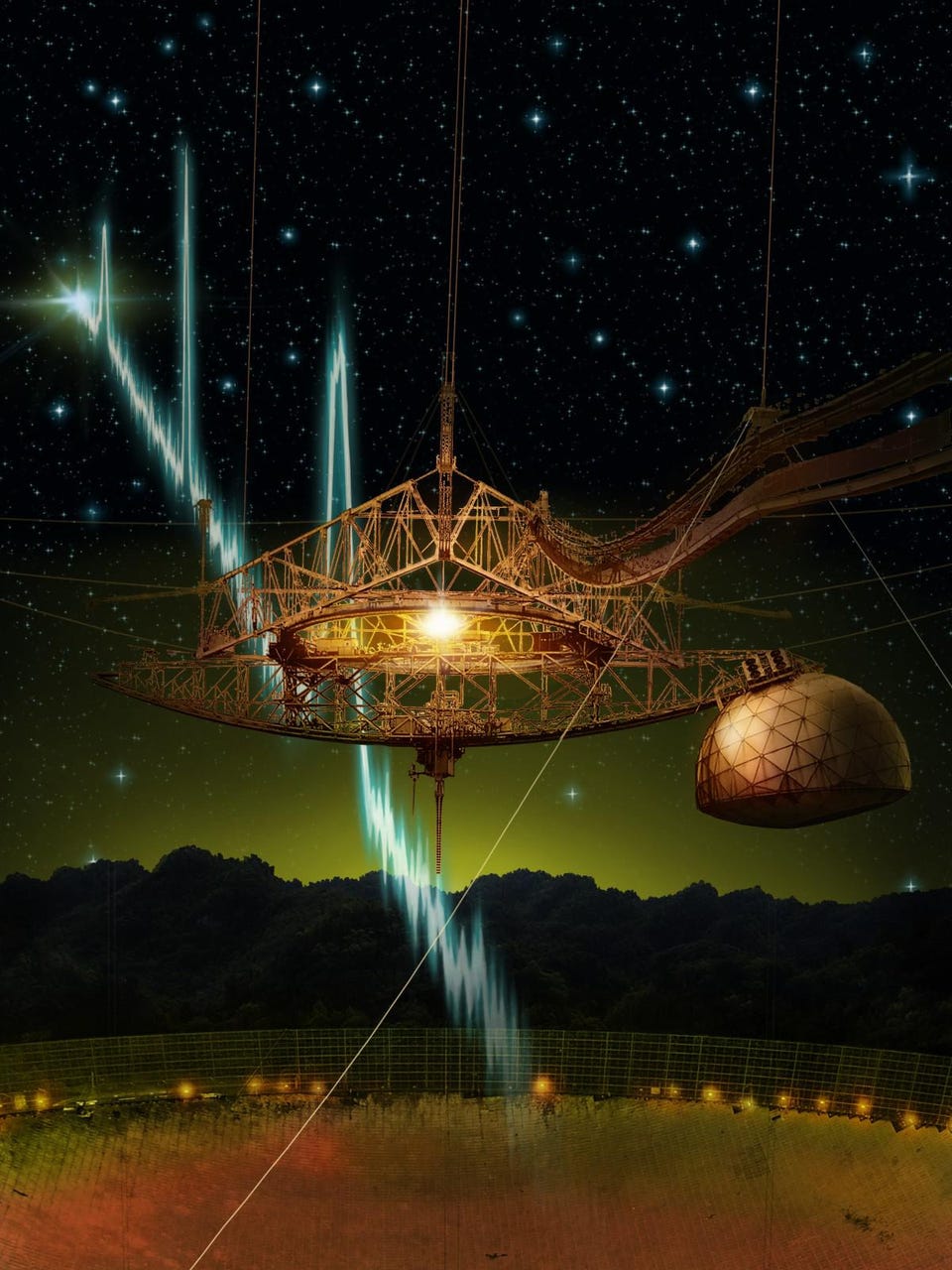 Before its collapse in 2020, the Arecibo telescope was the first to see multiple fast radio bursts from the same source. Although they are not a signal of intelligent alien origin, the telescope has been used to set many of the strictest limits on the existence of transmitting alien civilizations, as well as having been used to transmit messages from humanity out into the Universe. Leveraging radio telescopes remains perhaps the most powerful tool for searching for extraterrestrial intelligence.
Credit: Danielle Futselaar
Before its collapse in 2020, the Arecibo telescope was the first to see multiple fast radio bursts from the same source. Although they are not a signal of intelligent alien origin, the telescope has been used to set many of the strictest limits on the existence of transmitting alien civilizations, as well as having been used to transmit messages from humanity out into the Universe. Leveraging radio telescopes remains perhaps the most powerful tool for searching for extraterrestrial intelligence.
Credit: Danielle Futselaar
Here on Earth, we recognize that something remarkable happened. Billions of years ago, much closer to the moment of our planet’s formation than to the present day, life on our planet began. Although many of the details remain elusive, we are confident that there were life forms surviving, metabolizing nutrients for energy, and reproducing at least 3.8 billion years ago. By a little over half a billion years ago, some forms of life had become multicellular, had evolved sexual reproduction, and had also become large, complex, and highly differentiated. Intelligent, tool-using species — including our direct ancestors — have been around for millions of years. Finally, humans have become technologically advanced over the past few thousand years, entering the space age in the mid-20th century.
We also know that there’s an enormous Universe out there, full of stars and galaxies as far as we can see: stretching across billions and billions of light-years. Every one of those stars, and there are hundreds of billions of stars in the Milky Way alone, represents what we might call a “chance.” A chance at having planets. A chance of some of those planets being rocky. A chance for some of those rocky planets to be at the right distance from their star to potentially have liquid water on their surface. A chance for those rocky, water-rich planets to give rise to life. A chance for that life to survive, thrive, and become complex and differentiated, intelligent, or even technologically advanced.
It was by thinking about applying what happened in our Solar System, right here on Earth, to the rest of the stars and star systems in the Universe that led Frank Drake to put forth the Drake equation: the equation that birthed SETI, the search for extraterrestrial intelligence.
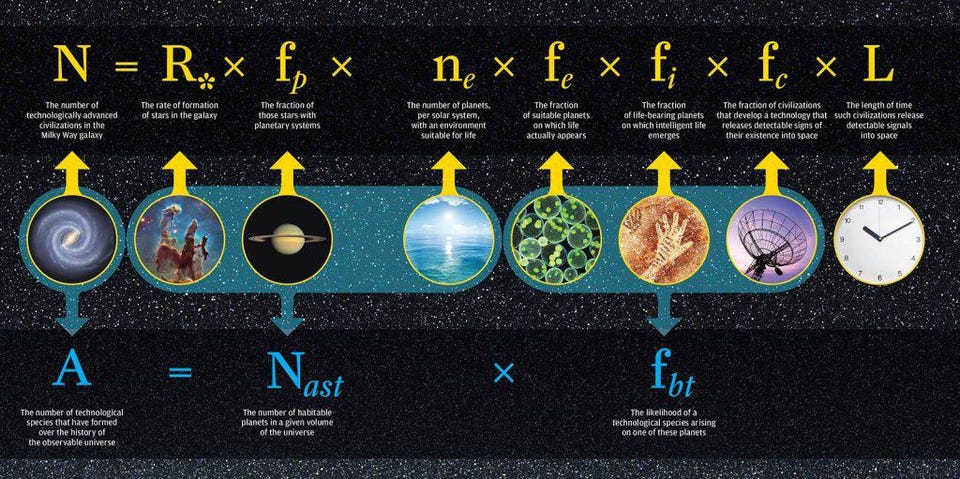 The Drake equation is one way to arrive at an estimate of the number of spacefaring, technologically advanced civilizations in the galaxy or Universe today. However, it relies on a number of assumptions that are not necessarily very good, and contains many unknowns that we lack the necessary information to provide meaningful estimates for.
Credit: University of Rochester
The Drake equation is one way to arrive at an estimate of the number of spacefaring, technologically advanced civilizations in the galaxy or Universe today. However, it relies on a number of assumptions that are not necessarily very good, and contains many unknowns that we lack the necessary information to provide meaningful estimates for.
Credit: University of Rochester
Above, you can see the Drake equation as it appeared in its original form. The specific terms themselves are not necessarily of particular importance, what’s important is the concepts behind those terms. Back when Drake proposed his equation, in 1961, we hadn’t yet discovered the cosmic microwave background: the critical piece of evidence that led to our modern picture of the hot Big Bang. We thought there were an estimated 1018 stars in the observable Universe: a number that’s too small by a factor of thousands. And we thought that we could “educated guess” our way to a reasonable estimate for the number of communicable civilizations out there right now, a perhaps hubristic proposition given the vastness of our ignorance.
What’s still useful about the Drake equation, however, is the following.
- We can use what we know today about stars, stellar populations, and galaxies to detail the number of stars and star systems within a certain distance of us.
- We can use what we know today about stars, metallicity, and exoplanets to estimate the number of stars that have planets.
- We can further use our exoplanet statistics to estimate the fraction of planets that are potentially habitable: planets with the right conditions and raw ingredients for chemical-based life to emerge.
That’s a huge advance over where science was back when the Drake equation was first proposed, and is worth detailing just a little bit before we move on to the latter terms.
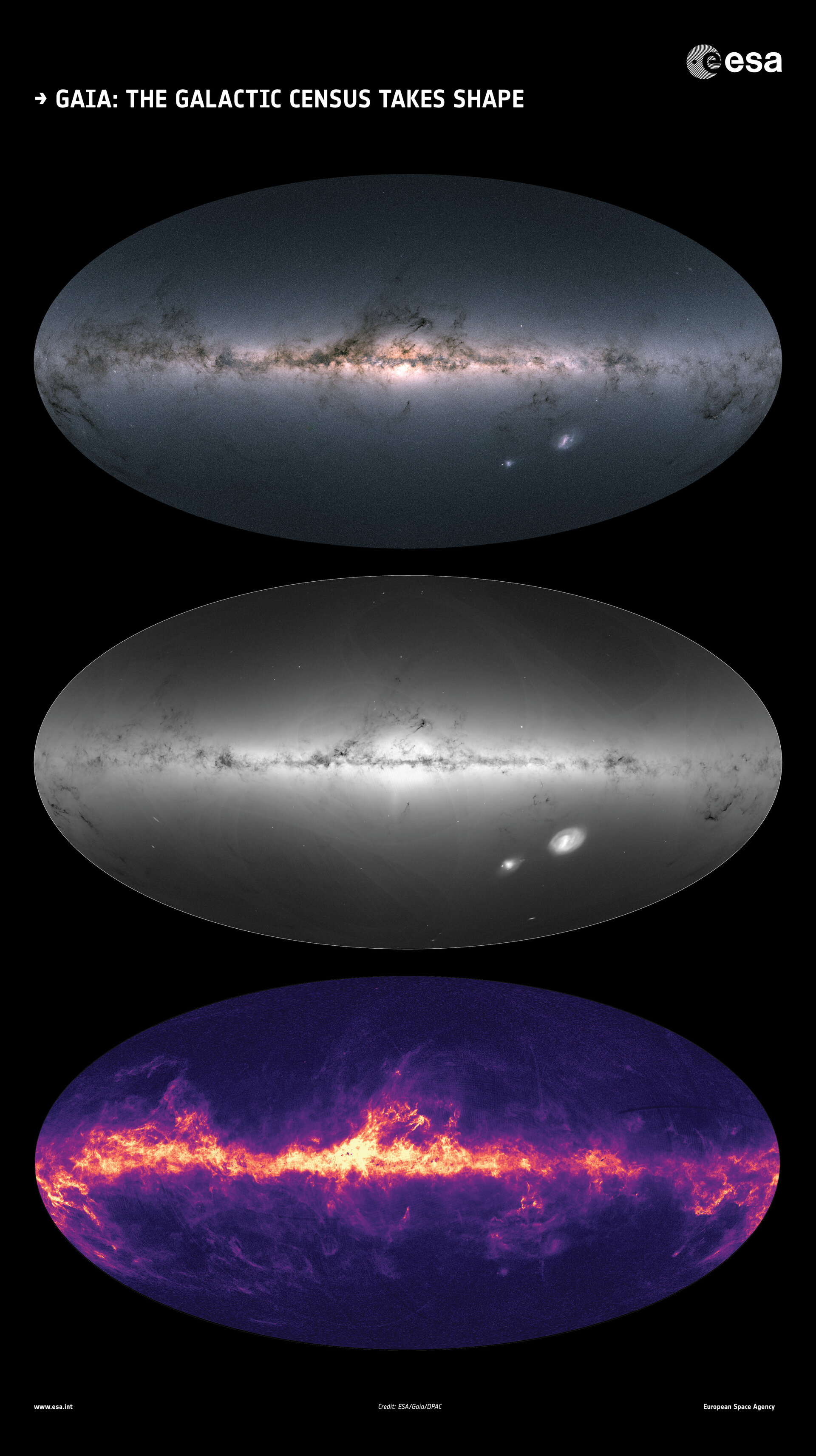 Gaia’s all-sky view of our Milky Way Galaxy and neighboring galaxies. The maps show the total brightness and color of stars (top), the total density of stars (middle), and the interstellar dust that fills the galaxy (bottom). Note how, on average, there are approximately ~10 million stars in each square degree, but that some regions, like the galactic plane or the galactic center, have stellar densities well above the overall average.
Credit: ESA/Gaia/DPAC
Gaia’s all-sky view of our Milky Way Galaxy and neighboring galaxies. The maps show the total brightness and color of stars (top), the total density of stars (middle), and the interstellar dust that fills the galaxy (bottom). Note how, on average, there are approximately ~10 million stars in each square degree, but that some regions, like the galactic plane or the galactic center, have stellar densities well above the overall average.
Credit: ESA/Gaia/DPAC
We used to estimate the number of stars in our galaxy in a simple fashion: by measuring the nearby stars we can see, measuring the rough size of the Milky Way, and then estimating the stellar density at various distances from the galactic center. Then, we could estimate the total number of stars in the Milky Way. The big problem with that is that it’s the brightest, rarest stars of all that are most easily visible, and the smallest, faintest, most common stars that are the hardest to detect. Over the past 30 years, we’ve discovered that the vast majority of stars in the Universe, perhaps 75-80%, are the small and faint red dwarfs. With observatories like Gaia, we’ve tracked the 3D positions of over a billion stars within the Milky Way. And overall, we now believe there are around 400 billion stars within the Milky Way, although some older astronomers still prefer a smaller estimate of around 200 billion. That’s a huge reduction in uncertainty!
From exoplanet studies, particularly with Kepler and TESS, we know that whether a star has planets or not is highly dependent on the metallicity — or heavy element content — of the star system itself. If you have more than 25% the amount of heavy elements that the Sun has, you’re almost guaranteed to have planets. If you have fewer than 10%, you almost certainly don’t have planets. Fortunately, about 80-90% of the stars we now see are enriched enough to have planets.
And finally, for most of the Sun-like stars, including the K-class, G-class, and F-class stars (but not the lowest-mass red dwarfs or the short-lived blue giants), there are often rocky worlds found at the right distance from their star that, if those worlds had Earth-like atmospheres, they could have liquid water on their surfaces.
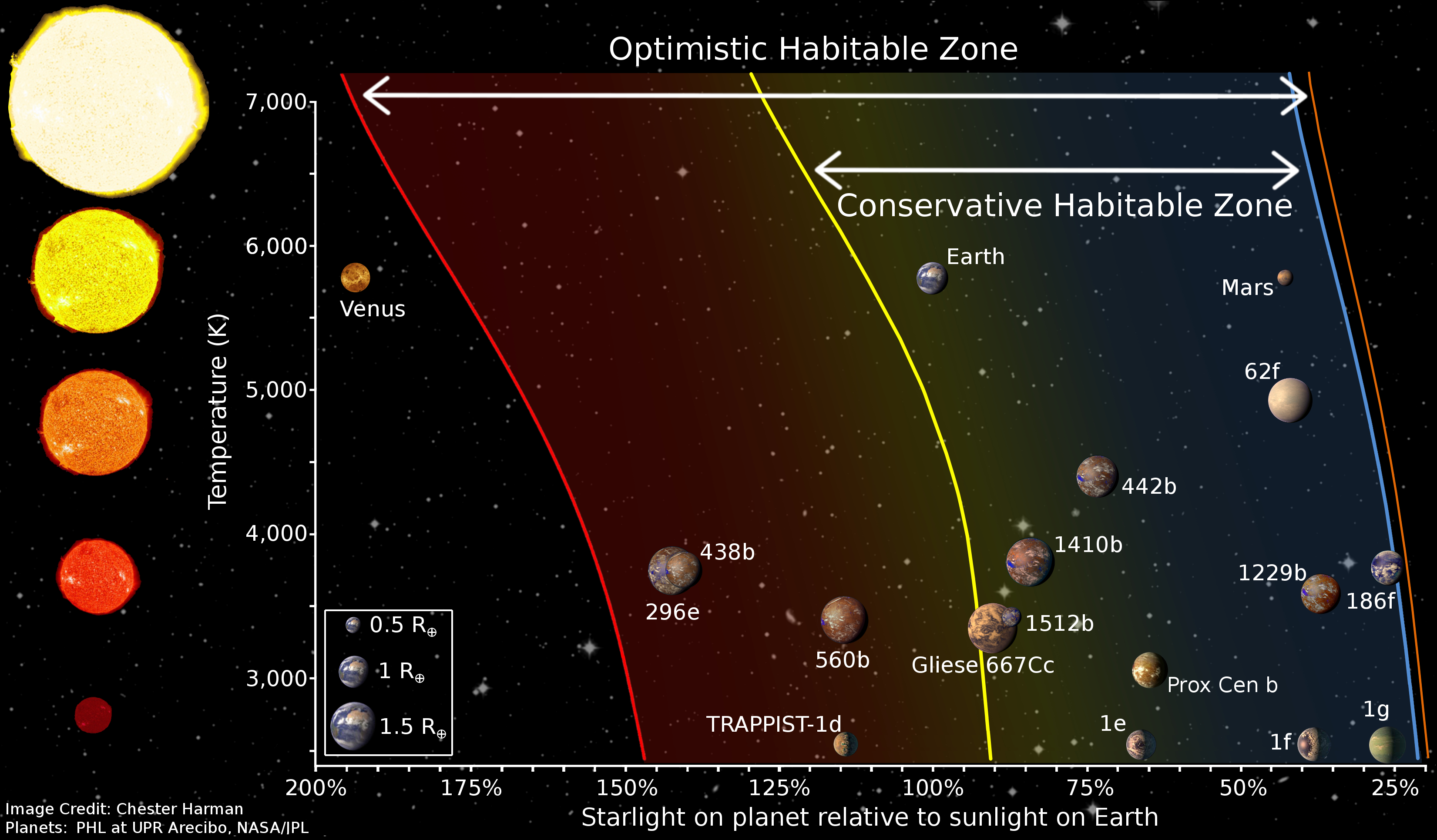 Our notion of a habitable zone is defined by the propensity of an Earth-sized planet with an Earth-like atmosphere at that particular distance from its parent star to have the capacity for liquid water, without a cover of ice, on its surface. Although this describes the conditions that Earth possesses, it is unknown whether this is a requirement, or even a preference, of life. Many worlds assumed to be good candidates for life will likely be uninhabited; others not presently considered will likely surprise us down the line.
Credit: Chester Harman; NASA/JPL, PHL at UPR Arecibo
Our notion of a habitable zone is defined by the propensity of an Earth-sized planet with an Earth-like atmosphere at that particular distance from its parent star to have the capacity for liquid water, without a cover of ice, on its surface. Although this describes the conditions that Earth possesses, it is unknown whether this is a requirement, or even a preference, of life. Many worlds assumed to be good candidates for life will likely be uninhabited; others not presently considered will likely surprise us down the line.
Credit: Chester Harman; NASA/JPL, PHL at UPR Arecibo
Overall, that has led to estimates that there are very likely between 300 million and 10 billion rocky exoplanets that are potentially habitable, and that’s within the Milky Way alone. However, what we still don’t know is profound, and there are terms reflecting that ignorance that are still relevant from Drake’s original equation. Those topics include:
- the fraction of planets deemed “potentially habitable” on which life actually appears,
- the fraction of those planets where intelligent life, at some point in that planet’s history, emerges,
- the fraction of planets with intelligent life where interstellar communication is developed,
- and lastly, the length of time that such civilizations emit potentially detectable signals into space before those signals cease and/or that civilization collapses.
Back in 1961, when this equation was first written down, the estimates were wildly optimistic. Drake and his colleagues assumed, and remember this is with no knowledge of what the actual answers are that life emerges on 100% of potentially habitable worlds, that 100% of those inhabited worlds give rise to intelligent life, and that between 10-20% of those intelligent life-bearing planets will develop interstellar communication, and thus will be releasing signals that are potentially detectable by us: a civilization in its technological infancy, having only recently gained the ability to detect such signals.
 As of early March, 2026, there are more than 6100 confirmed exoplanets detected thus far, with over 7000 additional exoplanet candidates that are still awaiting confirmation. Although it’s easiest to detect the highest-mass planets at the shortest separation distances from their parent stars, we’ve found evidence that many Earth-sized worlds exist around stars of all types, including at distances that would place them in the “sweet spot” for liquid water to flow on their surfaces with the proper atmospheres.
Credit: NASA Exoplanet Archive
As of early March, 2026, there are more than 6100 confirmed exoplanets detected thus far, with over 7000 additional exoplanet candidates that are still awaiting confirmation. Although it’s easiest to detect the highest-mass planets at the shortest separation distances from their parent stars, we’ve found evidence that many Earth-sized worlds exist around stars of all types, including at distances that would place them in the “sweet spot” for liquid water to flow on their surfaces with the proper atmospheres.
Credit: NASA Exoplanet Archive
The final term in the equation, however, is of paramount importance. Without it, we would be making an implicit set of assumptions:
- that all stars that have potentially habitable planets will have already evolved intelligent life on them,
- that a fraction of those planets will have developed interstellar communication,
- and then that those broadcasts, once they begin, will continue forever.
However, that is very clearly not the case. For the first 4.5 billion years of planet Earth’s history — and remember, it’s been a “potentially habitable” planet this whole time — we didn’t have interstellar communication capabilities.
Above and beyond that, the path to continuing to broadcast interstellar signals indefinitely is fraught with uncertainty: we will have to survive and thrive as a species, and as a collective civilization, if we want to continue those broadcasts. That’s why the last term in the Drake equation, simply parameterized as L, is so important: the longevity, or lifetime, over which an intelligent, technologically advanced civilization continues to make those broadcasts. After all, humanity has only been around for a few hundred thousand years, and with each year that passes, there’s a small but non-zero chance that some event, whether internal or external, will drive our species, and our civilization, to extinction.
 Although Earth contains the most liquid water on its surface of any of the 8 planets in our Solar System, the most water in any form is found on Jupiter’s moon Ganymede. Next in order is Saturn’s Titan, Jupiter’s Callisto, and Jupiter’s Europa. Planet Earth has only the 5th most water, placing it ahead of Pluto, Dione, Triton, and Enceladus, which land in 6th through 9th place in the Solar System, respectively. Other, more poorly explored Kuiper belt objects, such as Eris, may yet deserve a place on this list as well.
Credit: NASA
Although Earth contains the most liquid water on its surface of any of the 8 planets in our Solar System, the most water in any form is found on Jupiter’s moon Ganymede. Next in order is Saturn’s Titan, Jupiter’s Callisto, and Jupiter’s Europa. Planet Earth has only the 5th most water, placing it ahead of Pluto, Dione, Triton, and Enceladus, which land in 6th through 9th place in the Solar System, respectively. Other, more poorly explored Kuiper belt objects, such as Eris, may yet deserve a place on this list as well.
Credit: NASA
Our ignorance on those fronts is profound, of course. We’ve hoped to find signatures of life on a variety of worlds in our Solar System: Venus, Mars, Jovian moons like Europa and Ganymede, Saturnian moons like Titan and Enceladus, Neptune’s moon Triton, and Pluto, among others. While we certainly have a lot of exploring left to do, no robust, reproducible biosignatures have ever been spotted: just flimsy candidate “hints” where non-biological explanations haven’t been ruled out. We’ve just surpassed the 6100 exoplanet mark, but none of them exhibit any hitherto detected signs of life, although new and improved tools to examine them are in the pipeline. And SETI, despite decades of high-quality data and an extremely careful set of methodologies, hasn’t seen anything indicative of intelligent aliens thus far.
To recap:
- There are between 300 million and 10 billion potentially habitable planets, right now, in our Milky Way.
- We have no idea how many of those planets become inhabited, and whether life’s emergence is common, uncommon, or rare.
- Of the ones that become inhabited, we don’t know what fraction have sustained life there for a long time, much less what fraction evolves into complex, differentiated, and intelligent life forms. All we know is that, on Earth, it took billions of years for this to happen, and that it’s only in the most recent few million to tens-of-millions of years that “intelligence,” as we recognize it, has emerged here.
- Of planets where intelligent life arises, we have no idea how many of them become able to communicate across interstellar distances, or of how long (again, that pesky L from the Drake equation) they continue to transmit, on average. All we know is that we gained those capabilities in the 20th century, and we don’t know how long we’ll last.
All we can be certain of, so far, is that if there is one out there, we haven’t found or detected it yet.
 Intelligent aliens, if they exist in the galaxy or the Universe, might be detectable from a variety of signals: electromagnetic, from planet modification, or because they’re spacefaring. But we haven’t found any evidence for an inhabited alien planet so far. It’s also possible that aliens have traveled here and are watching us, and are responsible for some UAP/UFO sightings, although no credible evidence exists for it. The lack of any such detections can only lead us to place upper limits on the abundance and longevity of such civilizations, not estimates for our own civilization’s longevity.
Credit: Ryan Somma/flickr
But the specter of extinction, either from external or internal means, hovers not just over each of us, but over our whole civilization. Here in our technological infancy, we have a rapidly changing world, one rife with the potential to destroy us all.
- Given the prospect of nuclear war, humanity’s arsenal could indeed wipe out every living human on Earth from detonations and the ensuing fallout.
- With our eradication of the majority of the planet’s natural ecosystems, environmental/ecological collapse could become severe enough to wipe out most or even all of the current human population.
- As humans continue to expand, we come into contact with animal populations that we never have before, and diseases can be transmitted to us through them. Many diseases are more infectious and more lethal than COVID-19 was, and the next such pandemic could prove to be our species’ undoing.
- And finally, externally, impacts from objects passing through our inner Solar System could wipe all of humanity out, just as so much terrestrial life was eradicated 65 million years ago. Comet Swift-Tuttle, the parent body of the Perseid meteor shower, will potentially provide exactly that existential hazard in 4479; if we cannot redirect a large (~26 km) extraterrestrial body by before then, we may indeed meet our demise at that time.
All of these, plus many more scenarios, provide existential risks to our species. And, as you can imagine, once all of us go, so too will our ability to transmit signals that announce our existence.
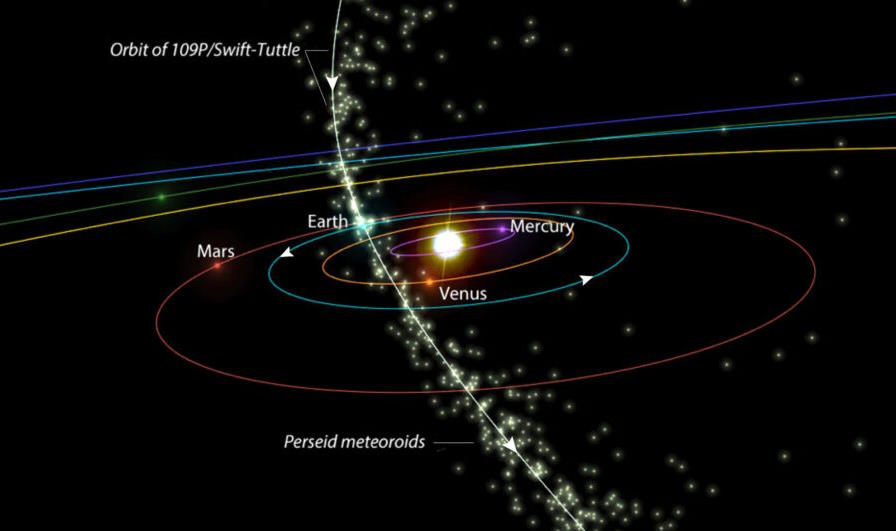 Each year, Earth passes through the debris stream of various comets, including Comet Swift-Tuttle, which creates the visual phenomenon known as the Perseid meteor shower, and that of Halley’s comet, which creates two meteor showers: the Eta Aquarids and the Orionids. Comet Swift-Tuttle remains the single most dangerous object known to humanity, as its large diameter (26 km), fast speeds, and Earth orbit-crossing nature renders many future close passes a big danger. The next major danger is in 4479, as a gravitational encounter with Jupiter may yet lead to a collision with Earth.
Credit: Ian Webster; Data: NASA / CAMS / Peter Jenniskens (SETI Institute)
Of course, there are more optimistic future scenarios for us that are still in play: where we avoid nuclear war, where we learn how to sustainably live in the natural world without destroying its ability to support us, and where we successfully adhere to the best practices for pandemic prevention, containment, and mitigation wherever possible. Asteroid and comet redirection is possible as well, as several missions have demonstrated, and perhaps a long-term future for humanity, as well as whatever humans wind up evolving into, will continue to include that information.
The question is: can we conclude anything about the mean lifetime of technologically advanced civilization, and learn anything meaningful about our own civilization’s likely future, from the non-detection of intelligent aliens thus far?
A new paper accepted in MNRAS Letters, of which a preprint is available here, the team of Sohrab Rahvar and Shahin Rouhani take that question head-on. Assuming the most optimistic scenario for the commonality of intelligent civilizations:
- where every star system with a rocky, potentially habitable planet develops life,
- where every planet that develops life winds up with an intelligent, technologically advanced civilization after ~4 billion years,
- and then those civilizations continue to transmit a detectable signal until they go extinct,
they conclude that the mean lifetime of each such civilization would have to be less than 5000 years. If the fraction of potentially habitable planets that wind up producing technologically advanced aliens is just 1%, instead, the average civilization lifetime could then be raised to 500,000 years and still be consistent with our non-detection of the presence of intelligent aliens.
 The non-detection of any intelligent, technologically advanced civilizations (blue, shaded area) rules out scenarios where intelligent alien civilizations are long-lived and abundant. If every potentially habitable world evolves a technologically advanced civilization after 4 billion years, then the average lifetime can be no more than 5000 years; if it’s 1% of such planets, then it can be no more than 500,000 years.
Credit: S. Rahvar and S. Rouhani, MNRAS Letters (accepted)/arXiv:2602.22252, 2026
The non-detection of any intelligent, technologically advanced civilizations (blue, shaded area) rules out scenarios where intelligent alien civilizations are long-lived and abundant. If every potentially habitable world evolves a technologically advanced civilization after 4 billion years, then the average lifetime can be no more than 5000 years; if it’s 1% of such planets, then it can be no more than 500,000 years.
Credit: S. Rahvar and S. Rouhani, MNRAS Letters (accepted)/arXiv:2602.22252, 2026
But that doesn’t really tell us anything about the average lifespan of “the average” technologically advanced, intelligent alien civilization. It only tells us that a more optimistic scenario than the ones considered by the authors are ruled out. If:
- life’s emergence isn’t guaranteed with the right conditions,
- and/or life’s emergence doesn’t guarantee that it will sustain itself and evolve toward intelligence and technological advancement within ~4 billion years,
then the “longevity constraints” are further relaxed. If only (or even, depending on your perspective) 1-in-a-million potentially inhabitable planets becomes as technologically advanced as we are on Earth right now, then the average civilization lifetime could be five billion years and we still wouldn’t have seen one by now.
Of course, the odds of that happening could be still lower than that; without a second example of life in the Universe, we cannot in any meaningful way quantify the number of intelligent, technologically advanced civilizations. We can only place (admittedly, rather weak) upper limits on how many there can be. As for our own civilization’s lifetime, the paper’s authors are sufficiently conservative, and even note, “We emphasize that these results should be interpreted as upper bounds derived from the Fermi paradox, not as predictions of actual lifespans.”
The only thing that we can perhaps count on is that, with no signs of anyone else to talk to, there’s no evidence that anyone is coming to save us from ourselves. It is up to us, here on Earth, to work together to solve the problems afflicting humanity today. The final term in the Drake equation, L, cannot be used to predict humanity’s demise. Instead, it’s up to us, and all of the generations of humans to come, to keep the dream of human civilization alive.
-
Science and TechHistory and SocietyAstronomySpace ExplorationAstrobiology
Theoretical astrophysicist and science writer
Full Profile Monthly Issue
February 2026
Biology’s New Era
In this monthly issue, we explore the bleeding edge of biotech, as well as the scientists, writers, and philosophers whose efforts helped get us here.
1 video
10 articles
Monthly Issue
February 2026
Biology’s New Era
In this monthly issue, we explore the bleeding edge of biotech, as well as the scientists, writers, and philosophers whose efforts helped get us here.
1 video
10 articles

Related Content
Starts With A BangNo, particle physics colliders cannot ever destroy the Universe
Smashing things together at unprecedented energies sounds dangerous. But it's nothing the Universe hasn't already seen, and survived.
by Ethan Siegel
Why alien civilizations may bloom and die unseen
Brian Cox examines why, despite billions of stars and trillions of planets, we have found no evidence of other intelligent life.
with Brian Cox 23mins
Starts With A Bang
23mins
Starts With A Bang
Record-breaking natural laser discovered 11 billion light-years away
Forget about the terawatt lasers we're making on Earth. The Universe makes natural ones thousands of times more powerful than the Sun.
by Ethan Siegel Starts With A Bang
The 5 biggest obstacles to AI data centers in space
There are plenty of engineering obstacles, and those can be overcome. But you cannot change the laws of physics, and those matter too.
by Ethan Siegel Learn from the world's biggest thinkers.
-
Videos
- Latest
- The Big Think Interview
-
Columns
- Mini Philosophy
- Starts with a Bang
- Big Think Books
- The Long Game
- Strange Maps
- 13.8
- The Well
- Rethinking Possible
-
Sections
- Philosophy
- Mind & Behavior
- Science & Tech
- Business
- History & Society
-
Classes
- Class Library
-
Subscribe
- Membership
- Free Newsletters
-
Partner
- Big Think+ Learning
- Creative Studio
- Advertise with Us
- Events
-
More
- About
- Careers
- Contact
- Privacy Policy
- Terms of Sale
- Accessibility