- Animals
- Land Mammals
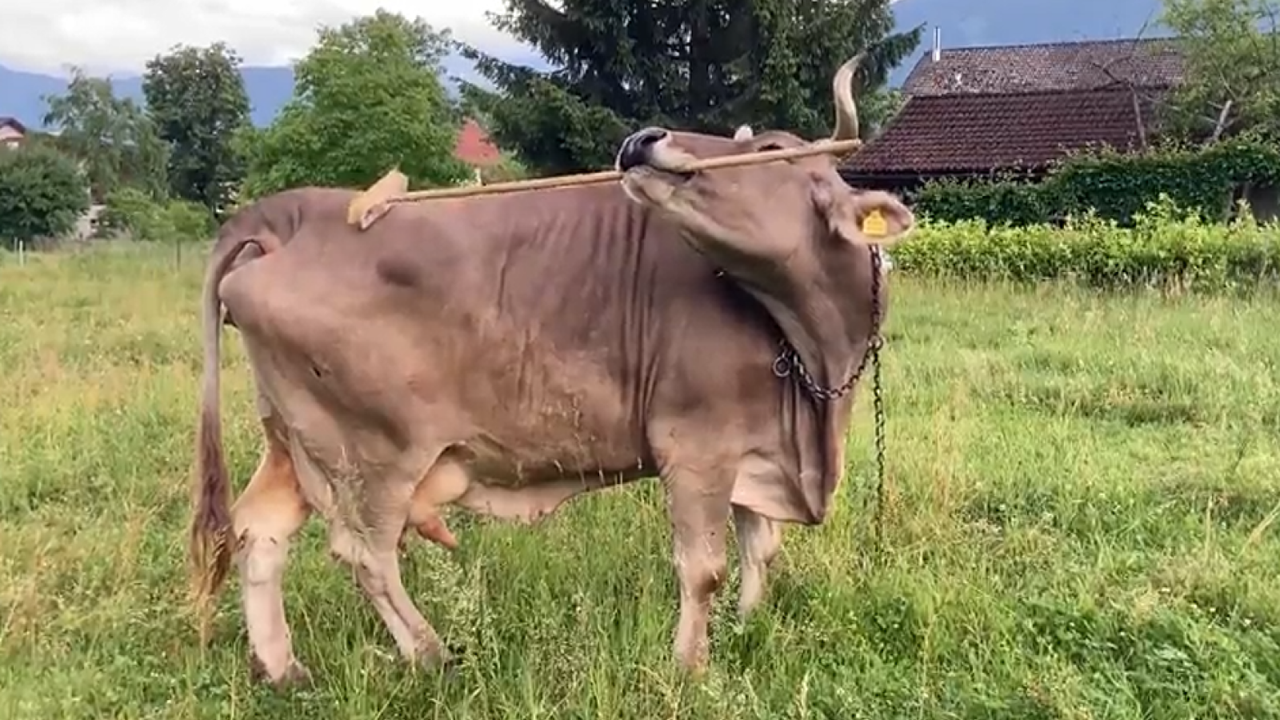
A pet cow in Austria started using a broom to scratch herself — the first ever documented case of bovine tool use.
When you purchase through links on our site, we may earn an affiliate commission. Here’s how it works.
Share Share by:- Copy link
- X
For the first time ever, a cow has been documented not only using a tool but selecting which part to use when scratching at different parts of her body.
You may like-
 Wolf stealing underwater crab traps caught on camera for the first time — signalling 'new dimension' in their behavior
-
 Chimps 'think about thinking' in order to weigh evidence and plan their actions, new research suggests
-
 Which animals are tricked by optical illusions?
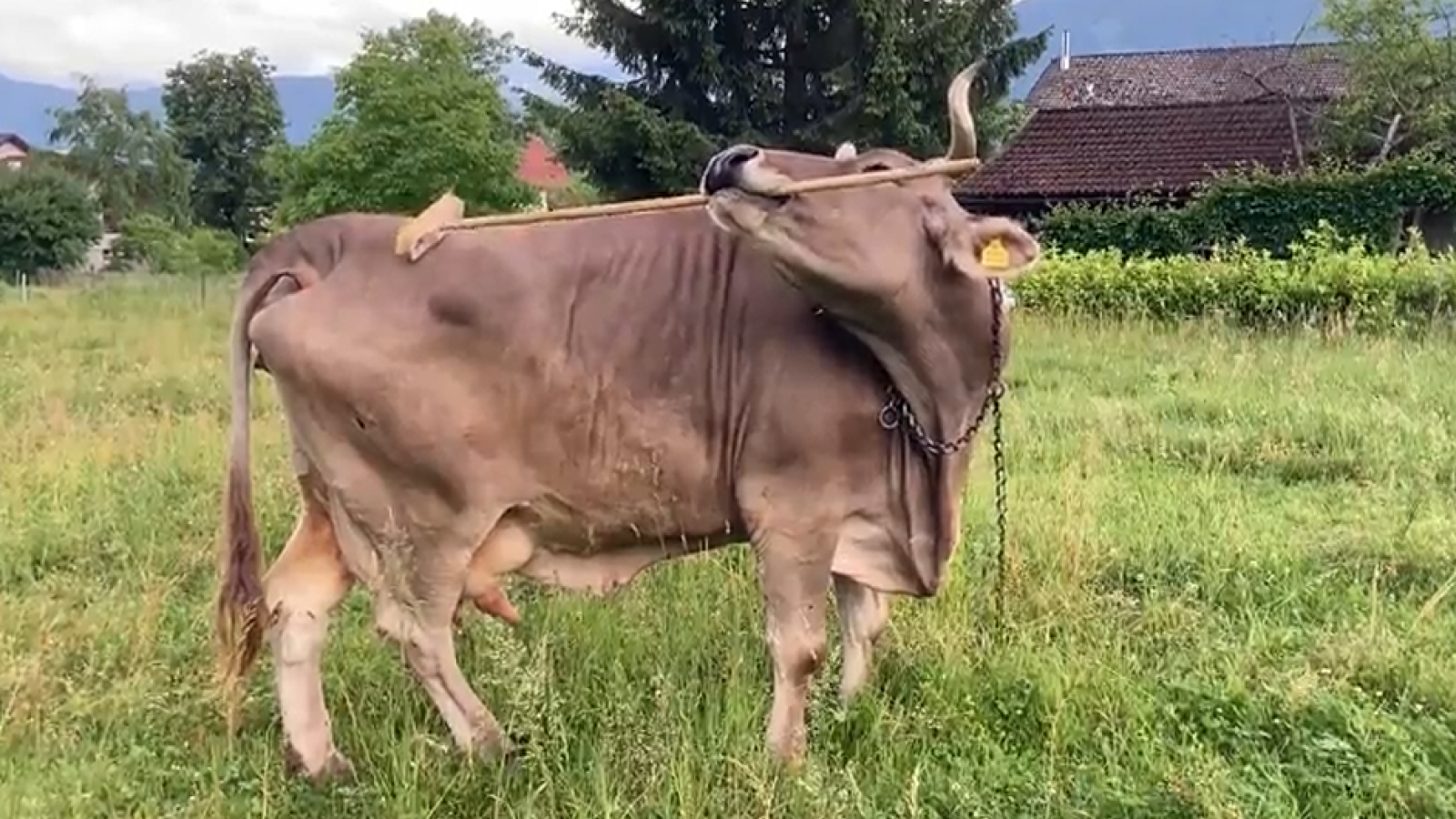
"People tend to think that anything an animal does with an object is tool use and sometimes you get sent videos of animals randomly interacting with objects, like 'My cat is using a tool because she's using my Amazon box as a house.' But this particular video was different," Auersperg told Live Science. "It showed the kind of a behavior I would expect from the stricter definitions of tool use, where you see a tool is an embodied part of the animal and it is used as a direct elongation of her body."
After seeing the video, Auersperg and her colleague, Antonio Osuna-Mascaró, an animal cognition researcher also at the University of Veterinary Medicine, set out to meet Veronika and put her to the test. They repeatedly placed a deck brush, or broom, on the ground in front of her in a random orientation to see what she would do.
"We decided to use a broom because a broom has a functional end and a non-functional end. So our prediction was that if Veronika is really sensitive to the functional properties of the tool, she will prefer to use the broom end," Osuna-Mascaró told Live Science.
Veronika picked up the object by the handle end and scratched herself with the broom end about 2.5 times more often than doing it the other way round, he said. But after a while, a more nuanced pattern emerged.
Sign up for the Live Science daily newsletter nowContact me with news and offers from other Future brandsReceive email from us on behalf of our trusted partners or sponsorsBy submitting your information you agree to the Terms & Conditions and Privacy Policy and are aged 16 or over.
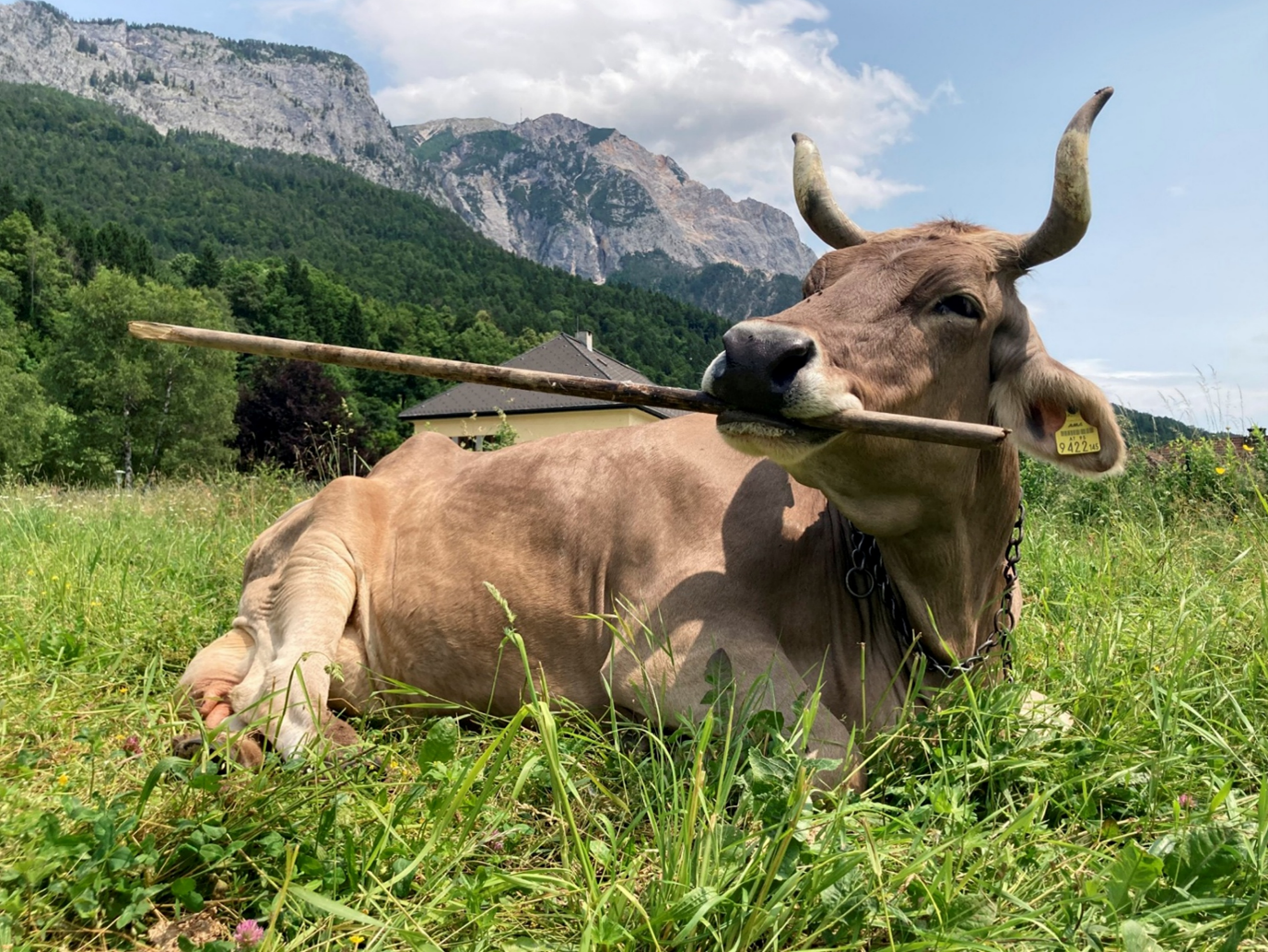
After 70 sessions, if Veronika was going to scratch the thick skin of her back, she generally picked up the broom in her mouth by the thin end and gave herself a good rigorous scratch with the big, abrasive brush. If she wanted to scratch a more delicate area, like her navel or udder, she would pick up the broom by the brush end and rub herself gently with the thin handle.
The study was published in Current Biology on Monday (Jan. 19).
Veronika's behavior also indicated that she knew which body part she intended to scratch before picking up the broom, rather than just using a tool in whatever orientation she happened to pick it up, Osuna-Mascaró said.
You may like-
Chimps 'think about thinking' in order to weigh evidence and plan their actions, new research suggests
-
Which animals are tricked by optical illusions?
-
 Human trash is 'kick-starting' the domestication of city-dwelling raccoons, study suggests
For example, she would raise her tail in anticipation when she was going to scratch her delicate anal region and readjust her grip on the tool to ensure she could reach it, he said.
The readjustment was no easy matter. To pick up the brush, Veronika would roll out her tongue, wrap it around the tool, bring it up to her mouth and press it between her lower teeth and the hard dental pad at the top of her mouth, said Auersperg. This means the tool sits there very firmly and can't be easily adjusted. Sometimes, Veronika would let go of the tool before scratching, then grab it again in a different place and then direct the tool at the body region that she wouldn't have been able to reach with the previous grip.
This behavior is very different from a cow just using a scratching pad, Auersperg said. Scratching yourself against something is just an interaction between an animal and an object. To qualify as tool use, the animal has to be responsible for the orientation of the object, as Veronika is.
"I have absolutely no doubt that this is tool use," Josep Call, a comparative psychologist at the University of St Andrews in Scotland, who wasn't involved in the study, told Live Science. "They clearly show that the cow uses the brush, the one end or the other, depending on the area that it is scratching. That's very nice."
Gloria Sabbatini, an animal biologist at the National Research Council of Italy's Unit of Cognitive Primatology and Primate Center in Rome, who wasn't involved in the research, agrees.
"Veronika shows an egocentric form of tool use, that is the use of a tool toward herself. This kind of tool use is simpler than tool use toward an external object or surface for many reasons," she told Live Science via email. "One is that she directly perceives the effects of tool using on herself and then she can quickly correct and modify the position of the tool."
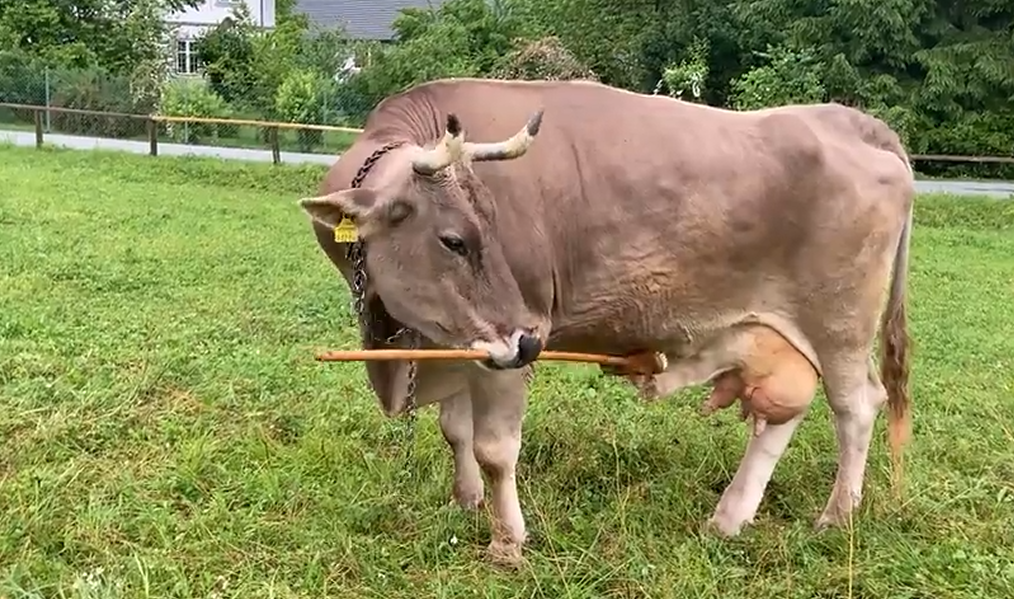
The findings represent the first documented case of tool use in cattle and use of a multi-purpose tool, Osuna-Mascaró said. The behavior can be partly explained by the fact that Veronika is kept as a family pet. She experiences different meadows and stables in the winter, and many objects fall into the meadow for her to interact with.
"Veronika was lucky to have the possibility to experience a day-a-day reality more complex and stimulating than the one usually offered to cows. Through the daily interaction between mind, body and environment, animals develop and improve their abilities and skills," Sabbatini said.
RELATED STORIES—Wolf stealing underwater crab traps caught on camera for the first time — signalling 'new dimension' in their behavior
—Which animals have entered the 'Stone Age'?
—Cockatoos join humans and chimps as only species that can use a set of tools
However, it doesn't mean this is a one-off. Osuna-Mascaró has also identified videos on social media of a Brahman bull (Bos indicus) using a stick to scratch an itch.
Given that the two species diverged more than 500,000 years ago and have been separately domesticated since, Osuna-Mascaró suggested that Veronica is showing a latent capability for innovation that could have been in cattle for thousands of years.
"We do not mean that ancient oxen were tool users, but that these animals have the capacity to innovate spontaneous solutions to complex problems," Auersperg said. "When they are little, cows play with objects, they love playing with balls, with ropes and also with sticks. So, if they have a rich environment, perhaps they will show these innovations more often."
 Chris SimmsLive Science Contributor
Chris Simms is a freelance journalist who previously worked at New Scientist for more than 10 years, in roles including chief subeditor and assistant news editor. He was also a senior subeditor at Nature and has a degree in zoology from Queen Mary University of London. In recent years, he has written numerous articles for New Scientist and in 2018 was shortlisted for Best Newcomer at the Association of British Science Writers awards.
Show More CommentsYou must confirm your public display name before commenting
Please logout and then login again, you will then be prompted to enter your display name.
Logout Read more Chimps 'think about thinking' in order to weigh evidence and plan their actions, new research suggests
 Which animals are tricked by optical illusions?
 Human trash is 'kick-starting' the domestication of city-dwelling raccoons, study suggests
 Crimean Stone Age 'crayons' were used by Neanderthals for symbolic drawings, study claims
 First of its kind 'butt drag fossil' discovered in South Africa — and it was left by a fuzzy elephant relative 126,000 years ago
 Orcas are adopting terrifying new behaviors. Are they getting smarter?
Latest in Land Mammals
Orcas are adopting terrifying new behaviors. Are they getting smarter?
Latest in Land Mammals
 Coyote scrambles onto Alcatraz Island after perilous, never-before-seen swim
 Ancient mummified cheetahs discovered in Saudi Arabia contain preserved DNA from the long-lost population
 Woolly rhino flesh pulled from ancient wolf stomach gives clues to ice age giant's extinction
 Cats meow more at men to get their attention, study suggests
 Did any cat breeds develop naturally?
 Pumas in Patagonia started feasting on penguins — but now they're behaving strangely, a new study finds
Latest in News
Pumas in Patagonia started feasting on penguins — but now they're behaving strangely, a new study finds
Latest in News
 Dark matter and neutrinos may interact, hinting at 'fundamental breakthrough' in particle physics
 Lab mice that 'touch grass' are less anxious — and that highlights a big problem in rodent research
 Californians have been using far less water than suppliers estimated — what does this mean for the state?
 Enormous freshwater reservoir discovered off the East Coast may be 20,000 years old and big enough to supply NYC for 800 years
 2.6 million-year-old jaw from extinct 'Nutcracker Man' is found where we didn't expect it
 Stunning time-lapse video captured using 'artificial eclipse' shows 3 massive eruptions on the sun
LATEST ARTICLES
Stunning time-lapse video captured using 'artificial eclipse' shows 3 massive eruptions on the sun
LATEST ARTICLES- 1Dark matter and neutrinos may interact, hinting at 'fundamental breakthrough' in particle physics
- 2Lab mice that 'touch grass' are less anxious — and that highlights a big problem in rodent research
- 32,400-year-old Hercules shrine and elite tombs discovered outside ancient Rome's walls
- 4Coyote scrambles onto Alcatraz Island after perilous, never-before-seen swim
- 5Stunning time-lapse video captured using 'artificial eclipse' shows 3 massive eruptions on the sun