- Animals
- Land Mammals
Large carnivores are both clashing and coexisting in the western United States. Although wolves dominate cougars and steal their prey, cougars' shift from elk- to deer-heavy diets, paired with a rugged landscape for escape, might help cougars avoid violent wolf encounters.
When you purchase through links on our site, we may earn an affiliate commission. Here’s how it works.
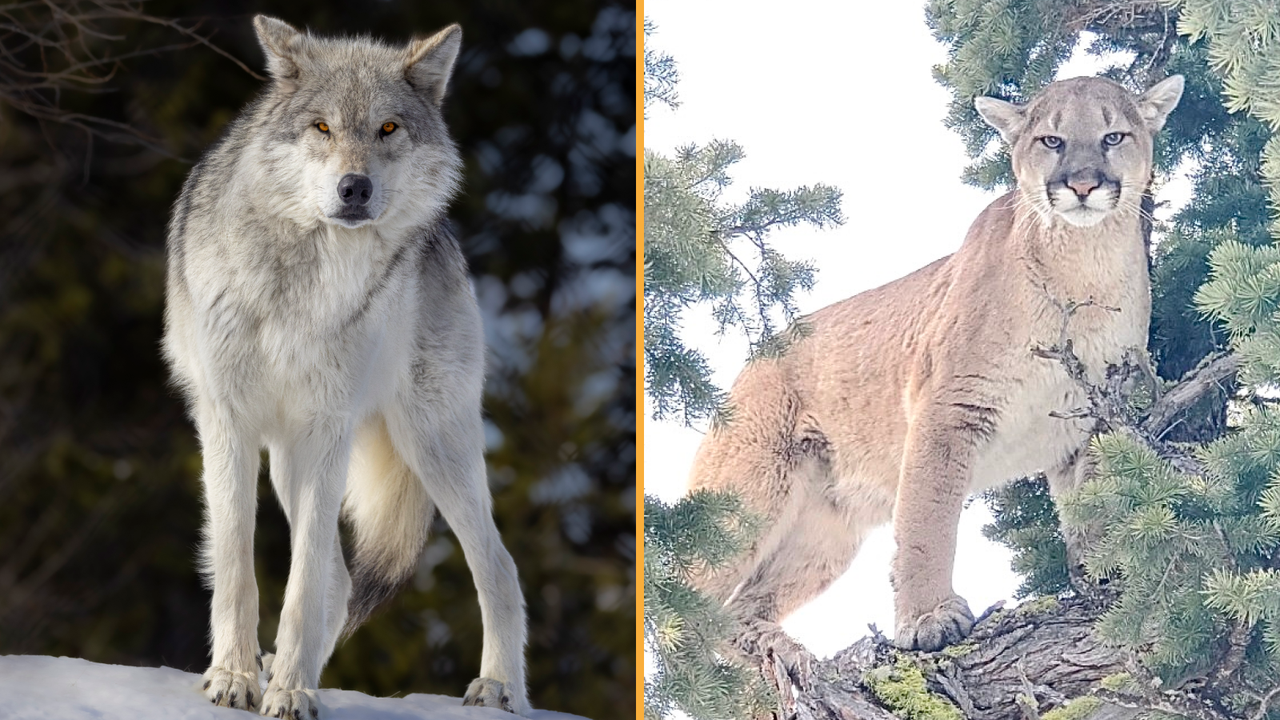
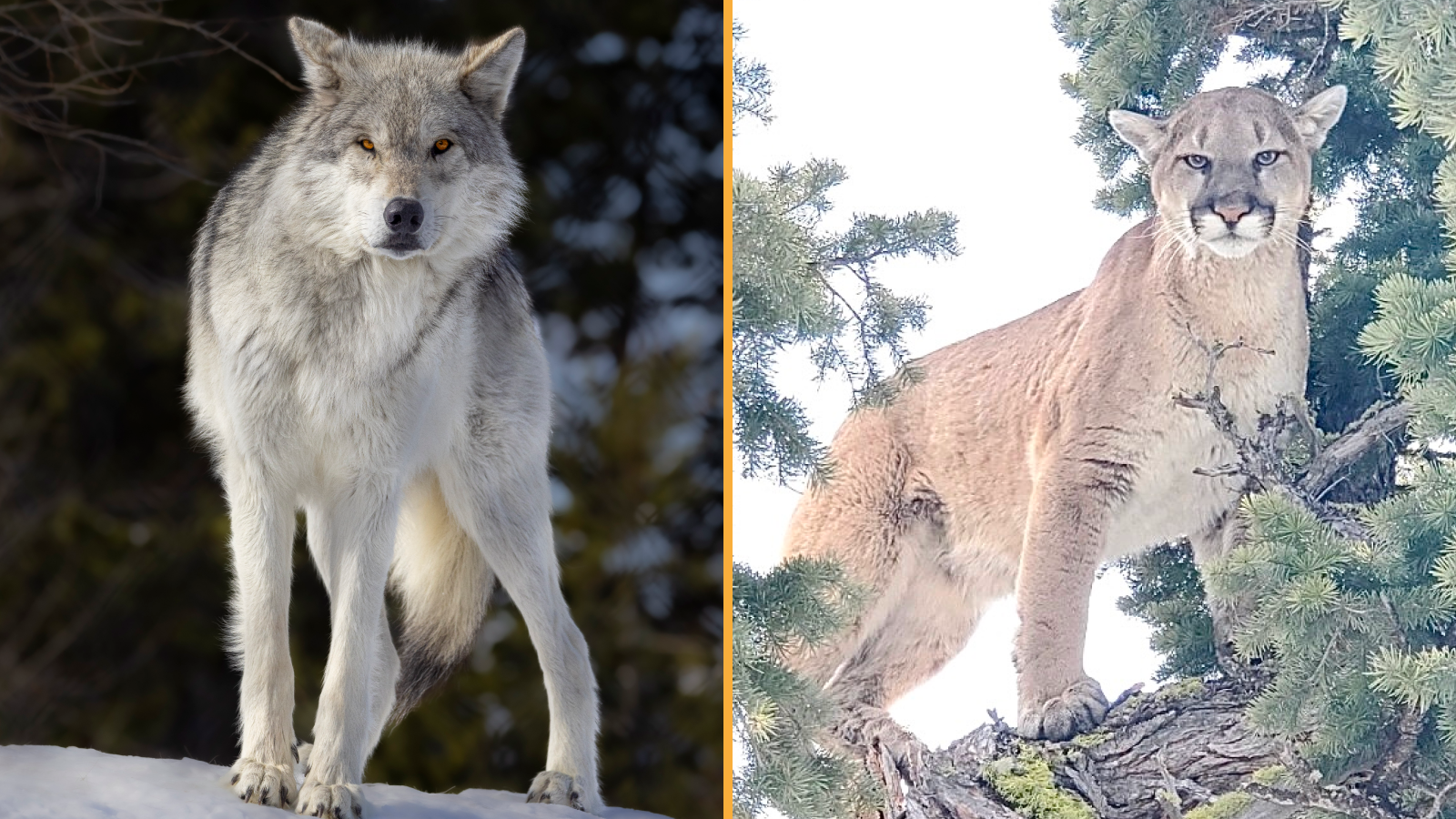 Wolves and cougars have returned to Yellowstone over the last 50 years after being hunted to near-extinction.
(Image credit: (left) Gary Blatter / 500px via Getty Images; (right) Justin Duffy./Oregon State University via Flickr, CC BY-SA 4.0)
Wolves and cougars have returned to Yellowstone over the last 50 years after being hunted to near-extinction.
(Image credit: (left) Gary Blatter / 500px via Getty Images; (right) Justin Duffy./Oregon State University via Flickr, CC BY-SA 4.0)
- Copy link
- X
Get the world’s most fascinating discoveries delivered straight to your inbox.
Become a Member in Seconds
Unlock instant access to exclusive member features.
Contact me with news and offers from other Future brands Receive email from us on behalf of our trusted partners or sponsors By submitting your information you agree to the Terms & Conditions and Privacy Policy and are aged 16 or over.You are now subscribed
Your newsletter sign-up was successful
Want to add more newsletters?

Delivered Daily
Daily Newsletter
Sign up for the latest discoveries, groundbreaking research and fascinating breakthroughs that impact you and the wider world direct to your inbox.
Signup +
Once a week
Life's Little Mysteries
Feed your curiosity with an exclusive mystery every week, solved with science and delivered direct to your inbox before it's seen anywhere else.
Signup +
Once a week
How It Works
Sign up to our free science & technology newsletter for your weekly fix of fascinating articles, quick quizzes, amazing images, and more
Signup +
Delivered daily
Space.com Newsletter
Breaking space news, the latest updates on rocket launches, skywatching events and more!
Signup +
Once a month
Watch This Space
Sign up to our monthly entertainment newsletter to keep up with all our coverage of the latest sci-fi and space movies, tv shows, games and books.
Signup +
Once a week
Night Sky This Week
Discover this week's must-see night sky events, moon phases, and stunning astrophotos. Sign up for our skywatching newsletter and explore the universe with us!
Signup +Join the club
Get full access to premium articles, exclusive features and a growing list of member rewards.
Explore An account already exists for this email address, please log in. Subscribe to our newsletterAfter wolves were reintroduced to Yellowstone National Park, cougars — that had only regained a foothold a few decades earlier — were able to coexist due to their diets changing and the varied landscape of the park, according to new research.
Run-ins between wolves (Canis lupus) and cougars (Puma concolor, also called mountain lions and pumas) in Yellowstone National Park happen when wolves steal prey from — and sometimes kill — cougars, and this dynamic becomes more harmonious when cougars shift to eating smaller prey, according to a new study published Jan. 26 in the journal PNAS. Successful wolf and cougar coexistence in Yellowstone, the findings suggest, depends more on the diversity of prey and the availability of escape terrain for cougars than it does on the overall abundance of prey.
"Yellowstone is a fascinating system because it's got the full complement of large carnivores and migratory ungulates that North America used to have," Chris Wilmers, a wildlife ecologist at the University of California, Santa Cruz who was not involved in the new study, told Live Science. "A lot of these species are coming back –– wolves were reintroduced, mountain lions and grizzly bear numbers have been recovering –– so it's also a system that's in flux. As these populations restore themselves, it's super interesting to look at these species' effects on each other."
You may like-
 Did reintroducing Wolves to Yellowstone really cause an ecological cascade?
-
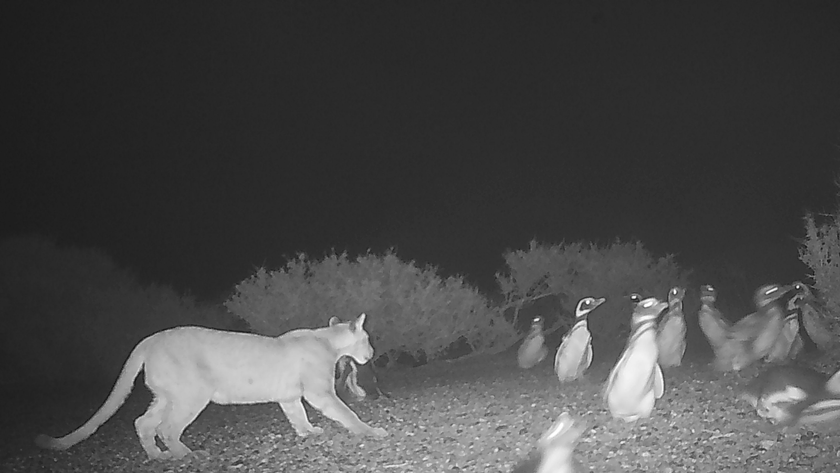 Pumas in Patagonia started feasting on penguins — but now they're behaving strangely, a new study finds
-
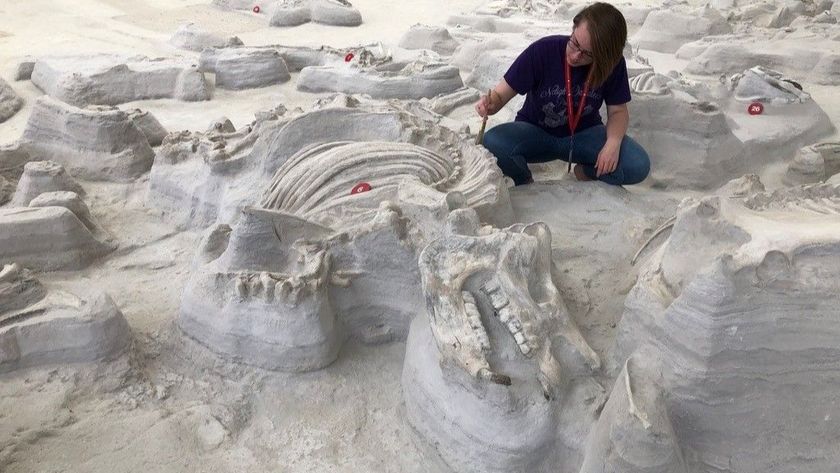 Large, bone-crushing dogs stalked 'Rhino Pompeii' after Yellowstone eruption 12 million years ago, ancient footprints reveal
Cougar and wolf habitats are increasingly overlapping in the western United States. Throughout the first half of the 20th century, both species were nearly eradicated from the U.S. due primarily to hunting. Cougar populations began to rebound in the 1960s under new protections, and wolf reintroduction began in the 1990s and benefited from expanded legal protection.
Both species are now prevalent throughout the western U.S., but scientists are still working to understand the animals' population dynamics and their impacts on the broader Yellowstone ecosystem.
The new study analyzed nine years of GPS data from collared wolves and cougars, combined with field observations at almost 4,000 sites throughout Yellowstone. The researchers found that wolves occasionally kill cougars, but cougars do not kill wolves.
These findings align with previous work that showed wolves were the more dominant large carnivore in this food web, even though the two species have similar body sizes. Wolves likely dominate because they move in packs, whereas cougars are solitary, which means wolves can run cougars off and steal their prey, said lead study author Wesley Binder, a doctoral student in the Department of Fisheries, Wildlife, and Conservation Sciences at Oregon State University.
Sign up for the Live Science daily newsletter nowContact me with news and offers from other Future brandsReceive email from us on behalf of our trusted partners or sponsorsBy submitting your information you agree to the Terms & Conditions and Privacy Policy and are aged 16 or over."These interactions are very one-sided," Binder told Live Science. "But cougars have the ability to adapt in some ways."
Both cougars' and wolves' diets are changing, according to the new findings: Between 1998 and 2024, elk went from constituting 95% to 64% of wolf diets, and from 80% to 53% of cougar diets, likely because Yellowstone elk (Cervus canadensis) populations are decreasing more broadly.
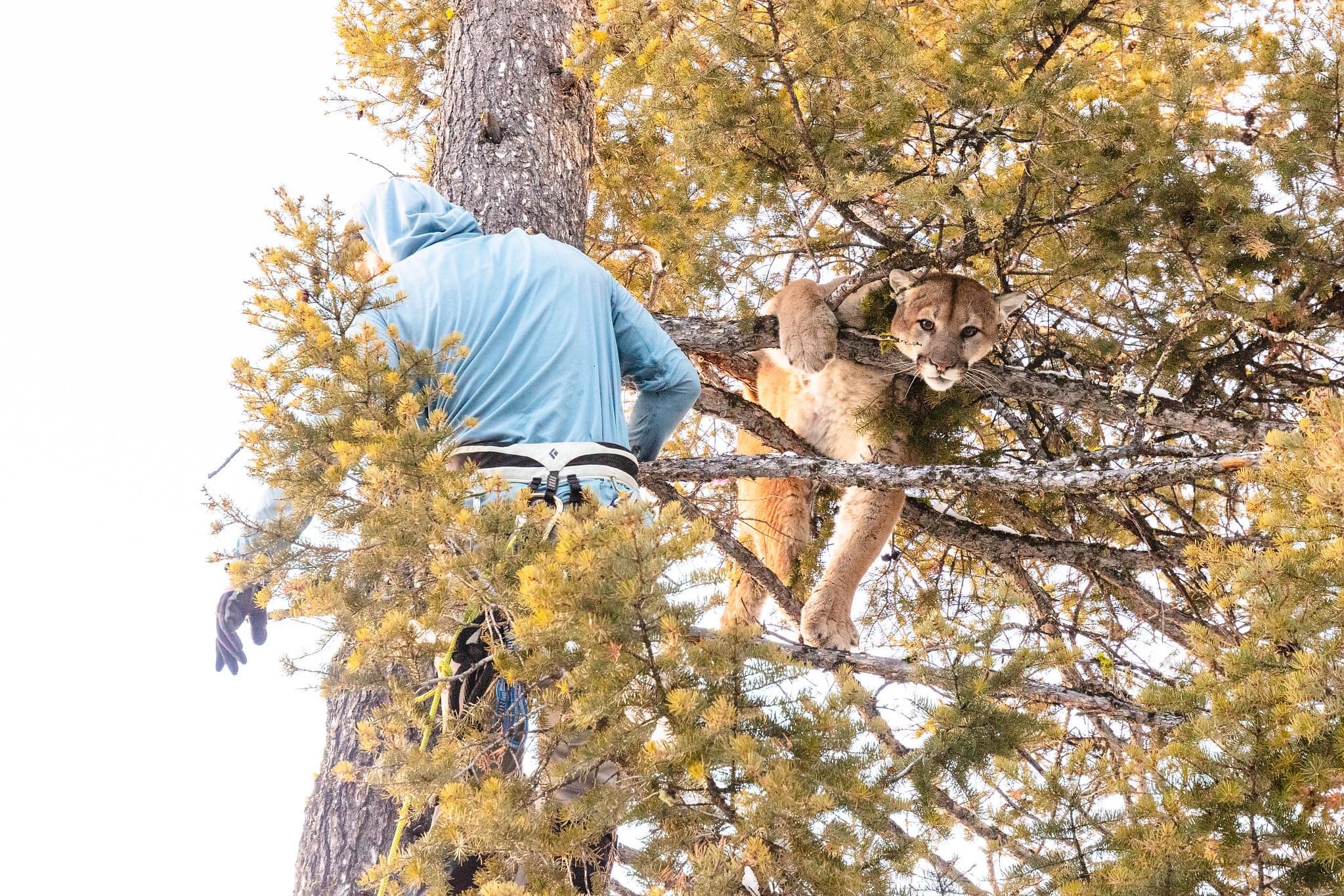
This decline led to changes in wolf and cougar interactions. "If cougars kill larger prey like elk, that gives wolves more time to find the cougar sitting on that kill," Binder said. "We found that wolves and cougars were six times more likely to interact when cougars killed elk, compared to deer. Deer are less than half the size of elk, so cougars eat them a lot faster, and wolves have a lot less opportunity to discover those kill sites."
You may like-
Pumas in Patagonia started feasting on penguins — but now they're behaving strangely, a new study finds
-
Large, bone-crushing dogs stalked 'Rhino Pompeii' after Yellowstone eruption 12 million years ago, ancient footprints reveal
-
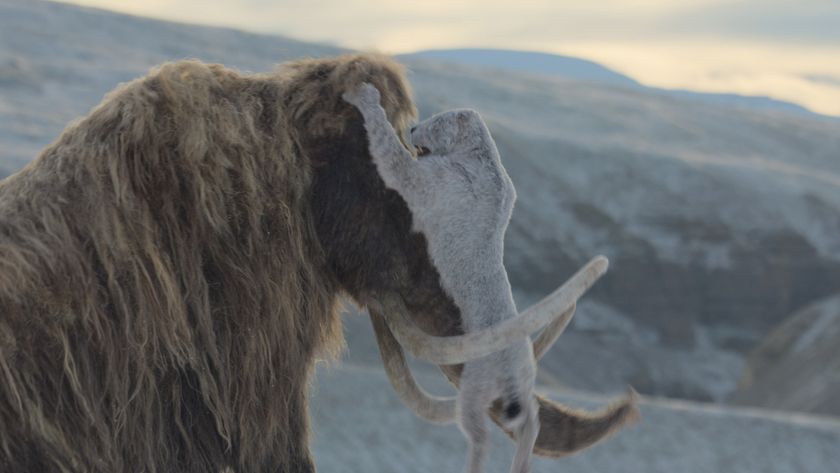 A new Apple TV series brings to life iconic animals of the last ice age.
Shifting cougar diets from declining elk numbers led to fewer interactions with wolves overall. Instead of elk, cougars began eating smaller prey, like deer. Wolves, they found, started eating more bison.
"It's important to realize that's why the cougars switched, but in doing so, it made them less vulnerable to scavenging and potentially getting killed by wolves," Wilmers said.
The terrain, the findings showed, also shapes the animals' encounters. When surrounded by rugged terrain or trees they can climb, cougars had fewer dangerous encounters with wolves.
RELATED STORIES—Did reintroducing Wolves to Yellowstone really cause an ecological cascade?
—Yellowstone's 'queen of the wolves' killed by rival pack after living to 11 years old and having 10 litters of pups
—Watch Yellowstone wolf pack hunting bison after death of one-eyed alpha 'queen'
Yellowstone's diversity of both prey and landscapes seems to be a sweet spot for wolf-cougar coexistence. Both species' populations are currently stable. "Wolves and cougars prefer different habitat, and Yellowstone has different habitat that suits each of these carnivores," Binder said.
The findings reveal the ideal landscape and prey characteristics for the stable coexistence of two large carnivore species — and how clashes between predators can have a ripple effect on the whole ecosystem.
"We're always trying to understand what the impact is of large carnivores on prey [populations]," Wilmers said, "and what the interactions are between the large carnivores, and how they might combine or cancel out each other's influence on prey. … It's the beginning of unraveling that story between wolves and [cougars]."
 Olivia FerrariLive Science Contributor
Olivia Ferrari is a New York City-based freelance journalist with a background in research and science communication. Olivia has lived and worked in the U.K., Costa Rica, Panama and Colombia. Her writing focuses on wildlife, environmental justice, climate change, and social science.
View MoreYou must confirm your public display name before commenting
Please logout and then login again, you will then be prompted to enter your display name.
Logout Read more Pumas in Patagonia started feasting on penguins — but now they're behaving strangely, a new study finds
 Large, bone-crushing dogs stalked 'Rhino Pompeii' after Yellowstone eruption 12 million years ago, ancient footprints reveal
 A new Apple TV series brings to life iconic animals of the last ice age.
 Coyote scrambles onto Alcatraz Island after perilous, never-before-seen swim
 Wolf stealing underwater crab traps caught on camera for the first time — signalling 'new dimension' in their behavior
 Most modern dogs have wolf DNA from relatively recent interbreeding. Here's which breeds are the most and least 'wolfish.'
Latest in Land Mammals
Most modern dogs have wolf DNA from relatively recent interbreeding. Here's which breeds are the most and least 'wolfish.'
Latest in Land Mammals
 'Part of the evolutionary fabric of our societies': Same-sex sexual behavior in primates may be a survival strategy, study finds
Coyote scrambles onto Alcatraz Island after perilous, never-before-seen swim
'Part of the evolutionary fabric of our societies': Same-sex sexual behavior in primates may be a survival strategy, study finds
Coyote scrambles onto Alcatraz Island after perilous, never-before-seen swim
 Ever watched a pet cow pick up a broom and scratch herself with it? You have now
 Ancient mummified cheetahs discovered in Saudi Arabia contain preserved DNA from the long-lost population
 Woolly rhino flesh pulled from ancient wolf stomach gives clues to ice age giant's extinction
 Cats meow more at men to get their attention, study suggests
Latest in News
Cats meow more at men to get their attention, study suggests
Latest in News
 Men develop cardiovascular disease 7 years before women
 Asteroid 2024 YR4's collision with the moon could create a flash visible from Earth
 Hydrogen leak derails Artemis II wet rehearsal, pushing launch date back by weeks
'System in flux': Scientists reveal what happened when wolves and cougars returned to Yellowstone
Hydrogen leak derails Artemis II wet rehearsal, pushing launch date back by weeks
'System in flux': Scientists reveal what happened when wolves and cougars returned to Yellowstone
 In the search for bees, Mozambique honey hunters and birds share a language with distinct, regional dialects
 'Landmark' elephant bone finding in Spain may be from time of Hannibal's war against Rome
LATEST ARTICLES
'Landmark' elephant bone finding in Spain may be from time of Hannibal's war against Rome
LATEST ARTICLES- 1Asteroid 2024 YR4's collision with the moon could create a flash visible from Earth, study finds
- 2Men develop cardiovascular disease 7 years before women, study suggests. But why?
- 3Hydrogen leak derails Artemis II wet rehearsal, pushing launch date back by weeks
- 4'Landmark' elephant bone finding in Spain may be from time of Hannibal's war against Rome
- 5Mokoqi Star Projector Night Light review