- Space
- Astronomy
Scientists hope to probe the nature of general relativity through a possible pulsar found in the center of the Milky Way, near a supermassive black hole.
When you purchase through links on our site, we may earn an affiliate commission. Here’s how it works.
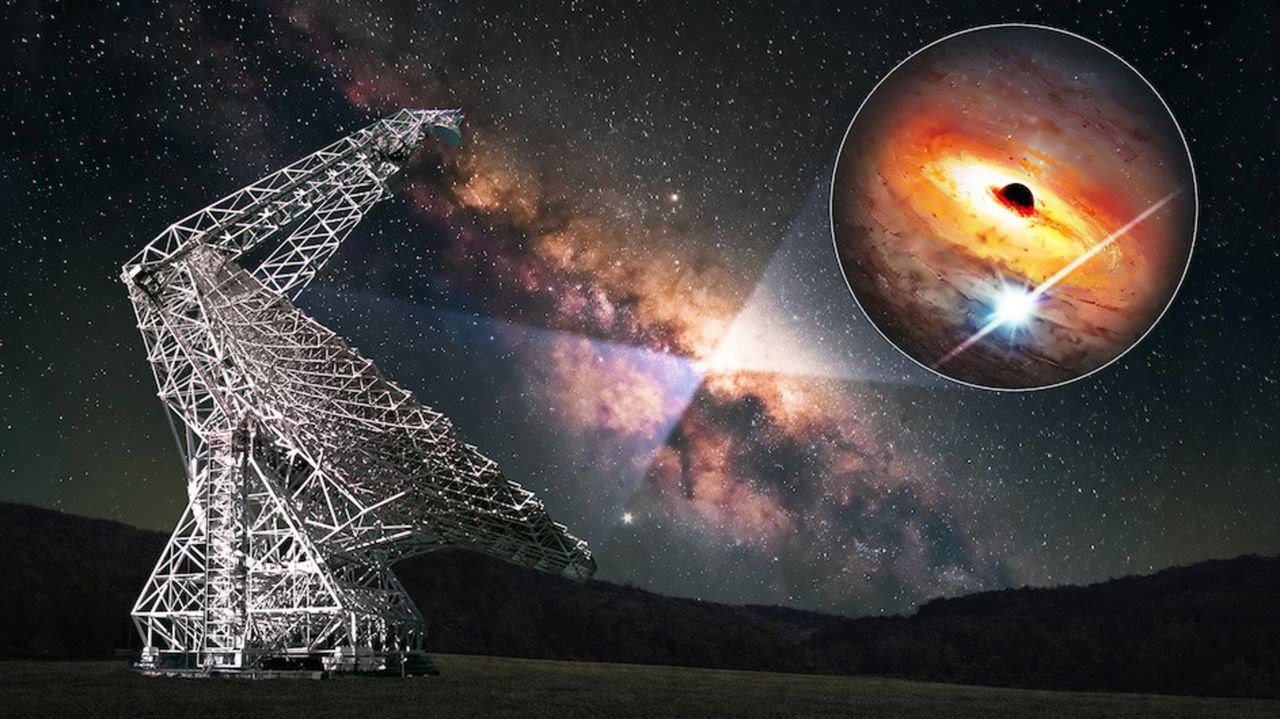
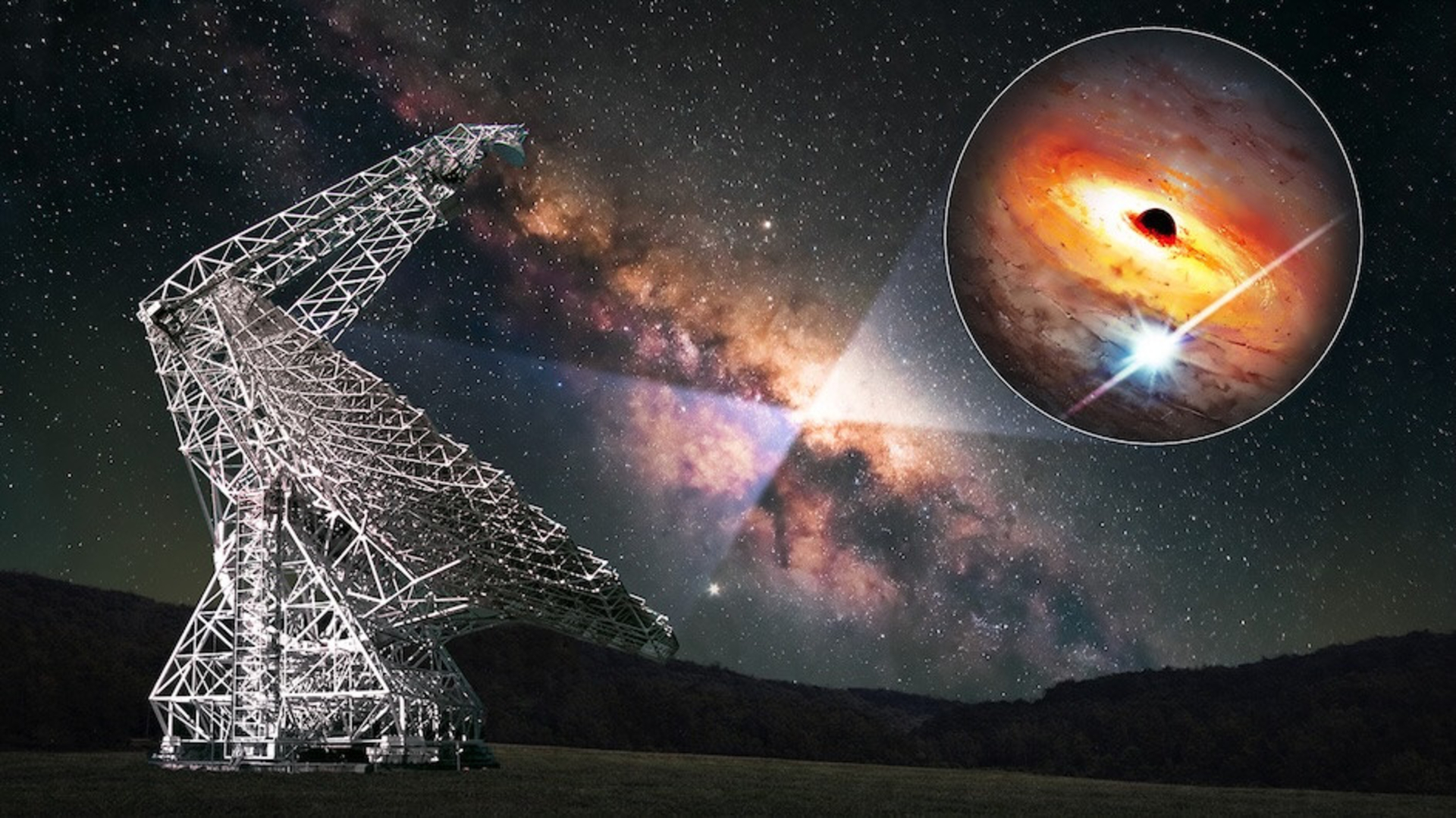 Illustration of the Green Bank radio telescope observing a pulsar in the center of the Milky Way galaxy.
(Image credit: Danielle Futselaar/Breakthrough Listen)
Illustration of the Green Bank radio telescope observing a pulsar in the center of the Milky Way galaxy.
(Image credit: Danielle Futselaar/Breakthrough Listen)
- Copy link
- X
Get the world’s most fascinating discoveries delivered straight to your inbox.
Become a Member in Seconds
Unlock instant access to exclusive member features.
Contact me with news and offers from other Future brands Receive email from us on behalf of our trusted partners or sponsors By submitting your information you agree to the Terms & Conditions and Privacy Policy and are aged 16 or over.You are now subscribed
Your newsletter sign-up was successful
Want to add more newsletters?

Delivered Daily
Daily Newsletter
Sign up for the latest discoveries, groundbreaking research and fascinating breakthroughs that impact you and the wider world direct to your inbox.
Signup +
Once a week
Life's Little Mysteries
Feed your curiosity with an exclusive mystery every week, solved with science and delivered direct to your inbox before it's seen anywhere else.
Signup +
Once a week
How It Works
Sign up to our free science & technology newsletter for your weekly fix of fascinating articles, quick quizzes, amazing images, and more
Signup +
Delivered daily
Space.com Newsletter
Breaking space news, the latest updates on rocket launches, skywatching events and more!
Signup +
Once a month
Watch This Space
Sign up to our monthly entertainment newsletter to keep up with all our coverage of the latest sci-fi and space movies, tv shows, games and books.
Signup +
Once a week
Night Sky This Week
Discover this week's must-see night sky events, moon phases, and stunning astrophotos. Sign up for our skywatching newsletter and explore the universe with us!
Signup +Join the club
Get full access to premium articles, exclusive features and a growing list of member rewards.
Explore An account already exists for this email address, please log in. Subscribe to our newsletterIs the ultradense core of a gigantic star lurking in the center of the Milky Way?
Scientists think they may have found just that: the signal of a pulsar, a rapidly rotating ancient star core, in the heart of our galaxy. The rare discovery could be used to test the predictions of Einstein's general relativity.
You may like-
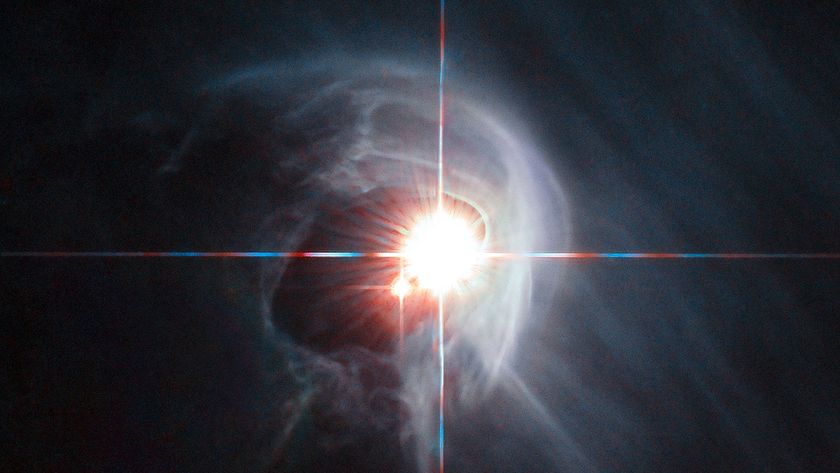 Two stars spiraling toward catastrophe are putting Einstein's gravity to the test
-
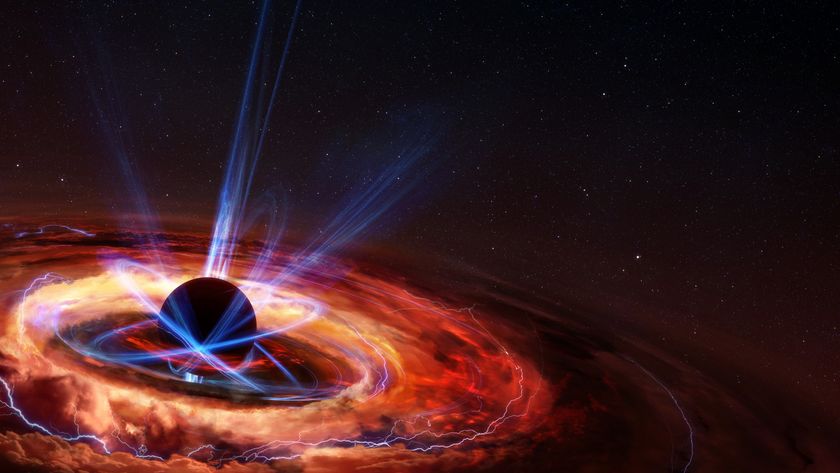 Impossibly powerful 'ghost particle' that hit Earth may have come from an exploding black hole
-
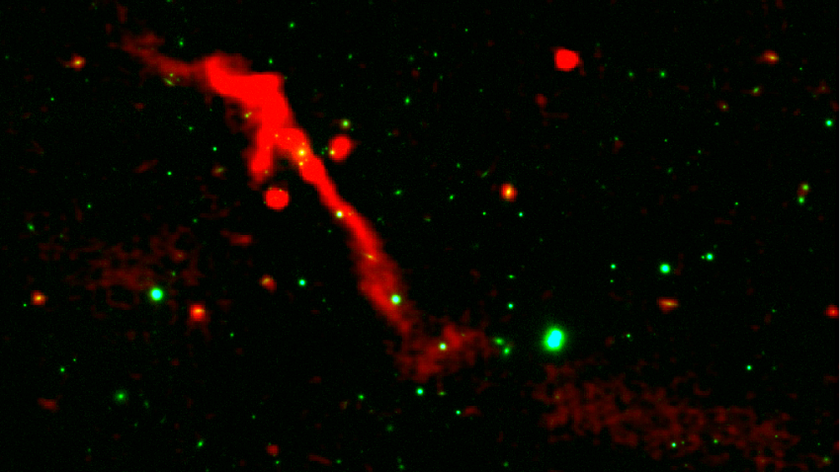 Scientists see monster black hole 'reborn' after 100 million years of rest
The researchers published their findings Monday (Feb. 9) in The Astrophysical Journal. The work was led by Karen Perez, a postdoctoral researcher at the SETI Institute who was a doctoral student at Columbia University at the time of the research.
"We're looking forward to what follow-up observations might reveal about this pulsar candidate," Perez said in a statement. In particular, she added, the researchers hope to use the pulsar to probe general relativity.
Testing the rules of the universe
General relativity, first proposed by Albert Einstein, proposes that gravity is not a force in nature but a property of how space-time curves.
A nearby pulsar in the Milky Way would let researchers learn about "precision measurements of the space-time around a supermassive black hole," the statement noted. That's because pulsars rotate so rapidly that they are sensitive to the subtle gravitational pulls of massive neighboring objects, like other stars.
Sign up for the Live Science daily newsletter nowContact me with news and offers from other Future brandsReceive email from us on behalf of our trusted partners or sponsorsBy submitting your information you agree to the Terms & Conditions and Privacy Policy and are aged 16 or over.The pulsar's rotation could then, in theory, produce "anomalies" in the pulses of light that it sends toward Earth, said study co-author Slavko Bogdanov, a research scientist at the Columbia Astrophysics Laboratory.
"In addition, when the pulses travel near a very massive object, they may be deflected and experience time delays due to the warping of space-time, as predicted by Einstein's general theory of relativity," Bogdanov added.
RELATED STORIES— 8 extremely rare 'millisecond pulsars' discovered inside globular clusters
— Distant 'galaxy' isn't a galaxy at all — but one of the brightest pulsars ever detected
— Mysterious glow at the Milky Way's center could reshape a major cosmic theory
Researchers detected the suspected pulsar through Breakthrough Listen, a scientific research program that aims to find signals of civilizations beyond Earth. The new findings came from the Breakthrough Listen Galactic Center Survey, which, as the name suggests, hunted for signals coming from the center of the Milky Way.
Breakthrough Listen released all of the data publicly, the researchers added, "allowing researchers worldwide to pursue independent analyses and complementary science cases."
Further research is needed to confirm whether the signal really was a pulsar, or if it came from some other exotic radio source.
Article SourcesSource: Perez, K. I., Gajjar, V., Bogdanov, S., Halpern, J. P., Demorest, P. B., Croft, S., Lebofsky, M., MacMahon, D. H. E., & Siemion, A. P. V. (2026). On the Deepest Search for Galactic Center Pulsars and an Examination of an Intriguing Millisecond Pulsar Candidate. The Astrophysical Journal, 998(1), 147. https://doi.org/10.3847/1538-4357/ae336c
Milky Way quiz: How well do you know our home galaxy?
TOPICS Milky Way Elizabeth HowellLive Science Contributor
Elizabeth Howell was staff reporter at Space.com between 2022 and 2024 and a regular contributor to Live Science and Space.com between 2012 and 2022. Elizabeth's reporting includes multiple exclusives with the White House, speaking several times with the International Space Station, witnessing five human spaceflight launches on two continents, flying parabolic, working inside a spacesuit, and participating in a simulated Mars mission. Her latest book, "Why Am I Taller?" (ECW Press, 2022) is co-written with astronaut Dave Williams.
View MoreYou must confirm your public display name before commenting
Please logout and then login again, you will then be prompted to enter your display name.
Logout Read more Two stars spiraling toward catastrophe are putting Einstein's gravity to the test
 Impossibly powerful 'ghost particle' that hit Earth may have come from an exploding black hole
 Scientists see monster black hole 'reborn' after 100 million years of rest
 Did a NASA telescope really 'see' dark matter? Strange gamma-rays spark bold claims, but scientists urge caution
 First-ever 'superkilonova' double star explosion puzzles astronomers
 Record-breaking black hole collision finally explained
Latest in Astronomy
Record-breaking black hole collision finally explained
Latest in Astronomy
 Something supercharged Uranus with radiation during Voyager flyby 40 years ago. Scientists now know what.
 New 'sungrazing' comet could become visible to the naked eye during the day — if the sun doesn't destroy it
Impossibly powerful 'ghost particle' that hit Earth may have come from an exploding black hole
New 'sungrazing' comet could become visible to the naked eye during the day — if the sun doesn't destroy it
Impossibly powerful 'ghost particle' that hit Earth may have come from an exploding black hole
 Dramatic death of Comet C/2025 K1 (ATLAS) caught on camera — Space photo of the week
 Every major galaxy is speeding away from us, except one — and we finally know why
 Star-killing black hole is one of the most energetic objects in the universe
Latest in News
Radio signal discovered at the center of our galaxy could put Einstein's relativity to the test
Star-killing black hole is one of the most energetic objects in the universe
Latest in News
Radio signal discovered at the center of our galaxy could put Einstein's relativity to the test
 Cancer vaccine shows promise against HPV-related throat tumors in early study
 New study favors 'fuzzy' dark matter as the backbone of the universe — contrary to decades of research
 Wildfires in northern Alaska are the worst they've been in 3,000 years
 China has planted so many trees around the Taklamakan Desert that it's turned this 'biological void' into a carbon sink
 Needle-free insulin? Scientists invent gel that delivers insulin through the skin in animal studies
LATEST ARTICLES
Needle-free insulin? Scientists invent gel that delivers insulin through the skin in animal studies
LATEST ARTICLES- 1Cancer vaccine shows promise against HPV-related throat tumors in early study
- 2New study favors 'fuzzy' dark matter as the backbone of the universe — contrary to decades of research
- 3Wildfires in northern Alaska are the worst they've been in 3,000 years
- 4World's oldest known sewn clothing may be stitched pieces of ice age hide unearthed in Oregon cave
- 5Are you a night owl or an early bird?