- Animals
- Extinct species
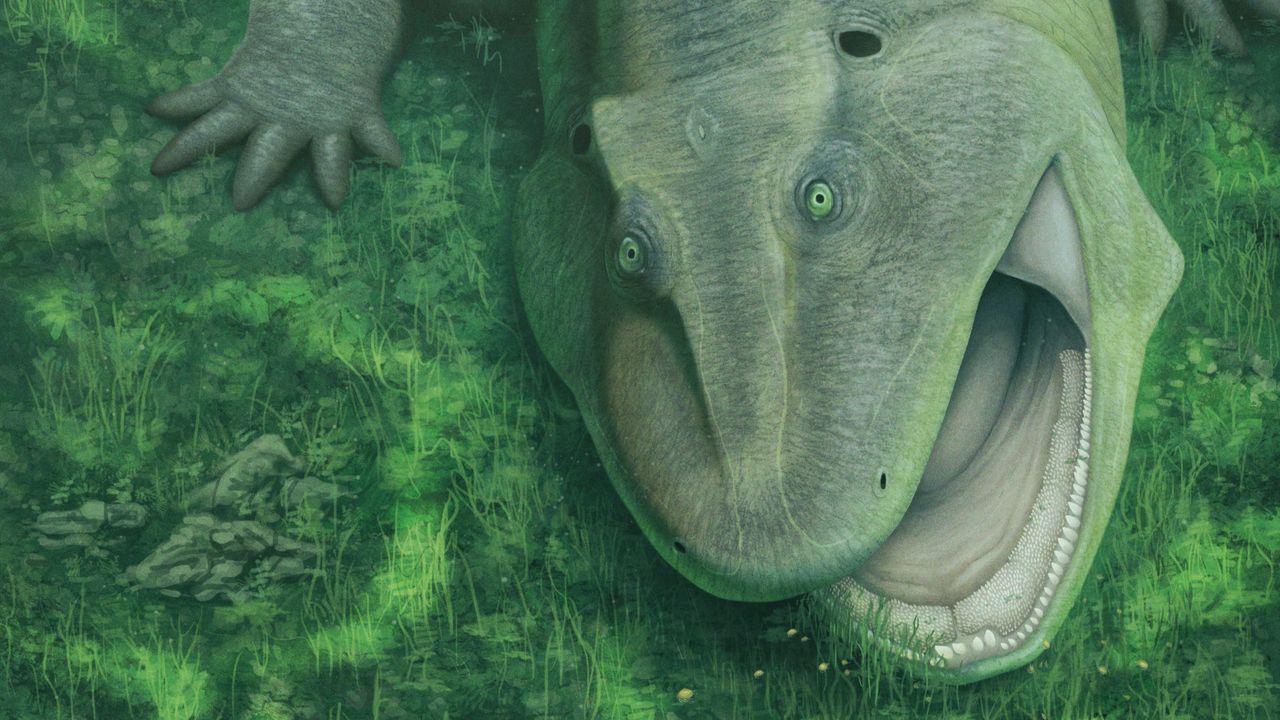
Scientists have described Tanyka amnicola, a newly identified species of prehistoric creature that lived 275 million years ago and had a bizarre twisted jaw with sideways-facing teeth.
When you purchase through links on our site, we may earn an affiliate commission. Here’s how it works.
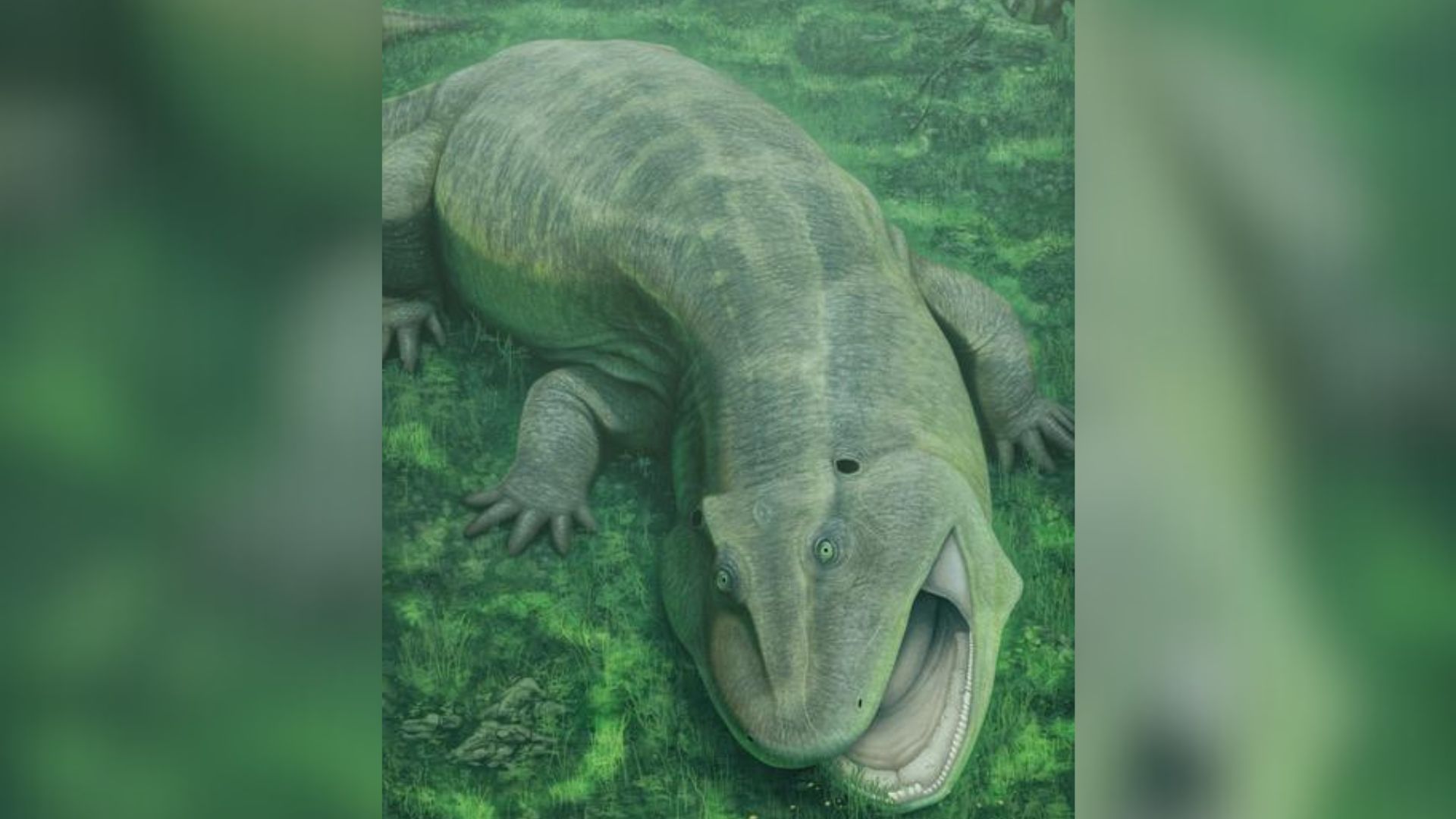 An artist's illustration showing what the newly described species, Tanyka amnicola, may have looked like.
(Image credit: Vitor Silva)
An artist's illustration showing what the newly described species, Tanyka amnicola, may have looked like.
(Image credit: Vitor Silva)
- Copy link
- X
Get the world’s most fascinating discoveries delivered straight to your inbox.
Become a Member in Seconds
Unlock instant access to exclusive member features.
Contact me with news and offers from other Future brands Receive email from us on behalf of our trusted partners or sponsors By submitting your information you agree to the Terms & Conditions and Privacy Policy and are aged 16 or over.You are now subscribed
Your newsletter sign-up was successful
Want to add more newsletters?

Delivered Daily
Daily Newsletter
Sign up for the latest discoveries, groundbreaking research and fascinating breakthroughs that impact you and the wider world direct to your inbox.
Signup +
Once a week
Life's Little Mysteries
Feed your curiosity with an exclusive mystery every week, solved with science and delivered direct to your inbox before it's seen anywhere else.
Signup +
Once a week
How It Works
Sign up to our free science & technology newsletter for your weekly fix of fascinating articles, quick quizzes, amazing images, and more
Signup +
Delivered daily
Space.com Newsletter
Breaking space news, the latest updates on rocket launches, skywatching events and more!
Signup +
Once a month
Watch This Space
Sign up to our monthly entertainment newsletter to keep up with all our coverage of the latest sci-fi and space movies, tv shows, games and books.
Signup +
Once a week
Night Sky This Week
Discover this week's must-see night sky events, moon phases, and stunning astrophotos. Sign up for our skywatching newsletter and explore the universe with us!
Signup +Join the club
Get full access to premium articles, exclusive features and a growing list of member rewards.
Explore An account already exists for this email address, please log in. Subscribe to our newsletterPaleontologists have revealed a bizarre prehistoric creature with a twisted jaw and sideways-facing teeth, and the water-dwelling weirdo was already a "living fossil" when it existed 275 million years ago.
The newly described species, named Tanyka amnicola, is an archaic member of the tetrapods — a large group of four-limbed vertebrates that today includes reptiles, birds, mammals and amphibians, according to a study published Wednesday (March 4) in the journal Proceedings of the Royal Society B.
You may like-
 Spinosaurus relative longer than a pickup truck stalked Thailand's rivers 125 million years ago
-
 'They are life, but not as we now know it': 26-foot organism that lived 420 million years ago is completely unknown branch of animal kingdom
-
 Our adorable, noodle-like ancestor had 4 eyes, half-a-billion-year-old fossils reveal
"Tanyka is from an ancient lineage that we didn't know survived to this time, and it's also just a really strange animal," lead study author Jason Pardo, a research associate at the Field Museum in Chicago, said in a statement. "In the sense that Tanyka was a remaining member of the stem tetrapod lineage, even after newer, more modern tetrapods evolved, Tanyka is a little like a platypus. It was a living fossil in its time."
Researchers identified the new species from nine fossilized lower jawbones, each roughly 6 inches (15 centimeters) long, recovered from a dry riverbed in northeastern Brazil. Although the creature's lower jawbones were distinctive enough for the team to determine the fossils represented a new species, the lack of other fossilized remains means much about the animal remains unknown.
So it's not a deformation, it's just the way the animal was made.
Jason Pardo, Field Museum research associate
Given what is known about its close relatives, however, T. amnicola might have resembled a salamander with a slightly longer snout. It possibly measured up to around 3 feet (around 91 centimeters) in length, Pardo said. The type of rocks in which the fossils were found also indicate that the creature lived in lake environments and presumably had "aquatic habits," according to the paper.
Analysis of the lower jawbones revealed some intriguing features — principally, that they were twisted so that the creature's teeth pointed outward to the sides, rather than upward as seen in virtually all other tetrapods.
Sign up for the Live Science daily newsletter nowContact me with news and offers from other Future brandsReceive email from us on behalf of our trusted partners or sponsorsBy submitting your information you agree to the Terms & Conditions and Privacy Policy and are aged 16 or over."The jaw has this weird twist that drove us crazy trying to figure it out," Pardo said. "We were scratching our heads over this for years, wondering if it was some kind of deformation. But at this point, we've got nine jaws from this animal, and they all have this twist, including the really, really well-preserved ones. So it's not a deformation, it's just the way the animal was made."
RELATED STORIES—Ancient superpredator that lived 328 million years ago was 'the T. rex of its time'
—Half-a-billion-year-old 3-eyed sea creature dubbed 'Mosura' breathed through big gills on its butt
—Our adorable, noodle-like ancestor had 4 eyes, half-a-billion-year-old fossils reveal
Furthermore, the inner surface of the lower jawbone, which faces the tongue in humans, was rotated upward; it was covered in a "remarkable" set of small, teeth-like structures called denticles that would have formed a grinding surface, according to the study. These features suggest the animal had a "relatively unique way" of feeding, Pardo said.
The authors suspect that T. amnicola was adapted to munching on small invertebrates or, potentially, some plant material. This would be unusual, given the lack of evidence for plant-eating or omnivorous diets in other stem tetrapods, which are thought to have been carnivores, the team said.
When T. amnicola lived, Brazil was part of the supercontinent Gondwana. According to the statement, the discovery provides a window into Gondwana's animals during this period. "Tanyka is telling us about how this community actually worked, how it was structured, and who was eating what," study co-author Ken Angielczyk, a curator of paleomammalogy at the Field Museum, said in the statement.
Article SourcesPardo, J., Marsicano, C., Smith, R., Cisneros, J., Angielczyk, K., Fröbisch, J., Kammerer, C., & Richter, M. (2026). An aberrant stem tetrapod from the early Permian of Brazil. Proceedings of the Royal Society B. https://doi.org/10.1098/rspb.2025.2106
 Aristos GeorgiouSocial Links NavigationLive Science Contributor
Aristos is a freelance science reporter who has previously worked for Newsweek, IBTimes UK and The World Weekly. He is particularly focused on archaeology and paleontology, although he has covered a wide variety of topics ranging from astronomy and mental health, to geology and the natural world. He holds a joint bachelor's degree in English and history from the University of Nottingham, and a master's from City St George's, University of London.
View MoreYou must confirm your public display name before commenting
Please logout and then login again, you will then be prompted to enter your display name.
Logout Read more
Spinosaurus relative longer than a pickup truck stalked Thailand's rivers 125 million years ago
'They are life, but not as we now know it': 26-foot organism that lived 420 million years ago is completely unknown branch of animal kingdom
 95 million-year-old Spinosaurus had a scimitar-shaped head crest and waded through the Sahara's rivers like a 'hell heron'
 2.6 million-year-old jaw from extinct 'Nutcracker Man' is found where we didn't expect it
 Archaeopteryx, one of the world's first proto birds, has a set of weird, never-before-seen features, new study reveals
 Giant 'cow of the Cretaceous' discovered almost 100 years ago identified as new duck-billed dinosaur
Latest in Extinct species
95 million-year-old Spinosaurus had a scimitar-shaped head crest and waded through the Sahara's rivers like a 'hell heron'
Our adorable, noodle-like ancestor had 4 eyes, half-a-billion-year-old fossils reveal
Archaeopteryx, one of the world's first proto birds, has a set of weird, never-before-seen features, new study reveals
Giant 'cow of the Cretaceous' discovered almost 100 years ago identified as new duck-billed dinosaur
Latest in Extinct species
95 million-year-old Spinosaurus had a scimitar-shaped head crest and waded through the Sahara's rivers like a 'hell heron'
Our adorable, noodle-like ancestor had 4 eyes, half-a-billion-year-old fossils reveal
Archaeopteryx, one of the world's first proto birds, has a set of weird, never-before-seen features, new study reveals
 Rock climbers in Italy accidentally discovered evidence of an 80 million-year-old sea turtle stampede
Spinosaurus relative longer than a pickup truck stalked Thailand's rivers 125 million years ago
Giant 'cow of the Cretaceous' discovered almost 100 years ago identified as new duck-billed dinosaur
Latest in News
Rock climbers in Italy accidentally discovered evidence of an 80 million-year-old sea turtle stampede
Spinosaurus relative longer than a pickup truck stalked Thailand's rivers 125 million years ago
Giant 'cow of the Cretaceous' discovered almost 100 years ago identified as new duck-billed dinosaur
Latest in News
 NASA fixes Artemis II rocket for April launch to take astronauts around moon
 Chewed-up orca fins on Russian beach point to cannibalism, and scientists say it may explain why some pods are so tight-knit
 Birds are declining faster and faster in 3 US hotspots, new study finds
 Stone Age woman was buried like a man, revealing flexible gender roles 7,000 years ago in Hungary
 Mysterious 'dots' discovered by Webb telescope may be the first stars in the universe on the verge of collapse
 Gold coin discovered by a metal detectorist in the UK may have been dropped by a Viking invader from the Great Heathen Army
LATEST ARTICLES
Gold coin discovered by a metal detectorist in the UK may have been dropped by a Viking invader from the Great Heathen Army
LATEST ARTICLES- 1NASA fixes Artemis II rocket for April launch to take astronauts around moon
- 2Birds are declining faster and faster in 3 US hotspots, new study finds
- 3'Seeing how important agriculture was for daily livelihoods, and how uncertain and precarious agriculture had become in these times, it just made me feel very passionate about working on this issue'
- 4Meet the world's smallest AI supercomputer — it packs 'doctorate-level intelligence', its makers say, and can fit into your pocket
- 5When was the last time Antarctica was ice-free?