- Planet Earth
- Earthquakes
A hidden chunk of an ancient tectonic plate is stuck to the Pacific Ocean floor and sliding under North America, complicating earthquake risk at the Cascadia subduction zone.
When you purchase through links on our site, we may earn an affiliate commission. Here’s how it works.
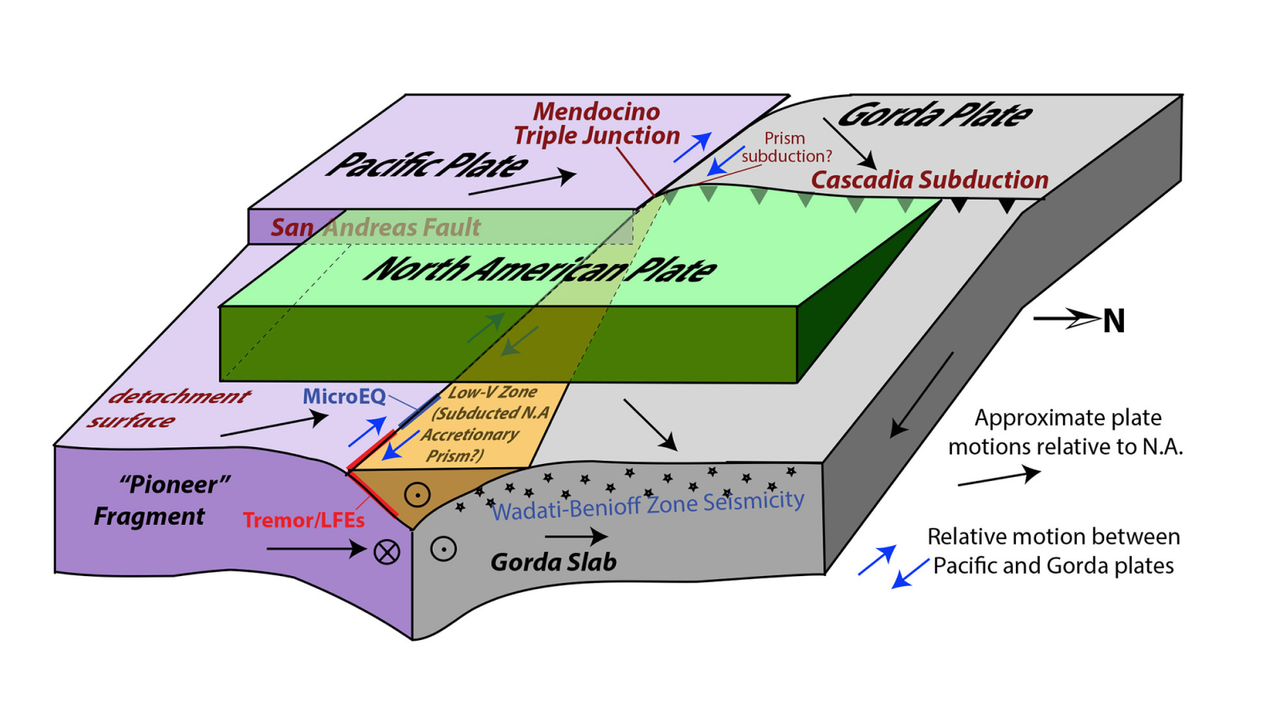
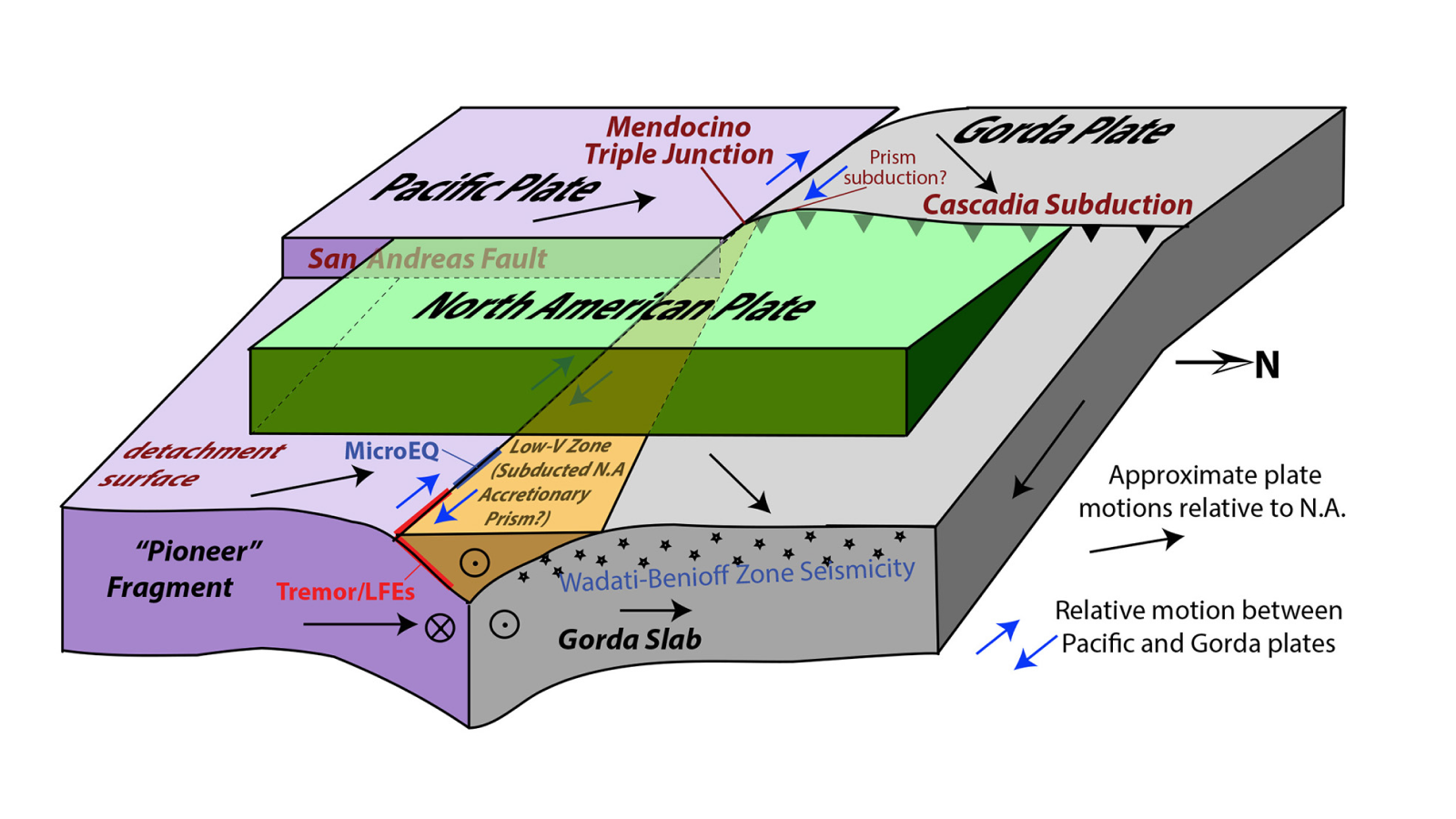 The Mendocino Triple Junction is the meeting point of three tectonic plates. Using data from tiny earthquakes, researchers propose a new model for this seismic zone. The Pacific plate is dragging the Pioneer fragment under the North American plate as it moves north. At the same time, a fragment of the North American plate has broken off and is being subducted with the Gorda plate.
(Image credit: David Shelly, USGS)
Share
Share by:
The Mendocino Triple Junction is the meeting point of three tectonic plates. Using data from tiny earthquakes, researchers propose a new model for this seismic zone. The Pacific plate is dragging the Pioneer fragment under the North American plate as it moves north. At the same time, a fragment of the North American plate has broken off and is being subducted with the Gorda plate.
(Image credit: David Shelly, USGS)
Share
Share by:
- Copy link
- X
A fragment of a long-lost tectonic plate is sliding under the North American continent in the southern part of the Cascadia subduction zone, scientists have discovered. This leftover plate fragment could pose a new earthquake risk to the region.
New research, published Thursday (Jan. 15) in the journal Science, revealed that the Pioneer Fragment — a leftover bit of an oceanic plate that disappeared under the North American Plate some 30 million years ago — is now stuck to the floor of the Pacific Ocean and is moving northwest along with that plate.
You may like-
 Scars from ancient 'megaquakes' at Cascadia subduction zone discovered in deep-sea landslides
-
 Ruptures from 'silent' earthquakes deep in Earth's crust can heal themselves within hours
-
 Parkfield, San Andreas, and the quest for a 'crystal ball' for predicting earthquakes before they happen
Some evidence suggests that earthquakes in the Cascadia subduction zone might trigger earthquakes along the San Andreas, a possibility that would widen the danger from the Cascadia fault.
While the new findings don't make the risk clear, said study first author David Shelly, a geophysicist at the U.S. Geological Survey in Golden, Colorado, they are a step toward understanding this relationship.
The Pioneer Fragment "does increase the area of contact between what’s effectively the Pacific Plate and the subduction zone," Shelly told Live Science.
Shelly and his colleagues probed the Mendocino triple junction using tiny low-frequency earthquakes and tremors — a kind of seismic shiver that originates deep in the crust and can't be felt without sensitive seismometers. "They’re teeny-tiny events but they often occur on the biggest faults," Shelly said.
Sign up for the Live Science daily newsletter nowContact me with news and offers from other Future brandsReceive email from us on behalf of our trusted partners or sponsorsBy submitting your information you agree to the Terms & Conditions and Privacy Policy and are aged 16 or over.By analyzing these events, the researchers determined the direction of subtle plate motions. At Mendocino, the Pacific Plate is sliding northwest against the North American Plate, bumping against the Gorda Plate as it pushes under North America. It's a complex situation, and there are competing explanations for exactly where all the pieces are and where the faultlines run.
Shelly and his colleagues found that the situation is even more complex, because a surprise piece of long-gone Farallon Plate still has an influence on the triple junction. This ancient tectonic plate started subducting under North America 200 million years ago, during the breakup of the supercontinent Pangaea. The Juan de Fuca is one remnant of the Farallon. But now, the researchers found that another remnant got stuck to the Pacific plate. This remnant, the Pioneer Fragment, isn't subducting but rather moving sidelong against the continent.
Meanwhile, bits of the Gorda Plate that got scraped off onto the North American Plate as the two ground together have now seemingly been passed back to the Gorda like a "tectonic hot potato" and may be diving back below North America, Shelly said.
RELATED STORIES—Mystery quake that rocked Northern California in 1954 came from 'eerily quiet' Cascadia Subduction Zone
—Why is the Pacific Ocean so big?
—Cascadia megafault has 1 especially deadly section, new map reveals
This bit of geological messiness may explain why one of the largest triple junction quakes, the 1992 Cape Mendocino earthquake, had a shallower origin than scientists expected. Because of the extra bits and pieces, "the fault may not be following the oceanic crust itself. It may be shallower than that," Shelly said.
Beyond increasing the surface area of the Pacific Plate that interacts with Cascadia, the Pioneer Fragment might have the potential to cause earthquakes itself. Between the fragment and the North American Plate is a nearly horizontal fault, like the icing in a layer cake.
"We don’t know whether that fault can generate large earthquakes, but it is a fault that isn’t currently in the hazard models," Shelly said. "So it’s something we need to consider in the future."
 Stephanie PappasSocial Links NavigationLive Science Contributor
Stephanie Pappas is a contributing writer for Live Science, covering topics ranging from geoscience to archaeology to the human brain and behavior. She was previously a senior writer for Live Science but is now a freelancer based in Denver, Colorado, and regularly contributes to Scientific American and The Monitor, the monthly magazine of the American Psychological Association. Stephanie received a bachelor's degree in psychology from the University of South Carolina and a graduate certificate in science communication from the University of California, Santa Cruz.
Show More CommentsYou must confirm your public display name before commenting
Please logout and then login again, you will then be prompted to enter your display name.
Logout Read more Scars from ancient 'megaquakes' at Cascadia subduction zone discovered in deep-sea landslides
 Ruptures from 'silent' earthquakes deep in Earth's crust can heal themselves within hours
 Parkfield, San Andreas, and the quest for a 'crystal ball' for predicting earthquakes before they happen
 Eruptions of ocean volcanoes may be the echoes of ancient continental breakups
 A gulf separating Africa and Asia is still pulling apart — 5 million years after scientists thought it had stopped
 Giant structure discovered deep beneath Bermuda is unlike anything else on Earth
Latest in Earthquakes
Scars from ancient 'megaquakes' at Cascadia subduction zone discovered in deep-sea landslides
Parkfield, San Andreas, and the quest for a 'crystal ball' for predicting earthquakes before they happen
Ruptures from 'silent' earthquakes deep in Earth's crust can heal themselves within hours
Giant structure discovered deep beneath Bermuda is unlike anything else on Earth
Latest in Earthquakes
Scars from ancient 'megaquakes' at Cascadia subduction zone discovered in deep-sea landslides
Parkfield, San Andreas, and the quest for a 'crystal ball' for predicting earthquakes before they happen
Ruptures from 'silent' earthquakes deep in Earth's crust can heal themselves within hours
 What are the signs that nature is telling us?' Scientists are triggering earthquakes in the Alps to find out what happens before one hits
 Link between Cascadia and San Andreas Fault earthquakes discovered 30 years after lost vessel stumbled across key data
 Mystery quake that rocked Northern California in 1954 came from 'eerily quiet' Cascadia Subduction Zone
Latest in News
Mystery quake that rocked Northern California in 1954 came from 'eerily quiet' Cascadia Subduction Zone
Latest in News
 Early research hints at why women experience more severe gut pain than men do
 Scientists see monster black hole 'reborn' after 100 million years of rest
 Tiny improvements in sleep, nutrition and exercise could significantly extend lifespan, study suggests
 Color blindness linked to lower bladder cancer survival, early study hints
 Earth hit by biggest 'solar radiation storm' in 23 years, triggering Northern Lights as far as Southern California
 Medieval 'super ship' found wrecked off Denmark is largest vessel of its kind
LATEST ARTICLES
Medieval 'super ship' found wrecked off Denmark is largest vessel of its kind
LATEST ARTICLES- 1Early research hints at why women experience more severe gut pain than men do
- 2'Like watching a cosmic volcano erupt': Scientists see monster black hole 'reborn' after 100 million years
- 3Tiny improvements in sleep, nutrition and exercise could significantly extend lifespan, study suggests
- 4James Webb telescope spies rare 'goddess of dawn' supernova from the early universe
- 5Earth hit by biggest 'solar radiation storm' in 23 years, triggering Northern Lights as far as Southern California