Her painting series is a record of those grand and mundane places lost to time or other occurrences, whose presence we continue to mourn.
 Lori Waxman
January 23, 2026
— 5 min read
Lori Waxman
January 23, 2026
— 5 min read
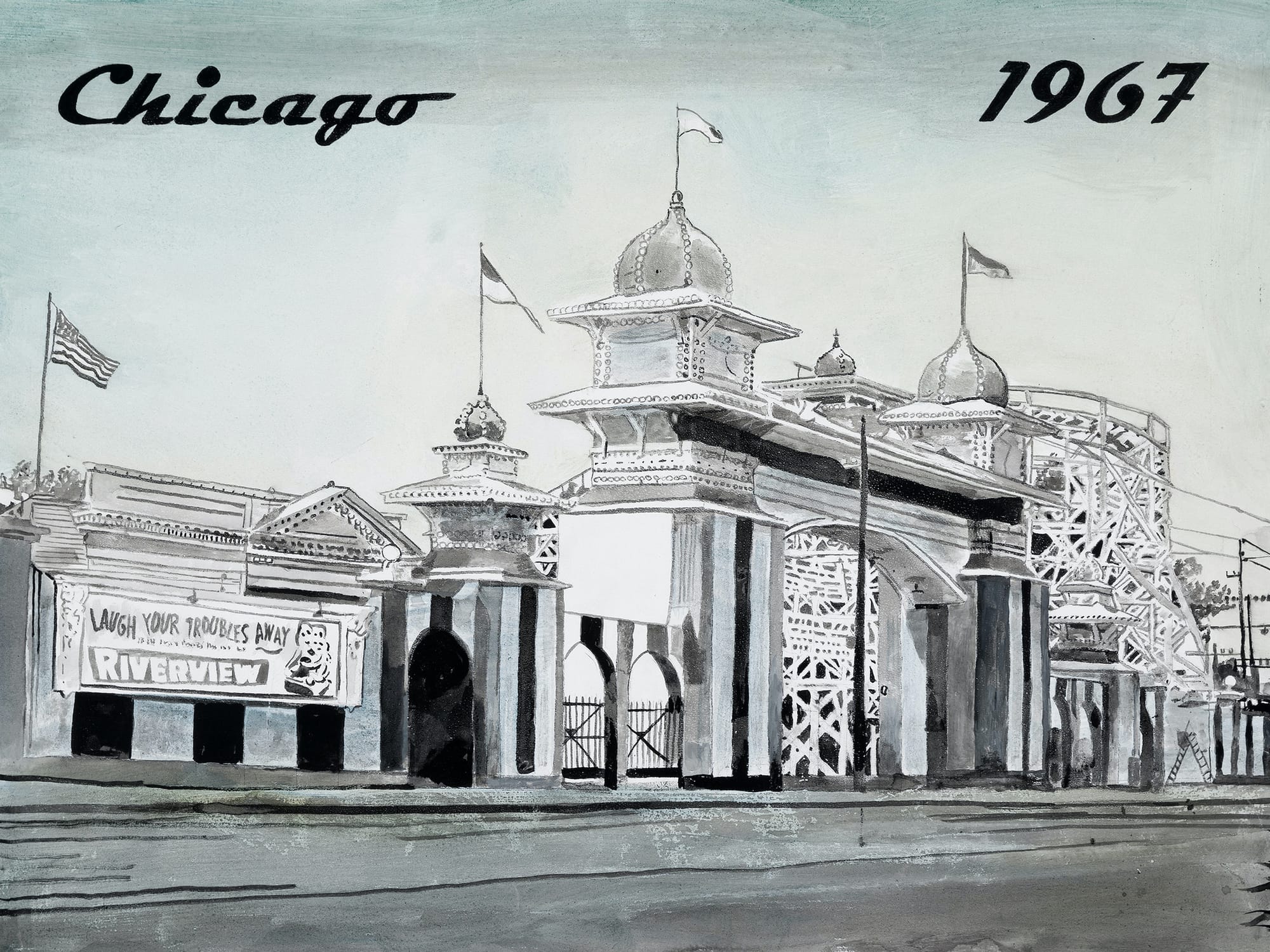
 Ellen Harvey, "Riverview Park" (2021), oil and acrylic on Gessoboard (all photos Etienne Frossard, unless otherwise noted)
CHICAGO — I was surprised to realize that I had personally visited over a dozen of the sites depicted in The Disappointed Tourist, a series of paintings of places lost to time, war, gentrification, natural disasters, and more mundane occurrences. The project, begun by artist Ellen Harvey in 2019, currently illustrates over 300 locales from some 40 countries, ranging from the Great Synagogue of Warsaw, the world’s largest Jewish house of worship when it was blown up by the Nazis in 1943, to Bavinger House of Norman, Oklahoma, an award-winning example of organic architecture by Bruce Goff, demolished in 2016. Also on view: the Colossus of Rhodes, felled by an earthquake in 226 BCE, and Tower Records, its retail stores liquidated in 2006, victims of a changing media landscape.
Loss is the common ground on which they all stand. Indeed, it is the central conceit of Harvey’s venture, whose subjects are suggested by the public in answer to the following prompt: “Is there some place that you would like to visit or revisit that no longer exists?” The result, on view at the Chicago Architecture Center in a standalone exhibition, fills three walls in an immense and overwhelmingly mournful grid. Each diner, mosque, castle, or library is realistically painted on an 18-by-24-inch panel in black and white acrylic, then finished with oil glazes and labelled, in a smartly chosen range of fonts, with its name, location, and the date on which it ceased existence. Backstories can be read on the project website. The visual effect evokes old, hand-tinted postcards, helpfully causing anywhere to look beautiful and feel longed for, no matter its actual attractiveness. I miss Blockbuster Video greatly, as I miss so much about physical media, but it was never a pretty place. Here it rests, having filed for bankruptcy in 2010 and again in 2014, when the last of its stores closed.
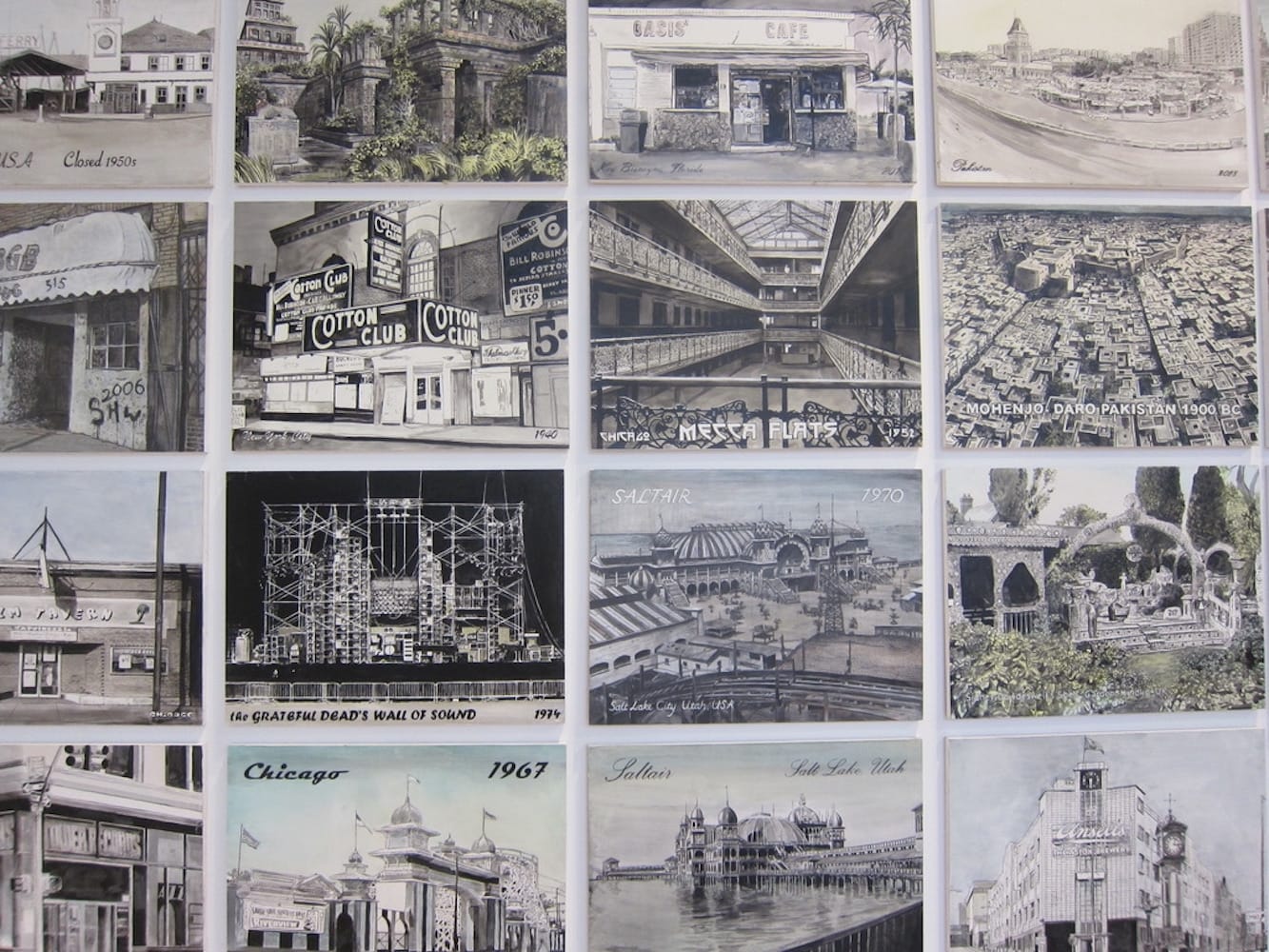 Installation view of Ellen Harvey's The Disappointed Tourist at the Chicago Architecture Center (photo Lori Waxman/Hyperallergic)
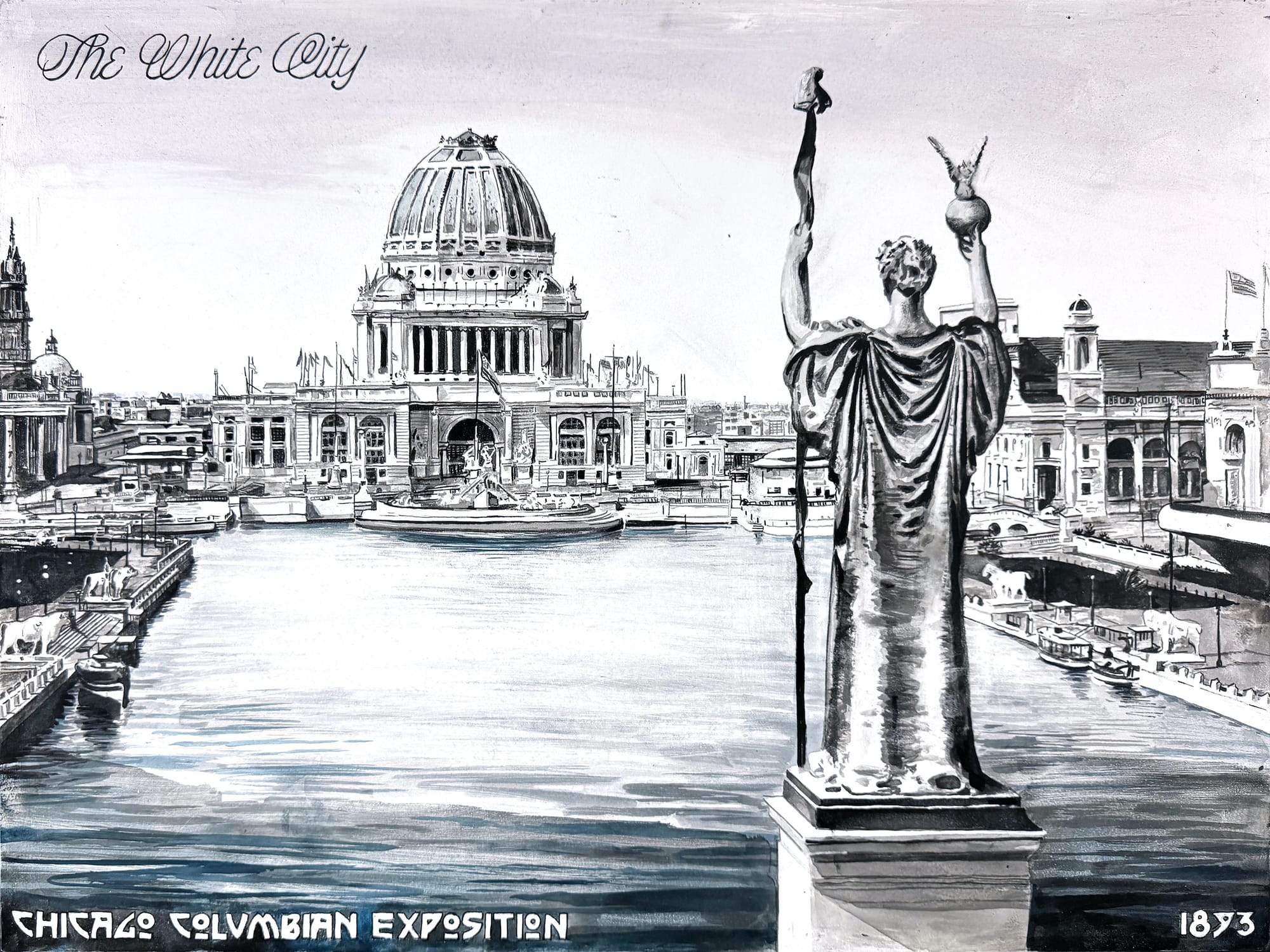 Ellen Harvey, "Columbian Exhibition–The White City" (2025), oil and acrylic on Gessoboard
Enhancement is something of a speciality of Harvey’s. The artist, who was born in 1967 in Kent, England, and moved to the United States with her family as a teen, first came to prominence for her New York Beautification Project. From 1999 to 2001, she surreptitiously painted 40 small oval landscapes — gorgeous little things, skillfully done in oil and looking like Romantic-era tags — onto dumpsters, building facades, structural pylons, doors, basically anywhere in the city she wanted, so long as it had already been graffitied. As an experiment in using traditional art making for contemporary ends, it was both brave and clever. The Disappointed Tourist ups the ante a hundredfold, because now the places have meaning.
Most of what was personally familiar to me from The Disappointed Tourist I knew from my years living in New York in the early aughts, and Harvey’s picturesque vistas stirred up feelings of nostalgia for an especially exciting time in my own life. They also left me sad and frustrated with the unrelenting and uncaring pace of urban development. Florent, the legendary late-night restaurant in the Meatpacking district — closed in 2008 due to rent increases. 5Pointz, that mecca of graffiti art in Long Island City — whitewashed by the landlord in 2013, and soon after torn down and replaced with condominiums. 2 Columbus Circle, the weirdest white whale of a building — reconfigured in 2008 in the most banal way possible by the Museum of Arts and Design, which should have known better. Tower Records, the World Trade Center, a Key Food in Park Slope — all gone. Chicago, where I have lived ever since, and to which Harvey dedicates 14 paintings, hardly fares any better. RIP Berlin nightclub and the original Prentice Women’s Hospital, designed by Bertrand Goldberg in all its curvy concrete glory.
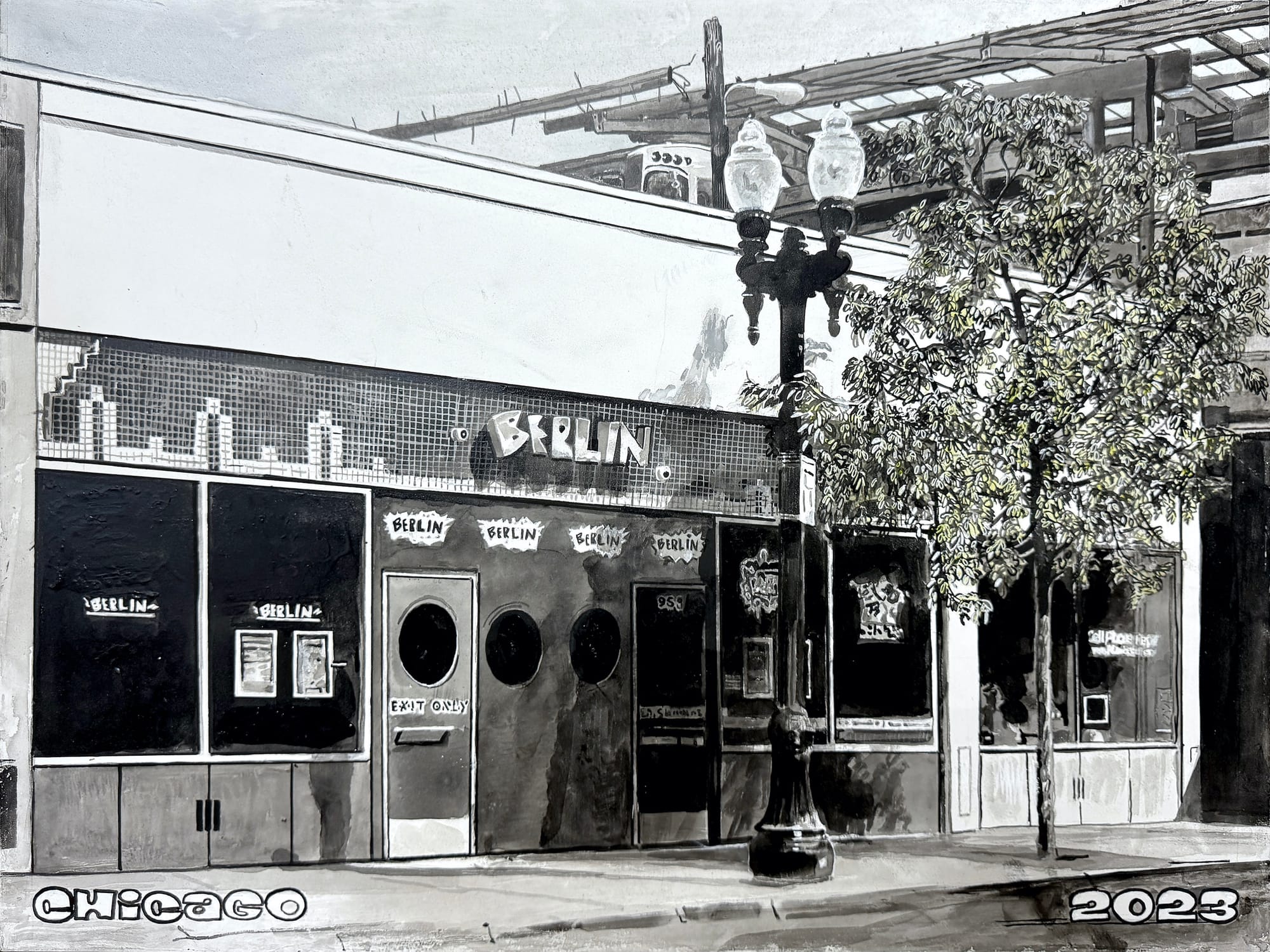 Ellen Harvey, "Berlin nightclub" (2025), oil and acrylic on Gessoboard
Most of those transformations can be attributed to the relatively banal causes of gentrification and corporatization. The destruction of the World Trade Center on September 11, 2001, belongs to a different category entirely, one that accounts for many of the losses on view, from ancient times up to present day. Even without recognizing by name the Great Walls of Benin, Christchurch Greyfriars in London, Sarajevo City Hall, the Temple of Bel in Palmyra, or the Al Nuri Mosque of Mosul, I could confidently guess at which violent conflicts led to their destruction. Sure to be growing in number will be those due to climate change, a list that for now includes the Chacaltaya Glacier in Bolivia, melted away in 2009, and icebergs more generally. Stranger are the casualties of ancient times about which we know little, but can still feel much, like the rainforests that once covered Ireland or the Hanging Gardens of Babylon.
Beyond traumatic disasters, The Disappointed Tourist offers an unofficial survey of what people value most. Panels dedicated to the Salem Oak, the Kletterbaum, the Arbol de la Noche Triste prove that places of significance need not be human-made — though mostly they are, and often they’re quite fun. Leisure complexes of all sorts and all eras figure strongly, from the engineering marvels built for international expositions to stadiums ancient and modern. Amazing bathing facilities of yesteryear abound, including the Moskva Pool, the largest in the world, outdoor, circular, and heated year round in central Moscow, until it was torn down in 1994 and replaced with a cathedral; and the Cliftonville Lido in Margate, England, a complex whose giant seaside pool was filled daily by the tide until its closure in 1978. The Savoy Ballroom, the legendary nightclub of Harlem, is here, as is the Toorak Drive-In, a modest theater in Melbourne. Wildly popular in their heyday all, closed or replaced as entertainment evolved.
And on and on it goes. In a world of endless change and destruction, of bad luck and time passing, The Disappointed Tourist will always have new places to visit, and Ellen Harvey more canvases to fill.
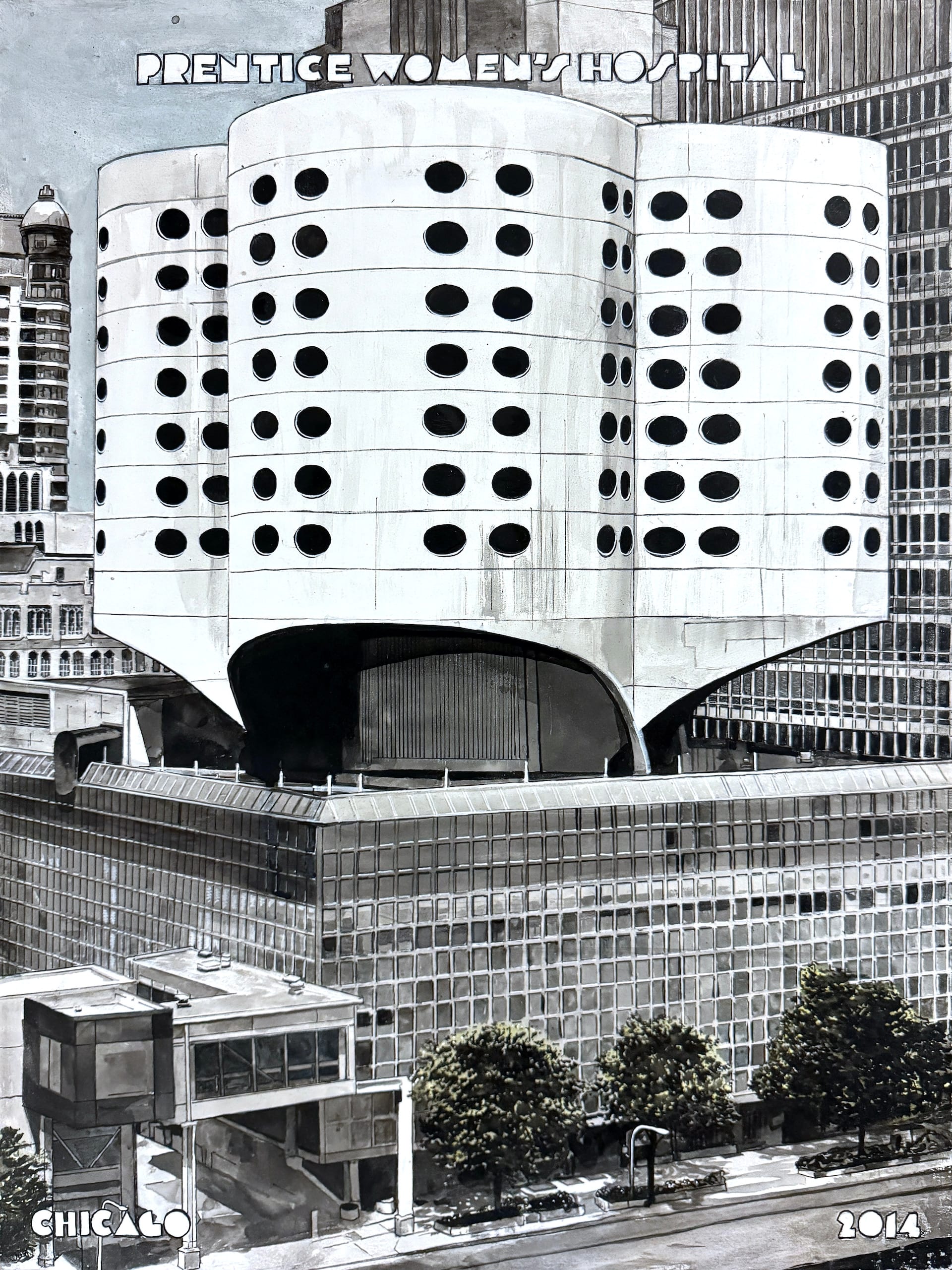 Ellen Harvey, "Prentice Women's Hospital" (2025), oil and acrylic on Gessoboard
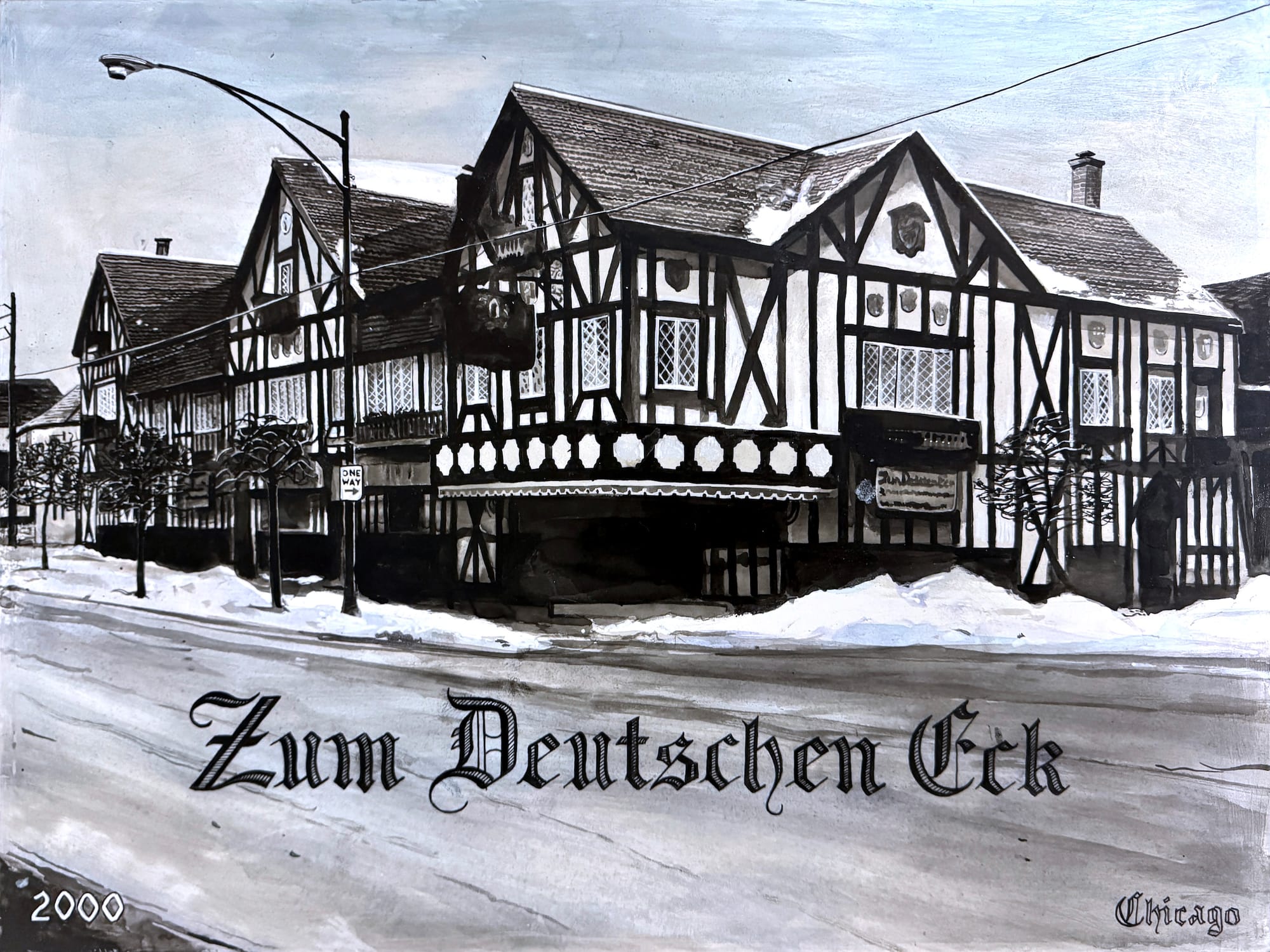 Ellen Harvey, "Zum Deutschen Eck" (2025), oil and acrylic on Gessoboard
The Disappointed Tourist continues at the Chicago Architecture Center (111 East Wacker Drive, Chicago, Illinois) through April 19. The exhibition was curated by CAC Senior Director of Exhibitions Eve Fineman.