- Technology
- Robotics
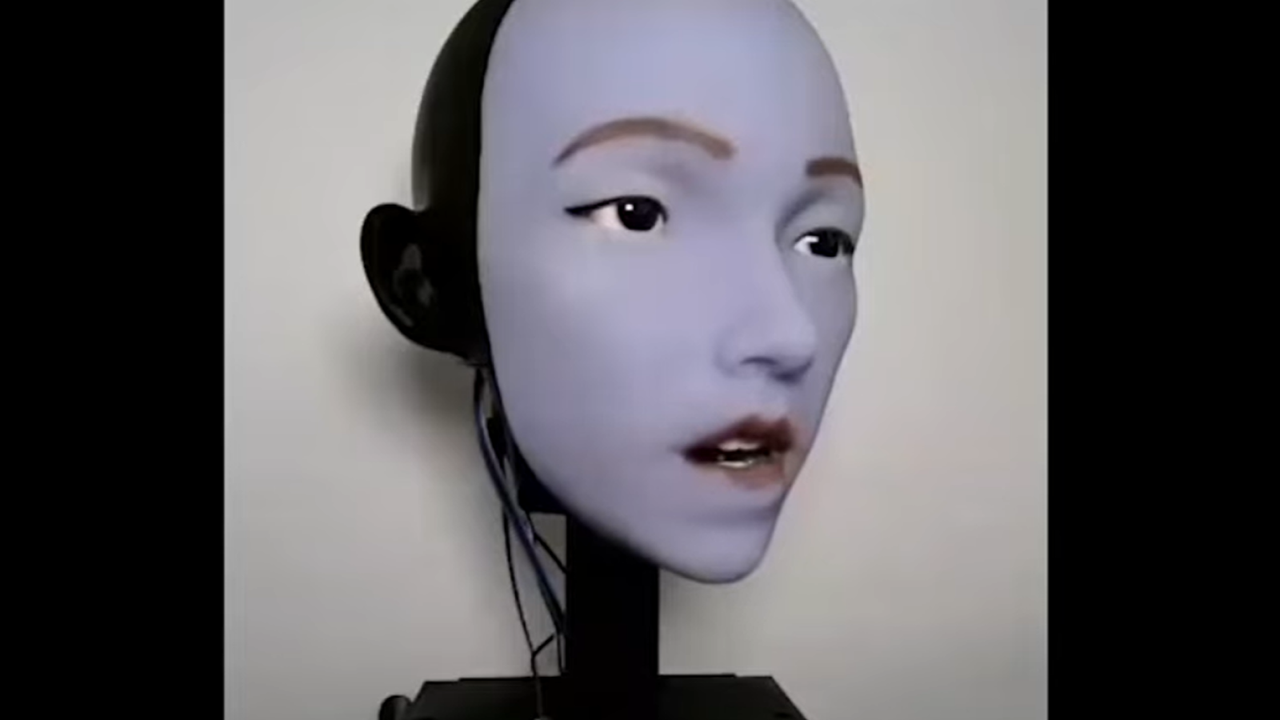
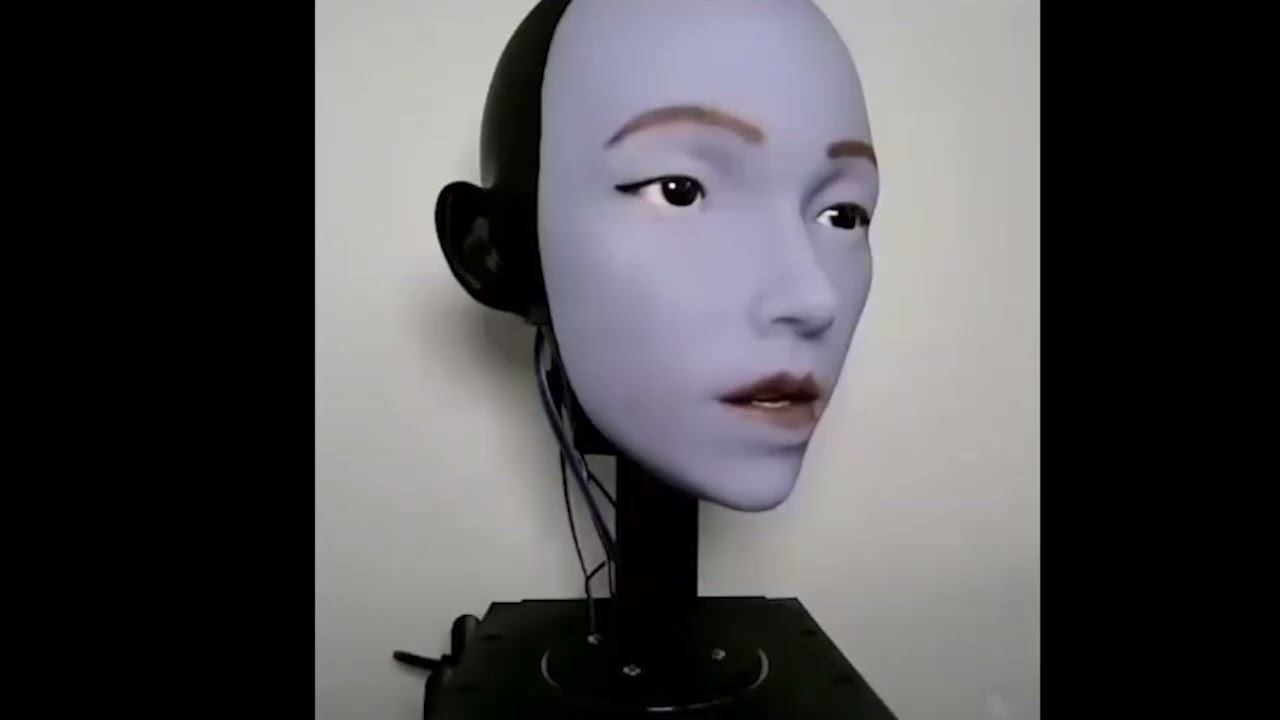
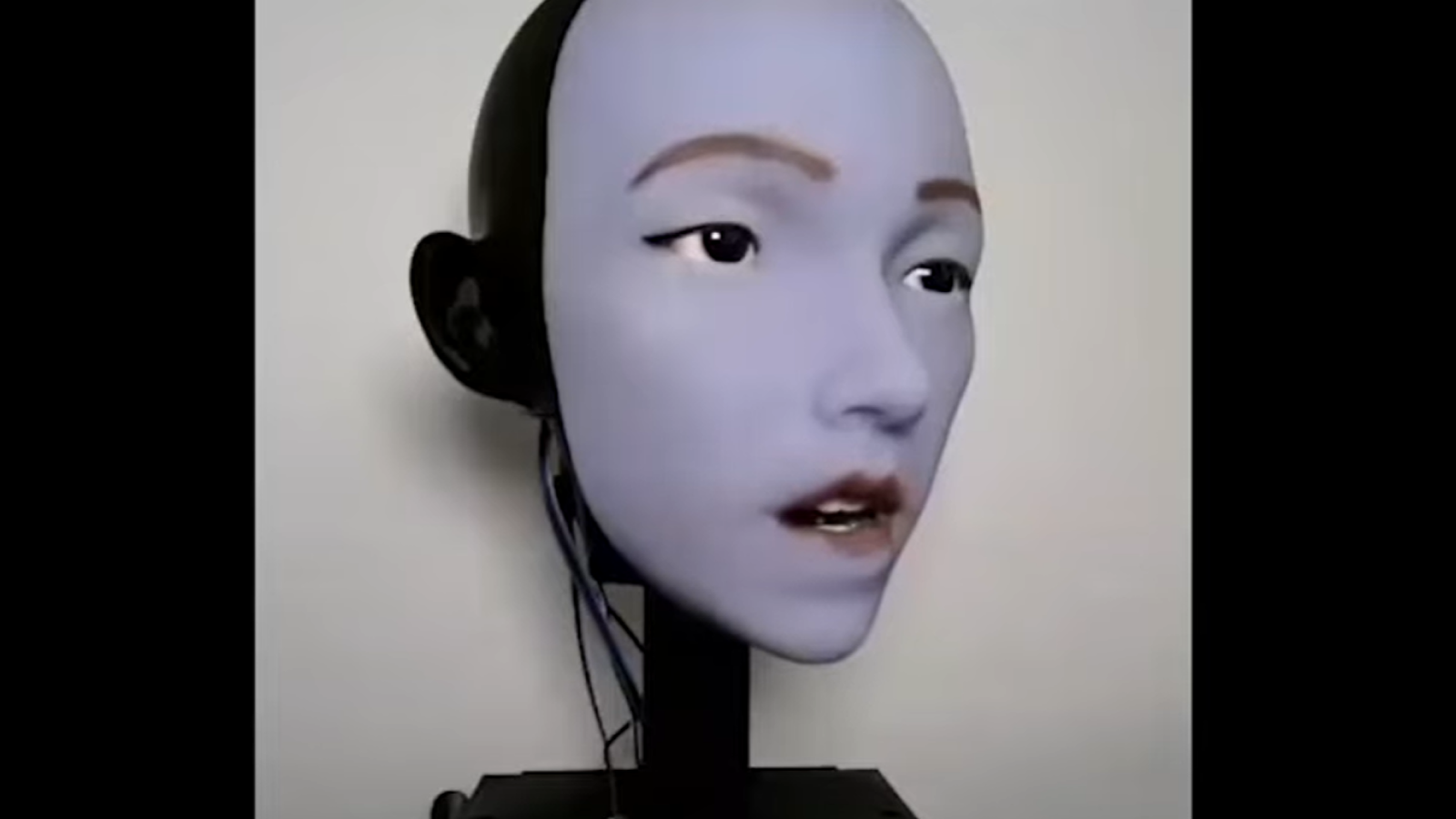
EMO the robot learned how its silicone lips would move in response to its 26 facial motors by staring at its reflection.
When you purchase through links on our site, we may earn an affiliate commission. Here’s how it works.
Share Share by:- Copy link
- X
 Watch On
Can you be certain the person talking to you is 100% absolutely not a robot? Soon, you might not be so sure.
For the first time, scientists have built a robot that can move its mouth exactly like a human. This means it avoids the so-called "uncanny valley" effect, where a bot’s actions appear unsettling because they are uncomfortably close to natural — but don't quite meet that threshold.
The Columbia University researchers achieved the feat by allowing their robot, EMO, to study itself in a mirror. It learned how its flexible face and silicone lips would move in response to the precise actions of its 26 facial motors, each capable of moving in up to 10 degrees of freedom.
You may like-
 Watch: Chinese company's new humanoid robot moves so smoothly, they had to cut it open to prove a person wasn't hiding inside
-
 Why the rise of humanoid robots could make us less comfortable with each other
-
 AI can develop 'personality' spontaneously with minimal prompting, research shows. What does that mean for how we use it?
They outlined their methods in a study published Jan. 14 in the journal Science Robotics.
How EMO learned to move its face like a human
EMO uses an artificial intelligence (AI) system called a "vision-to-action" language model (VLA), meaning it can learn how to translate what it sees into coordinated physical movements without pre-defined rules. During training, the humanoid robot made thousands of seemingly random expressions and lip movements while it stared at its own reflection in the mirror.
Next, the scientists sat EMO in front of hours of YouTube videos showing humans talking in different languages and singing. This allowed it to connect its knowledge of how its motors produced facial movements to the corresponding sounds, all without any understanding of what was being said. Eventually, EMO was able to take spoken audio in 10 different languages and synchronize its lips near-perfectly.
"We had particular difficulties with hard sounds like ‘B’ and with sounds involving lip puckering, such as ‘W’," Hod Lipson, an engineering professor and the director of Columbia’s Creative Machines Lab, said in a statement. "But these abilities will likely improve with time and practice."
Sign up for the Live Science daily newsletter nowContact me with news and offers from other Future brandsReceive email from us on behalf of our trusted partners or sponsorsBy submitting your information you agree to the Terms & Conditions and Privacy Policy and are aged 16 or over.Many a roboticist has tried and failed to create a convincing humanoid, so before unveiling EMO to the world, it needed to be put to the test in front of real people. The scientists then showed videos of the robot speaking using the VLA model, and two other approaches for controlling its mouth, to 1,300 volunteers, — alongside a reference video demonstrating ideal lip motion.
The two other approaches were an amplitude baseline, in which EMO moved its lips based on the loudness of the audio, and a nearest-neighbor landmarks baseline, in which it mimicked facial movements it had seen others make that produced similar sounds. The volunteers were instructed to choose the clip that best matched the ideal lip motion, and they chose VLA for 62.46% of cases — compared to 23.15% and 14.38% for the amplitude and nearest-neighbor landmarks baselines, respectively.
Robot carers will require friendly faces
While there are differences across genders and cultures in how people distribute their gaze, humans in general rely heavily on facial cues when interacting with each other. A 2021 eye-tracking study found that we look at the face of our conversation partners 87% of the time, with roughly 10 to 15% of that time focused specifically on the mouth. Other research has shown that mouth movements are so important that they even affect what we hear.
You may like-
Watch: Chinese company's new humanoid robot moves so smoothly, they had to cut it open to prove a person wasn't hiding inside
-
Why the rise of humanoid robots could make us less comfortable with each other
-
AI can develop 'personality' spontaneously with minimal prompting, research shows. What does that mean for how we use it?
The researchers believe that overlooking the face’s significance is part of the reason other projects have failed to create convincing robots.
"Much of humanoid robotics today is focused on leg and hand motion, for activities like walking and grasping," Lipson said. "But facial affection is equally important for any robotic application involving human interaction."
As AI technology continues to advance at a breakneck pace, robots are expected to take on an increasing number of roles that require direct interaction with humans, including in education, medicine and elderly care. This means their efficacy will correlate to how well they can match human facial expressions.
RELATED STORIES—MIT's new AI can teach itself to control robots by watching the world through their eyes — it only needs a single camera
—Watch this humanlike robot 'rise from the dead' with creepy speed and stability
—China launches world's first robot that can run by itself 24/7
"Robots with this ability will clearly have a much better ability to connect with humans because such a significant portion of our communication involves facial body language, and that entire channel is still untapped," said lead author of the study, Yuhang Hu, in the press release.
But his team is not the only one working on making humanoid robots more lifelike. In October 2025, a Chinese company released a video of an eerily realistic robot head, created as part of their effort to make interactions between people and robots feel more natural. The year before that, a Japanese team unveiled an artificial self-healing skin that could make robot faces look human.
 Fiona Jackson
Fiona Jackson is a freelance writer and editor primarily covering science and technology. She has worked as a reporter on the science desk at MailOnline, and also covered enterprise tech news for TechRepublic, eWEEK, and TechHQ.
Fiona cut her teeth writing human interest stories for global news outlets at the press agency SWNS. She has a Master's degree in Chemistry, an NCTJ Diploma and a cocker spaniel named Sully, who she lives with in Bristol, UK.
Show More CommentsYou must confirm your public display name before commenting
Please logout and then login again, you will then be prompted to enter your display name.
Logout Read more Watch: Chinese company's new humanoid robot moves so smoothly, they had to cut it open to prove a person wasn't hiding inside
 Why the rise of humanoid robots could make us less comfortable with each other
 AI can develop 'personality' spontaneously with minimal prompting, research shows. What does that mean for how we use it?
 New 'Transformer' humanoid robot can launch a shapeshifting drone off its back — watch it in action
 Switching off AI's ability to lie makes it more likely to claim it's conscious, eerie study finds
 AI is getting better and better at generating faces — but you can train to spot the fakes
Latest in Robotics
Why the rise of humanoid robots could make us less comfortable with each other
AI is getting better and better at generating faces — but you can train to spot the fakes
Latest in Robotics
Why the rise of humanoid robots could make us less comfortable with each other
 Creepy robotic hand detaches at the wrist before scurrying away to collect objects
New 'Transformer' humanoid robot can launch a shapeshifting drone off its back — watch it in action
Watch: Chinese company's new humanoid robot moves so smoothly, they had to cut it open to prove a person wasn't hiding inside
Creepy robotic hand detaches at the wrist before scurrying away to collect objects
New 'Transformer' humanoid robot can launch a shapeshifting drone off its back — watch it in action
Watch: Chinese company's new humanoid robot moves so smoothly, they had to cut it open to prove a person wasn't hiding inside
 Bizarre robotic chair concept looks like a crab and can carry you around the house — it can even help you into your car
 Humanoid robots could lift 4,000 times their own weight thanks to breakthrough 'artificial muscle'
Latest in News
Humanoid robots could lift 4,000 times their own weight thanks to breakthrough 'artificial muscle'
Latest in News
 Creepy humanoid robot face learned to move its lips more accurately by staring at itself in the mirror, then watching YouTube
 Shark attacks in Hawaii spike in October, and scientists think they know why
 Rock climbers in Italy accidentally discovered evidence of an 80 million-year-old sea turtle stampede
 IVF hormones could be delivered with painless 'microneedle' patch someday, early study hints
 1,400-year-old Zapotec tomb discovered in Mexico features enormous owl sculpture symbolizing death
 The UK has lost its measles elimination status — again
LATEST ARTICLES
The UK has lost its measles elimination status — again
LATEST ARTICLES 1160,000-year-old sophisticated stone tools discovered in China may not have been made by Homo sapiens
- 2Rock climbers in Italy accidentally discovered evidence of an 80 million-year-old sea turtle stampede
- 3Ancient lake full of crop circles lurks in the shadow of Saudi Arabia's 'camel-hump' mountain — Earth from space
- 4Shark attacks in Hawaii spike in October, and scientists think they know why
- 5IVF hormones could be delivered with painless 'microneedle' patch someday, early study hints