- Space
- Astronomy
- Cosmology
Will two rare supernovas finally tell us how fast the universe is expanding? Perhaps, but we'll have to wait for it for them to 'reappear'.
When you purchase through links on our site, we may earn an affiliate commission. Here’s how it works.
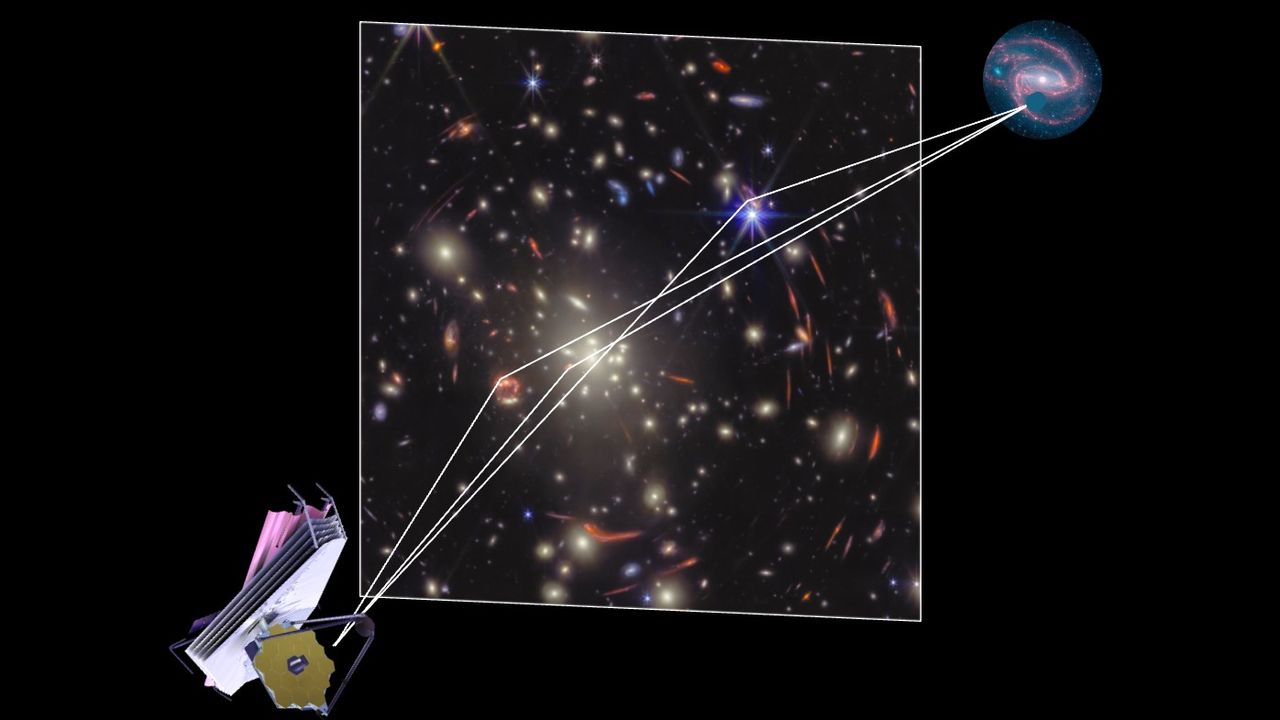
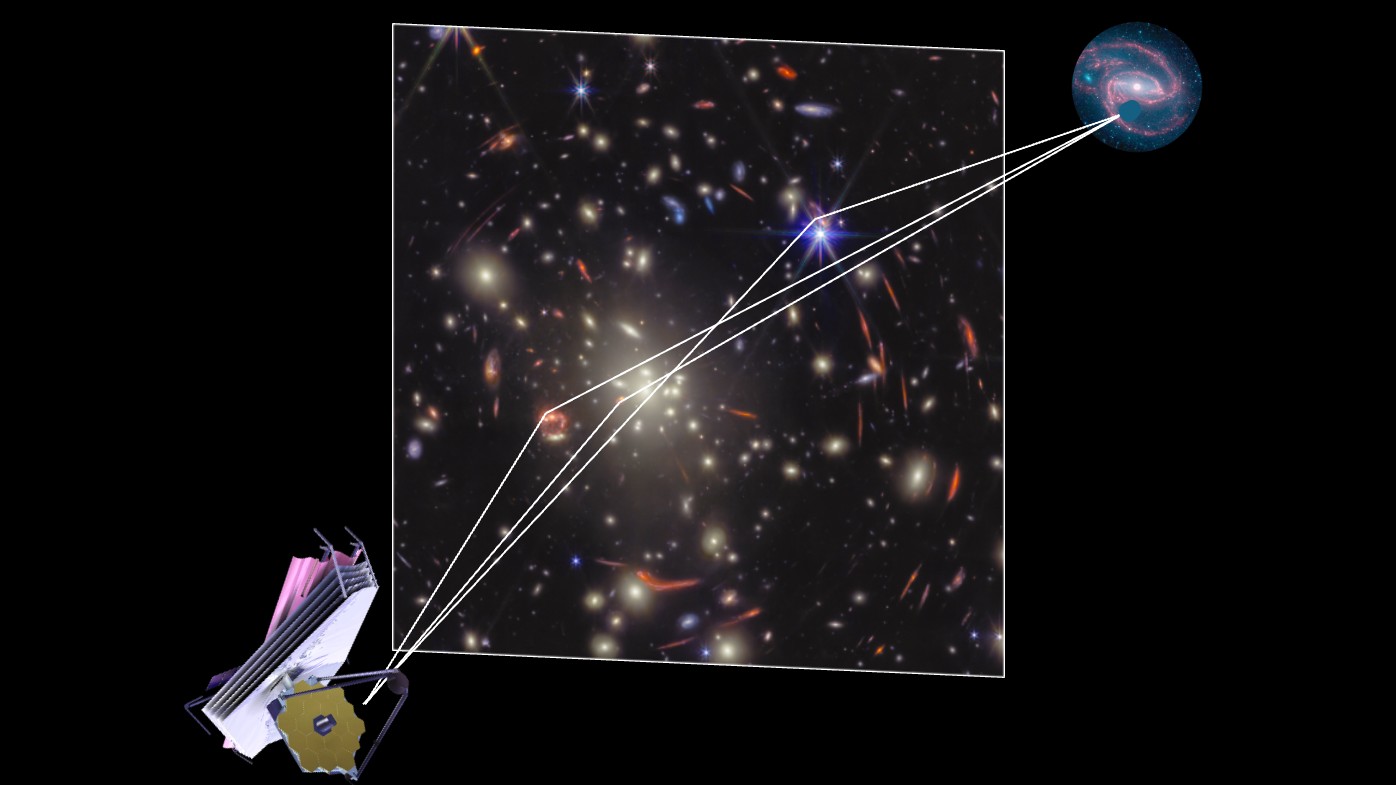 The massive MJ0308 galaxy cluster in the foreground produces a gravitational lensing effect, which causes multiple images of SN Ares to appear.
(Image credit: NASA/ESA/CSA/image processing: Gavin Farley)
Share
Share by:
The massive MJ0308 galaxy cluster in the foreground produces a gravitational lensing effect, which causes multiple images of SN Ares to appear.
(Image credit: NASA/ESA/CSA/image processing: Gavin Farley)
Share
Share by:
- Copy link
- X
Two incredibly rare supernovas that erupted billions of years ago provide a unique opportunity to explain cosmology's biggest mystery — How fast is the universe expanding?
But there's a twist: Even though astronomers have already observed these exploding stars, we will have to wait up to 60 years for their light to reach us again.
A phenomenon called gravitational lensing has split the light from these obliterated stars into multiple images, each of which travels a different path through space-time to reach us. As a result, researchers will one day be able to measure the delay between these ghostly images to offer an unprecedented constraint on the expansion rate of the universe — a problem that has long bedeviled scientists, as the universe appears to be expanding at different rates depending on where they look.
You may like-
 James Webb telescope may have spotted the earliest supernova in the universe
-
 James Webb telescope discovers earliest Type II supernova in the known universe
-
 First-ever 'superkilonova' double star explosion puzzles astronomers
Cosmic magnifying glasses reveal the invisible
These supernova observations are among the first results from the Vast Exploration for Nascent, Unexplored Sources (VENUS) treasury program. The VENUS survey employs the James Webb Space Telescope (JWST) to observe 60 dense galaxy clusters, which act as cosmic lenses that split and focus the light from extremely distant, otherwise invisible sources such as supernovas.
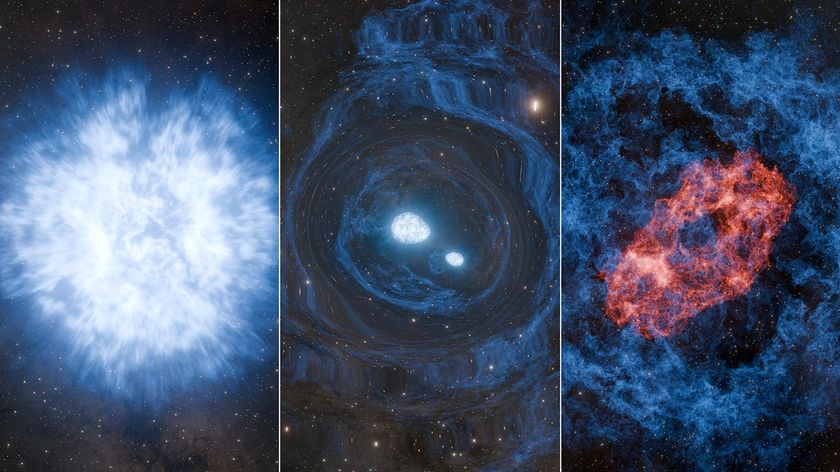
This cosmic phenomenon, called gravitational lensing, is a direct consequence of gravity's effect on the fabric of space-time and was first proposed by Albert Einstein in his theory of relativity. It occurs when a massive celestial object, like a galaxy cluster, bends the light from a more distant source that's located behind it, thus magnifying the object.
"Strong gravitational lensing transforms galaxy clusters into nature's most powerful telescopes," Seiji Fujimoto, principal investigator of the VENUS program and an astrophysicist at the University of Toronto, said in a statement. "VENUS was designed to maximally find the rarest events in the distant Universe, and these lensed [supernovas] are exactly the kind of phenomena that only this approach can reveal."
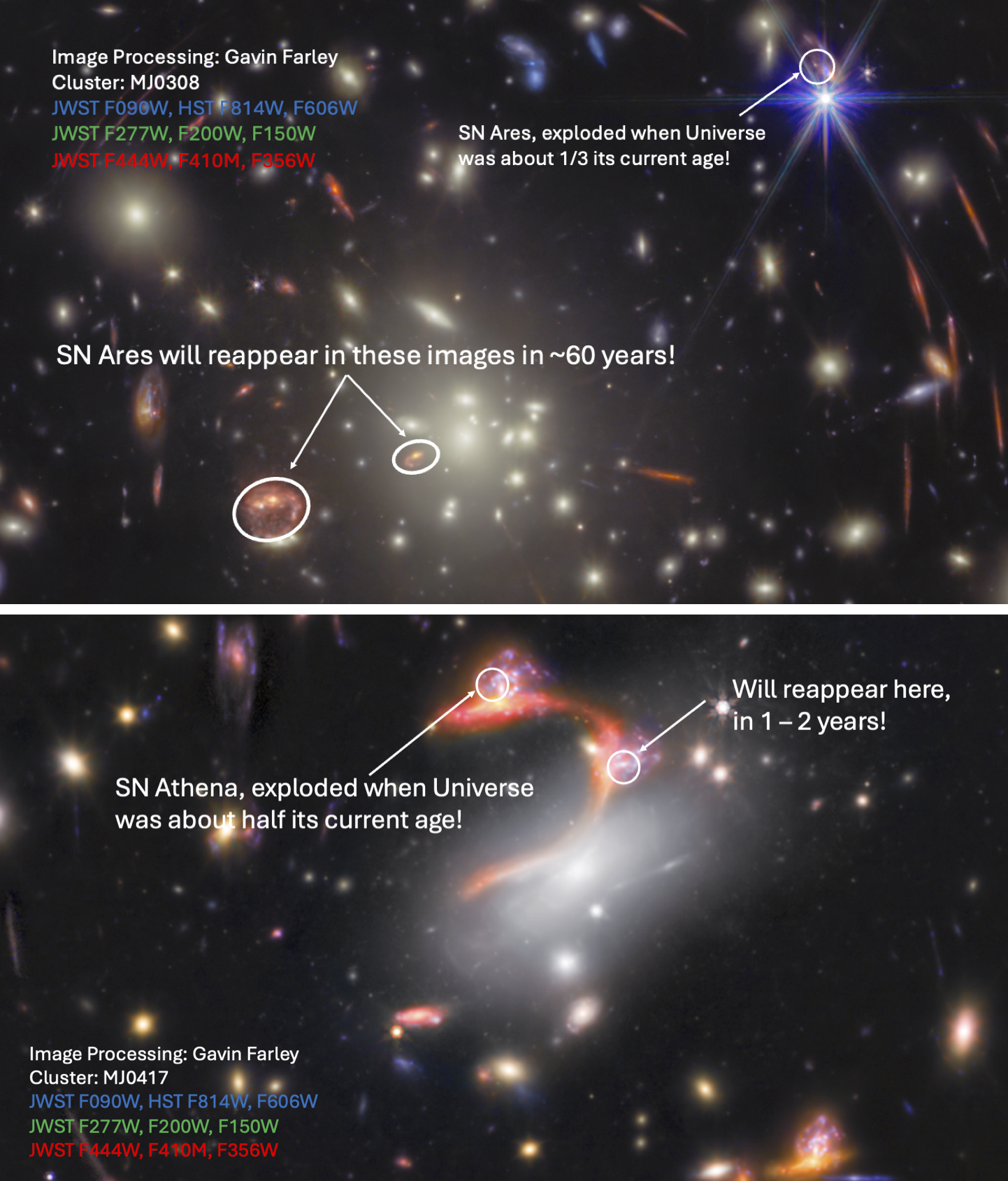
Sign up for the Live Science daily newsletter nowContact me with news and offers from other Future brandsReceive email from us on behalf of our trusted partners or sponsorsBy submitting your information you agree to the Terms & Conditions and Privacy Policy and are aged 16 or over.SN Ares is the first lensed supernova discovered via the VENUS program. The explosion occurred almost 10 billion years ago, when the universe was around one-third its current age. The warp in space-time caused by a foreground galaxy cluster, MJ0308, split the light from SN Ares into three images.
One image has already reached our telescopes. But the light from the other two images passes much closer to the massive center of MJ0308, so it experiences a much greater slowdown due to gravitational time dilation. Therefore, the other two images of SN Ares will arrive in approximately 60 years — an unprecedented delay.
"Such a long anticipated delay between images of a strongly lensed supernova has never been seen before and could be the chance for a predictive experiment that could put unbelievably precise constraints on cosmological evolution," Larison said in a statement.
You may like-
James Webb telescope may have spotted the earliest supernova in the universe
-
James Webb telescope discovers earliest Type II supernova in the known universe
-
First-ever 'superkilonova' double star explosion puzzles astronomers
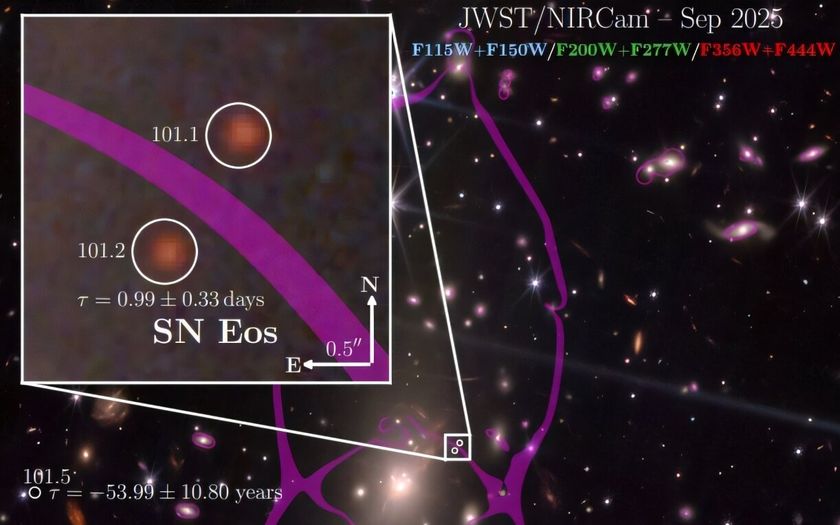
In the meantime, a delayed image of SN Athena, which erupted as a supernova when the universe was about half its current age, is anticipated to arrive in the next one to two years. Although it won't be as cosmologically precise as its mythological half brother Ares, Athena will reveal how accurate our predictive powers have become.
A sorely needed natural experiment
The predicted reappearance of these supernovas, compared with their actual arrival times in the future, will provide precise constraints on the expansion rate of the universe, a value known as the Hubble constant.
Curiously, when cosmologists measure the Hubble constant, they obtain different values based on the measurement method — a disparity known as the Hubble tension. Calculations based on the cosmic microwave background — the oldest light in the universe, emitted when the cosmos was only 380,000 years old — yield a universal expansion rate of 67 kilometers per second per megaparsec.
Yet calculations based on the Hubble Space Telescope's observations of pulsating Cepheid stars, used as "standard candles" for their specific luminosity patterns, yield a value of 73 kilometers per second per megaparsec.
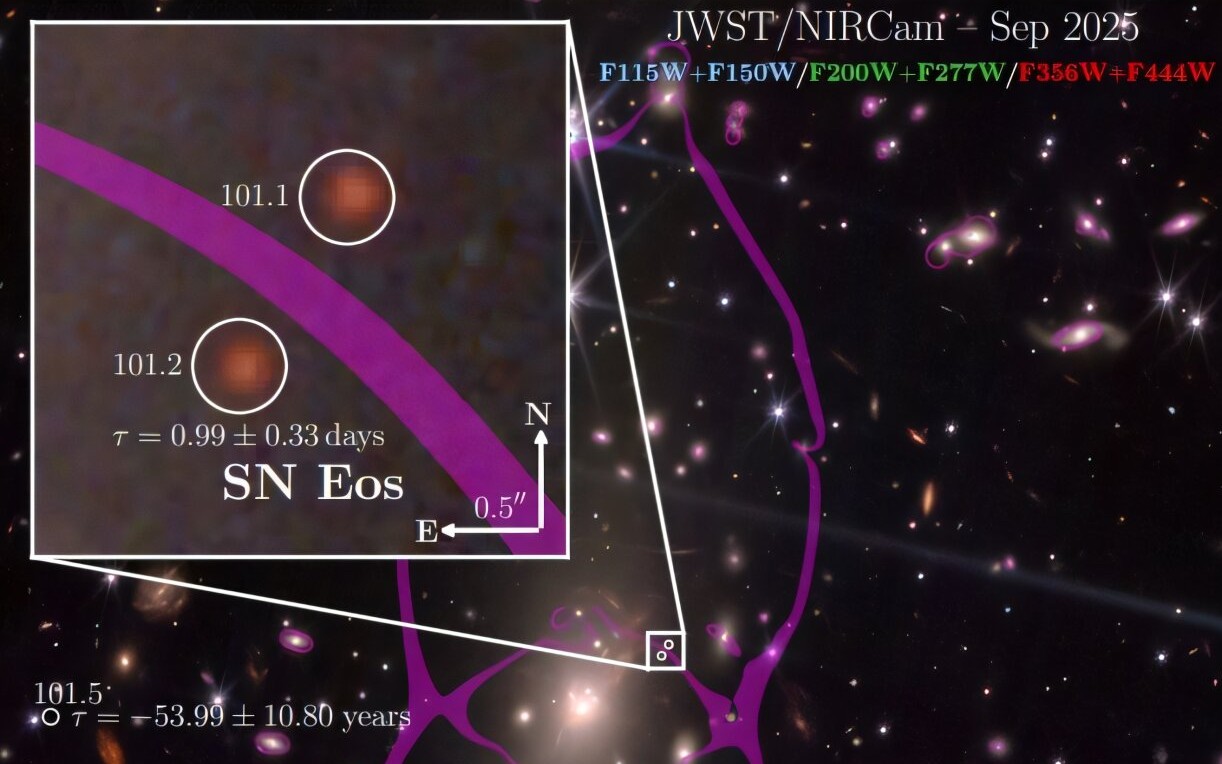
Within the observable sphere of the cosmos, the delayed images from SN Ares and SN Athena may help reconcile the Hubble tension.
"If we can measure the difference in when these images arrive, we recover a measurement of the physical scale of the lensing system which spans the Universe between the supernova and us here on Earth," Larison told Live Science via email. "Any distance measurement we can make like this in the Universe tells us how the Universe has been evolving over cosmic time, as these distances directly depend on this evolution."
Equally importantly, the lensed supernovas allow astronomers to make this measurement in a "single, self-consistent step," Larison added.
The time delays from these supernovas also allow an independent measurement method — unrelated to the cosmic microwave background or standard candles like Cepheid stars — at a time when such a measurement is "sorely needed" to test "possible unknown systematics” governing cosmological expansion.
From Big Bang to big mystery
Coincidentally, 60 years have passed since the first formal suggestion to use lensed supernovas as a tool to explore the universe's expansion. However, fewer than 10 such supernovas had been discovered before the VENUS program observations.
"Since VENUS started last July, we have discovered 8 new lensed supernovae over 43 observations, almost doubling the known sample in a remarkably fast time frame," Larison told Live Science. "It seems that, although lensed supernovae are certainly rare, the real limitation has been in observing capabilities. It is really only with JWST that we are achieving the depth and wavelength coverage necessary to find these en masse, which is exactly what VENUS was designed to do."
related stories—James Webb telescope spots Milky Way's long-lost 'twin' — and it is 'fundamentally changing our view of the early universe'
—'I was astonished': Ancient galaxy discovered by James Webb telescope contains the oldest oxygen scientists have ever seen
—'Totally unexpected' galaxy discovered by James Webb telescope defies our understanding of the early universe
As a result, lensed supernovas may be the most exciting prospects in long-baseline cosmology, the study of how the universe has changed throughout its 13.8 billion years of existence.
The answer is up in the air; there's no guarantee that the expansion of the universe will continue to accelerate, especially as dark energy may be weakening. If it is, then the current expansion of the cosmos could one day become a contraction, having profound consequences on the ultimate fate of the universe.
Ultimately, SN Ares and SN Athena may hint at the potential death of the universe and whether it ends with a roar or a whimper — will the cosmos collapse in a Big Crunch, or expand indefinitely into the thin, cold darkness of a Big Freeze?
Ivan FarkasLive Science ContributorIvan is a long-time writer who loves learning about technology, history, culture, and just about every major “ology” from “anthro” to “zoo.” Ivan also dabbles in internet comedy, marketing materials, and industry insight articles. An exercise science major, when Ivan isn’t staring at a book or screen he’s probably out in nature or lifting progressively heftier things off the ground. Ivan was born in sunny Romania and now resides in even-sunnier California.
View MoreYou must confirm your public display name before commenting
Please logout and then login again, you will then be prompted to enter your display name.
Logout Read more James Webb telescope may have spotted the earliest supernova in the universe
 James Webb telescope discovers earliest Type II supernova in the known universe
 First-ever 'superkilonova' double star explosion puzzles astronomers
 Standard model of cosmology holds up in massive 6-year study of the universe
 Strange, 7-hour explosion from deep space is unlike anything scientists have seen — Space photo of the week
 30 models of the universe proved wrong by final data from groundbreaking telescope
Latest in Cosmology
30 models of the universe proved wrong by final data from groundbreaking telescope
Latest in Cosmology
 James Webb telescope saw black holes emerging from 'cocoons' near the dawn of time
 'How can all of this be happening?': Scientists spot massive group of ancient galaxies so hot they shouldn't exist
30 models of the universe proved wrong by final data from groundbreaking telescope
'How can all of this be happening?': Scientists spot massive group of ancient galaxies so hot they shouldn't exist
30 models of the universe proved wrong by final data from groundbreaking telescope
 James Webb telescope may have found the first stars in the universe, new study claims
 'Puzzling' object discovered by James Webb telescope may be the earliest known galaxy in the universe
 Record-breaking 'dark object' found hiding within a warped 'Einstein ring' 10 billion light-years away
Latest in News
Record-breaking 'dark object' found hiding within a warped 'Einstein ring' 10 billion light-years away
Latest in News
 Earth is 'missing' lighter elements. They may be hiding in its solid inner core.
 Lifespan may be 50% heritable, study suggests
Astronomers spot 'time-warped' supernovas whose light both has and hasn't reached Earth
Lifespan may be 50% heritable, study suggests
Astronomers spot 'time-warped' supernovas whose light both has and hasn't reached Earth
 Life may have rebounded 'ridiculously fast' after the dinosaur-killing asteroid impact
 'Nose-in-a-dish' reveals why the common cold hits some people hard, while others recover easily
 Rare medieval seal discovered in UK is inscribed with 'Richard's secret' and bears a Roman-period gemstone
LATEST ARTICLES
Rare medieval seal discovered in UK is inscribed with 'Richard's secret' and bears a Roman-period gemstone
LATEST ARTICLES 1'It's similar to how Google can map your home without your consent': Why using aerial lasers to map an archaeology site should have Indigenous partnership
- 2'Nose-in-a-dish' reveals why the common cold hits some people hard, while others recover easily
- 3Earth is 'missing' lighter elements. They may be hiding in its solid inner core.
- 4Oneisall Pet Air Purifier (PP02) review: Great value pick for dog and cat lovers
- 5Rare medieval seal discovered in UK is inscribed with 'Richard's secret' and bears a Roman-period gemstone