- Search What are you curious about? Popular SearchesCritical thinkingPhilosophyEmotional IntelligenceFree Will Latest Videos Latest Articles
-
Topics
Philosophy
- Ethics
- Religion
- Flourishing
- Knowledge
- Philosophy of Science
- Philosophy of Art
- Language
- Political Theory
- Identity
- Meaning & Purpose
Science & Tech
- Physics
- Biology
- Aerospace
- Health
- Geology
- Computing
- Engineering
- Energy
- Biotechnology
- Astronomy
Mind & Behavior
- Psychology
- Neuroscience
- Decision-Making
- Mental Health
- Consciousness
- Emotional Intelligence
- Personality
- Relationships
- Parenting
Business
- Entrepreneurship
- Leadership
- Finance
- Marketing
- Innovation
- Strategy
- Management
- Artificial Intelligence
- Startups
- Economics
History & Society
- History
- Literature
- Art
- Music
- Film
- Progress
- Culture
- Sociology
- Policy
- Geopolitics
- Latest
-
Videos
Latest Videos
 Why pain doesn’t need to teach you anything
with
Kate Bowler
Why pain doesn’t need to teach you anything
with
Kate Bowler
 The block universe: a theory where every moment already exists
with
Jim Al-Khalili
The block universe: a theory where every moment already exists
with
Jim Al-Khalili
 Why alien civilizations may bloom and die unseen
with
Brian Cox
Why alien civilizations may bloom and die unseen
with
Brian Cox
 A look into the mind of someone without empathy
with
Abigail Marsh
A look into the mind of someone without empathy
with
Abigail Marsh
 How experimental archaeologists are resurrecting our forgotten past
with
Sam Kean
How experimental archaeologists are resurrecting our forgotten past
with
Sam Kean
 We’ve been looking for life. Here’s why we should look for intelligence instead
with
Sara Seager
See All
We’ve been looking for life. Here’s why we should look for intelligence instead
with
Sara Seager
See All
-
Columns
 Mini Philosophy
A philosophy column for personal reflection.
Mini Philosophy
A philosophy column for personal reflection.
 Starts With A Bang
An astrophysics column on big questions and our universe.
Starts With A Bang
An astrophysics column on big questions and our universe.
 Books
A literature column to feed your curiosity.
Books
A literature column to feed your curiosity.
 The Long Game
A business column on long-term thinking.
The Long Game
A business column on long-term thinking.
 Strange Maps
A geography column on history and society.
Strange Maps
A geography column on history and society.
 The Well
A collection of essays and videos on life’s biggest questions.
The Well
A collection of essays and videos on life’s biggest questions.
 13.8
A column at the intersection of science and culture.
13.8
A column at the intersection of science and culture.
-
Classes
Featured Classes
 Members
8 videos
Cultivating the Conditions for Innovation
Martin Gonzalez
Members
8 videos
Cultivating the Conditions for Innovation
Martin Gonzalez
 Members
5 videos
The Humanity of Leadership
Simon Sinek
Ethnographer and author
Members
5 videos
The Humanity of Leadership
Simon Sinek
Ethnographer and author
 Members
7 videos
How to Lead With Integrity
Steve Stoute
Founder and CEO, UnitedMasters and Translation
Members
7 videos
How to Lead With Integrity
Steve Stoute
Founder and CEO, UnitedMasters and Translation
 Members
6 videos
Transform Your Organization with AI
Daphne Koller
Founder and CEO of insitro.
Members
6 videos
Transform Your Organization with AI
Daphne Koller
Founder and CEO of insitro.
 Members
10 videos
Unlocking Your Team’s Hidden Potential
Adam Grant
Organizational psychologist and author
Members
10 videos
Unlocking Your Team’s Hidden Potential
Adam Grant
Organizational psychologist and author
 Members
6 videos
The Secrets of Unreasonable Hospitality
Will Guidara
Restaurateur and Author, Unreasonable Hospitality
Browse
Members
6 videos
The Secrets of Unreasonable Hospitality
Will Guidara
Restaurateur and Author, Unreasonable Hospitality
Browse
-
More
- Newsletters
- Monthly Issues
- Events
- Big Think+ Learning
- Creative Studio
- Advertise with Us
- About
- Careers
- View our Twitter (X) feed View our Youtube channel View our Instagram feed View our Substack feed
-
My account
- My Classes
- My Account
- My List
- BT+ for my Business
- Early Releases
- Sign Out
- Membership
- Latest
-
Topics
Back
Philosophy
Science & Tech
Mind & Behavior
Business
History & Society
-
Videos
Back
Latest Videos
Why pain doesn’t need to teach you anything
Not every hard thing happens for a reason, says Duke historian and writer Kate Bowler. She explains how our need...
The block universe: a theory where every moment already exists
Theoretical physicist Jim Al-Khalili explores why our sense of time may be incredibly misleading, including the idea that past, present,...
Why alien civilizations may bloom and die unseen
Brian Cox examines why, despite billions of stars and trillions of planets, we have found no evidence of other intelligent...
A look into the mind of someone without empathy
Abigail Marsh unpacks what defines psychopathy, how it differs from antisocial behavior, and why terms like “sociopath” only add confusion.
How experimental archaeologists are resurrecting our forgotten past
Sam Kean examines how rogue archaeologists are recreating the sounds, tastes, smells, and practices of the ancient past.
We’ve been looking for life. Here’s why we should look for intelligence instead
Thanks to modern tech, Earth is now considered a ‘detectable’ planet. Astrophysicist Sara Seager explains how this idea can lead...
 The tiny transistors remaking our global order
"The production of the silicon wafers that are used in the chip manufacturing process requires extraordinary levels of purity."
The tiny transistors remaking our global order
"The production of the silicon wafers that are used in the chip manufacturing process requires extraordinary levels of purity."
 The biological necessity of boredom in the age of screens
"I call it a tyranny of attention because there's so many demands on our attention coming from so many different...
The biological necessity of boredom in the age of screens
"I call it a tyranny of attention because there's so many demands on our attention coming from so many different...
-
Columns
Back
Columns
Mini Philosophy
A philosophy column for personal reflection.
Starts With A Bang
An astrophysics column on big questions and our universe.
Books
A literature column to feed your curiosity.
The Long Game
A business column on long-term thinking.
Strange Maps
A geography column on history and society.
The Well
A collection of essays and videos on life’s biggest questions.
13.8
A column at the intersection of science and culture.
-
Classes
Back
Featured Classes
Members
8 videos
Cultivating the Conditions for Innovation
Martin Gonzalez
Members
5 videos
The Humanity of Leadership
Simon Sinek
Ethnographer and author
Members
7 videos
How to Lead With Integrity
Steve Stoute
Founder and CEO, UnitedMasters and Translation
Members
6 videos
Transform Your Organization with AI
Daphne Koller
Founder and CEO of insitro.
Members
10 videos
Unlocking Your Team’s Hidden Potential
Adam Grant
Organizational psychologist and author
Members
6 videos
The Secrets of Unreasonable Hospitality
Will Guidara
Restaurateur and Author, Unreasonable Hospitality
- My Account Back
- Sign In
- Membership
- More Back
Resembling a cosmic brain, the Exposed Cranium Nebula instead shows a dying, massive star, as JWST reveals. Its fate remains uncertain.
by Ethan Siegel March 9, 2026 Known as the Exposed Cranium Nebula, this dual view shows the nebula PMR 1 surrounding a late-stage star that's significantly more massive than the Sun. At left, JWST's NIRCam views reveal a faint outer shell of gas with a dust-rich series of complex structures inside, while at right, mid-infrared views reveal more of the heated, glowing material but fewer filamentary details and fewer background stars and galaxies. These are the sharpest, clearest view of the Exposed Cranium Nebula ever acquired, by far.
Credit: NASA, ESA, CSA, STScI; Image Processing: Joseph DePasquale (STScI)
Key Takeaways- When stars approach their deaths, they routinely exhibit large winds, ejecting and blowing off their outer layers before the star’s central core either gently contracts or violently detonates.
- In the case of the Exposed Cranium Nebula, PMR 1, we’re seeing a star several times as massive as the Sun in its final living stages: just a few thousand years away from its eventual, ultimate fate.
- We’re unsure of whether it will die explosively in a supernova or quietly to form a white dwarf, but we can see multiple layers to its ejecta right now, in a best-ever dual view provided by JWST.

An astrophysics column on big questions and our universe.
Get our free newsletter on Substack-
Science and TechAstrophysicsAstronomySpace ExplorationStellar Evolution
Whenever stars are born, their masses determine their fates.
 The (modern) Morgan–Keenan spectral classification system, with the surface temperature range of each star class shown above it, in kelvin. The overwhelming majority of stars today are M-class stars, with only 1 known O- or B-class star within 25 parsecs. Our Sun is a G-class star, along with about 5-10% of total stars. However, in the early Universe, almost all of the stars were O- or B-class stars, with an average mass 25 times greater than average stars today. In general, more massive stars live shorter lives, and die in more explosive fates.
Credit: LucasVB/Wikimedia Commons; Annotations: E. Siegel
Sun-like stars evolve into giants, blow off their outer layers, and contract: forming white dwarfs.
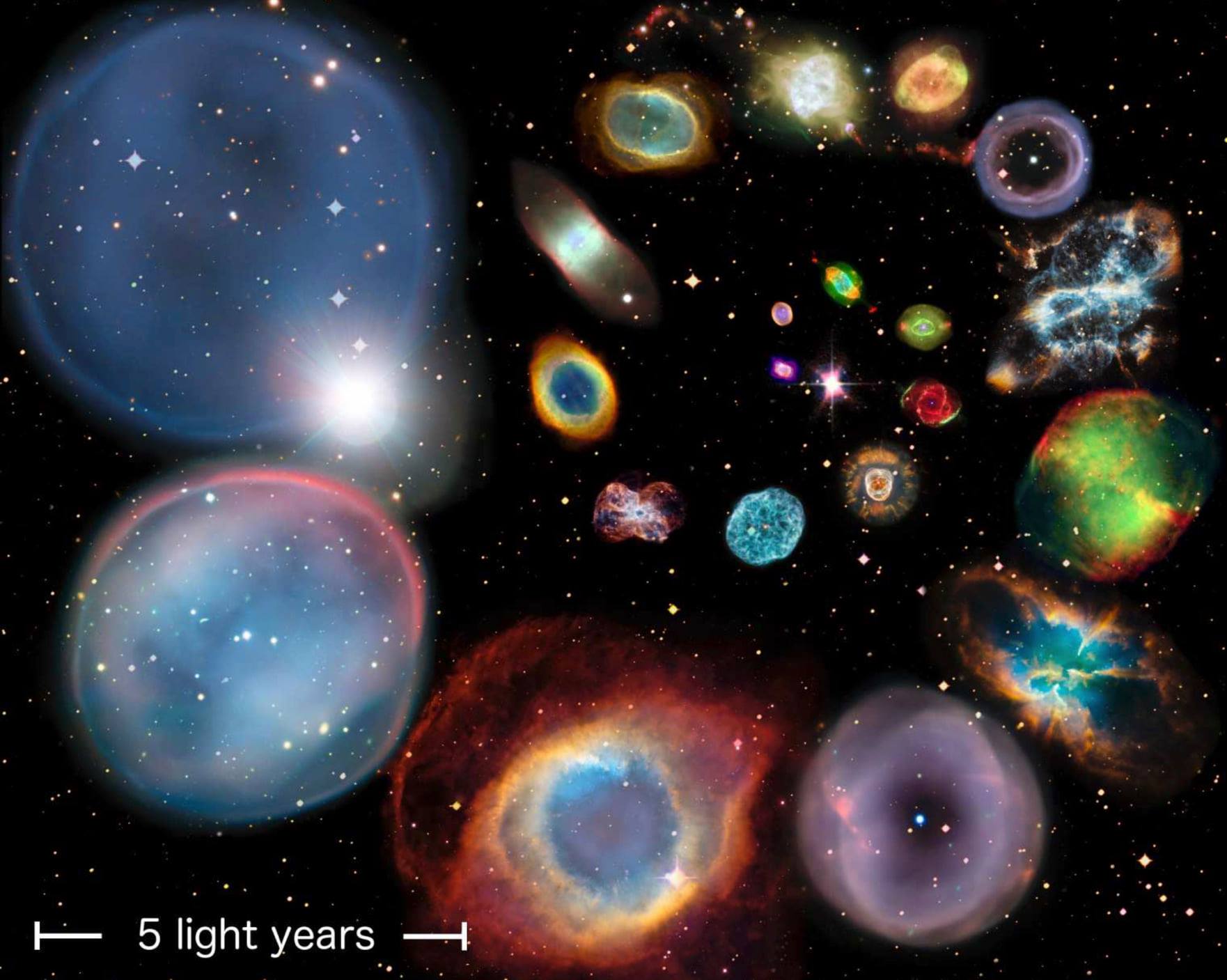 From their earliest beginnings to their final extent before fading away, Sun-like stars will grow from their present size to the size of a red giant (~the Earth’s orbit) to up to ~5 light-years in diameter, typically. The largest known planetary nebulae can reach approximately double that size, up to ~10 light-years across. Typically, stars born with 8 solar masses or under can experience this fate, but observing an evolved Sun-like star is often ambiguous as far as determining its ultimate demise.
Credit: Ivan Bojičić, Quentin Parker, and David Frew, Laboratory for Space Research, HKU
Significantly more massive stars become supergiants, destined to violently die in supernovae.
 When stars run out of hydrogen in their cores, they evolve off of the main sequence, becoming subgiants, then red giants, then igniting helium in their cores (which is the tip-of-the-red-giant branch phase), and then evolving onto the horizontal branch and eventually into supergiants (for high-mass stars) or into the asymptotic giant branch (for non-high-mass stars) before dying. The mass of a star determines its ultimate fate, but the rate of fusion is set by other internal properties.
Credit: Starhuckster.com
When stars run out of hydrogen in their cores, they evolve off of the main sequence, becoming subgiants, then red giants, then igniting helium in their cores (which is the tip-of-the-red-giant branch phase), and then evolving onto the horizontal branch and eventually into supergiants (for high-mass stars) or into the asymptotic giant branch (for non-high-mass stars) before dying. The mass of a star determines its ultimate fate, but the rate of fusion is set by other internal properties.
Credit: Starhuckster.com
The line separating the two is blurry, as both star types experience winds and ejecta before dying.
 This infographic shows nine of the ten historical supernovae, along with remnants, that have been identified over the past 2000 years within the Milky Way. Not shown is G1.9+0.3, which occurred near the galactic center approximately 155 years ago, but was only discovered posthumously in 1985. Our best supernova remnant observations all come from NASA’s Chandra X-ray telescope.
Credit: NASA/Chandra X-ray telescope
This infographic shows nine of the ten historical supernovae, along with remnants, that have been identified over the past 2000 years within the Milky Way. Not shown is G1.9+0.3, which occurred near the galactic center approximately 155 years ago, but was only discovered posthumously in 1985. Our best supernova remnant observations all come from NASA’s Chandra X-ray telescope.
Credit: NASA/Chandra X-ray telescope
Around 5000 light-years away, the faint nebula PMR 1 hides a star whose fate is not yet known.
 This view from the Digitized Sky Survey shows the area of the sky where nebula PMR 1, also known as the Exposed Cranium Nebula, is located. Note that almost no visual signature of the Nebula’s existence can be spotted in visible light wavelengths.
Credit: Digitized Sky Survey/Association for Universities for Research in Astronomy; Animation: E. Siegel
This view from the Digitized Sky Survey shows the area of the sky where nebula PMR 1, also known as the Exposed Cranium Nebula, is located. Note that almost no visual signature of the Nebula’s existence can be spotted in visible light wavelengths.
Credit: Digitized Sky Survey/Association for Universities for Research in Astronomy; Animation: E. Siegel
NASA’s Spitzer revealed its structure in 2013, bestowing a nickname: the Exposed Cranium Nebula.
 This was the first high-quality image of the structure of the nebula surrounding the star at the center of PMR 1. Taken by NASA’s Spitzer in 2013, it was Spitzer scientists who coined the name “Exposed Cranium Nebula” on account of the object’s shape. The ionized gas at the center is surrounded by a glowing reservoir of hydrogen gas: reflecting the maximum amount of science extractable from the Spitzer data.
Credit: NASA/JPL-Caltech/J. Hora (Harvard-Smithsonian CfA)
This was the first high-quality image of the structure of the nebula surrounding the star at the center of PMR 1. Taken by NASA’s Spitzer in 2013, it was Spitzer scientists who coined the name “Exposed Cranium Nebula” on account of the object’s shape. The ionized gas at the center is surrounded by a glowing reservoir of hydrogen gas: reflecting the maximum amount of science extractable from the Spitzer data.
Credit: NASA/JPL-Caltech/J. Hora (Harvard-Smithsonian CfA)
Gaia data, although powerful, showcased nothing of visual interest.
 This view of a specific region of space shows data from the Gaia mission, with many objects of interest highlighted in blue circles. The red circle, added for clarity, shows the location of PMR 1 and the Exposed Cranium Nebula, which does not exhibit a visually interesting signature in Gaia data.
Credit: ESA/Gaia, Legacy Surveys/D. Lang (Perimeter Institute); Animation: E. Siegel
This view of a specific region of space shows data from the Gaia mission, with many objects of interest highlighted in blue circles. The red circle, added for clarity, shows the location of PMR 1 and the Exposed Cranium Nebula, which does not exhibit a visually interesting signature in Gaia data.
Credit: ESA/Gaia, Legacy Surveys/D. Lang (Perimeter Institute); Animation: E. Siegel
All it revealed was a reddened core: evidence of its dust-rich nature.
 Using data from Gaia, the central stars of many nebulae were catalogued and had their properties extracted, including the core of the Exposed Cranium Nebula, marked as PMR 1 here. It is one of the most severely reddened objects, as indicated by its presence far to the right on this graph, of all the stars found at the cores of nebulae.
Credit: N. Chornay and N.A. Walton, Astronomy & Astrophysics, 2020
Using data from Gaia, the central stars of many nebulae were catalogued and had their properties extracted, including the core of the Exposed Cranium Nebula, marked as PMR 1 here. It is one of the most severely reddened objects, as indicated by its presence far to the right on this graph, of all the stars found at the cores of nebulae.
Credit: N. Chornay and N.A. Walton, Astronomy & Astrophysics, 2020
However, JWST just imaged it across many wavelengths, with both NIRCam and MIRI.
 All told, the Exposed Cranium Nebula was imaged in a total of 8 different filters by JWST: at 1.5, 1.87, 4.44, and 4.70 microns in near-infrared wavelengths, as well as 10.0, 11.3, 12.8, and 18.0 microns by the mid-infrared instrument. The nebula itself is about two light-years in diameter, although NIRCam and MIRI views showcase vastly different details from one another: about the Nebula as well as what lies behind/around it.
Credit: NASA, ESA, CSA, STScI; Image Processing: Joseph DePasquale (STScI)
All told, the Exposed Cranium Nebula was imaged in a total of 8 different filters by JWST: at 1.5, 1.87, 4.44, and 4.70 microns in near-infrared wavelengths, as well as 10.0, 11.3, 12.8, and 18.0 microns by the mid-infrared instrument. The nebula itself is about two light-years in diameter, although NIRCam and MIRI views showcase vastly different details from one another: about the Nebula as well as what lies behind/around it.
Credit: NASA, ESA, CSA, STScI; Image Processing: Joseph DePasquale (STScI)
Near-infrared views showcase early hydrogen ejecta and complex, dusty internal structure.
 At the heart of the Exposed Cranium Nebula is a massive star: several times more massive than the Sun, close to the border of stars that die to form planetary nebulae and white dwarfs versus those that explode in supernovae and leave neutron stars behind. The multi-layered ejecta that enshrouds the central star creates enough uncertainty that despite the quality of JWST imagery, we still do not know this star’s future fate for certain.
Credit: NASA, ESA, CSA, STScI; Image Processing: Joseph DePasquale (STScI)
At the heart of the Exposed Cranium Nebula is a massive star: several times more massive than the Sun, close to the border of stars that die to form planetary nebulae and white dwarfs versus those that explode in supernovae and leave neutron stars behind. The multi-layered ejecta that enshrouds the central star creates enough uncertainty that despite the quality of JWST imagery, we still do not know this star’s future fate for certain.
Credit: NASA, ESA, CSA, STScI; Image Processing: Joseph DePasquale (STScI)
Meanwhile, mid-infrared views highlight the heated dusty innards, including along the dust lanes.
 This mid-infrared view of the Exposed Cranium Nebula from JWST’s MIRI instrument shows off two distinct phases from how the nebula was formed: an earlier stage where mostly hydrogen was expelled, followed by a more complex mix of material, rich in wispy structure, found closer to the nebula’s center. More ejected material is seen in MIRI’s views than NIRCam’s views, highlighting the asymmetric nature of the nebula.
Credit: NASA, ESA, CSA, STScI; Image Processing: Joseph DePasquale (STScI)
This mid-infrared view of the Exposed Cranium Nebula from JWST’s MIRI instrument shows off two distinct phases from how the nebula was formed: an earlier stage where mostly hydrogen was expelled, followed by a more complex mix of material, rich in wispy structure, found closer to the nebula’s center. More ejected material is seen in MIRI’s views than NIRCam’s views, highlighting the asymmetric nature of the nebula.
Credit: NASA, ESA, CSA, STScI; Image Processing: Joseph DePasquale (STScI)
Dividing the exposed cranium’s “hemispheres” in NIRCam data, the MIRI data instead unifies them.
 The central dust lane that bisects the Exposed Cranium Nebula appears very different in mid-infrared views (left) versus near-infrared views (right) with JWST. While the dust lane is present in both, MIRI’s views focus on the heated material within or behind the dust, showing a significantly extended structure. Meanwhile, the dust blocks most of the near-infrared light in NIRCam’s views, dividing the cranium into two hemisphere-like structures.
Credit: NASA, ESA, CSA, STScI; Image Processing: Joseph DePasquale (STScI)
The central dust lane that bisects the Exposed Cranium Nebula appears very different in mid-infrared views (left) versus near-infrared views (right) with JWST. While the dust lane is present in both, MIRI’s views focus on the heated material within or behind the dust, showing a significantly extended structure. Meanwhile, the dust blocks most of the near-infrared light in NIRCam’s views, dividing the cranium into two hemisphere-like structures.
Credit: NASA, ESA, CSA, STScI; Image Processing: Joseph DePasquale (STScI)
The central star’s fate and nature remains unknown.
 This view of the central core of the Exposed Cranium Nebula shows the brightest star found in/near the extreme center, which may be either a red giant or a red supergiant that’s behind the central dust lane separating the cranium’s two so-called “hemispheres.” The star’s mass, nature, and ultimate fate remains uncertain at this time.
Credit: NASA, ESA, CSA, STScI; Image Processing: Joseph DePasquale (STScI)
This view of the central core of the Exposed Cranium Nebula shows the brightest star found in/near the extreme center, which may be either a red giant or a red supergiant that’s behind the central dust lane separating the cranium’s two so-called “hemispheres.” The star’s mass, nature, and ultimate fate remains uncertain at this time.
Credit: NASA, ESA, CSA, STScI; Image Processing: Joseph DePasquale (STScI)
It may yet be a Wolf-Rayet star that will die in a supernova.
 The luminous, hot star Wolf-Rayet 124 (WR 124) is prominent at the center of this James Webb Space Telescope’s composite image, which combines near-infrared and mid-infrared wavelengths of light from Webb’s Near-Infrared Camera and Mid-Infrared Instrument. This star, radiating at about 120,000 K, weighs in at about 30 solar masses, with 10 solar masses already expelled. Its future fate is not known for certain, but is expected to be a supernova. It is possible that the Exposed Cranium Nebula may follow a similar evolutionary track.
Credit: NASA, ESA, CSA, STScI, Webb ERO Production Team
Alternatively, it may soon form a preplanetary nebula, eventually becoming a white dwarf.
 This image of the Egg Nebula from the Hubble Space Telescope, the newest and most comprehensive one ever assembled, showcases freshly ejected stardust from a post-AGB star that’s then illuminated by a contracting central star whose light pokes out from a dense cloud of dust. While the Exposed Cranium Nebula is presently in an earlier evolutionary stage than this preplanetary nebula, it may yet evolve into one before eventually becoming a white dwarf.
Credit: NASA, ESA, Bruce Balick (UWashington)
Either way, JWST’s power has unveiled unprecedented cosmic details.
 This view alternates between the NIRCam and MIRI views of the Exposed Cranium Nebula with practically perfect alignment. Whereas the near-infrared views showcase the central dark dust lane and highlight many stars and background objects, the mid-infrared views highlight the heated internal material, which shows very little evidence for the underlying dust lane in a visual way. By looking at the Universe in a variety of wavelengths, a diversity of details are revealed.
Credit: NASA, ESA, CSA, STScI; Image Processing: Joseph DePasquale (STScI); Animation: E. Siegel
This view alternates between the NIRCam and MIRI views of the Exposed Cranium Nebula with practically perfect alignment. Whereas the near-infrared views showcase the central dark dust lane and highlight many stars and background objects, the mid-infrared views highlight the heated internal material, which shows very little evidence for the underlying dust lane in a visual way. By looking at the Universe in a variety of wavelengths, a diversity of details are revealed.
Credit: NASA, ESA, CSA, STScI; Image Processing: Joseph DePasquale (STScI); Animation: E. Siegel
Mostly Mute Monday tells an astronomical story in images, visuals, and no more than 200 words.
-
Science and TechAstrophysicsAstronomySpace ExplorationStellar Evolution
Theoretical astrophysicist and science writer
Full Profile Monthly Issue
February 2026
Biology’s New Era
In this monthly issue, we explore the bleeding edge of biotech, as well as the scientists, writers, and philosophers whose efforts helped get us here.
1 video
10 articles
Monthly Issue
February 2026
Biology’s New Era
In this monthly issue, we explore the bleeding edge of biotech, as well as the scientists, writers, and philosophers whose efforts helped get us here.
1 video
10 articles

Related Content
Starts With A BangLast gasps of dying Sun-like star captured by Hubble
Before Sun-like stars die, they transition from AGB red giants into preplanetary nebulae. Here's how Hubble sees the famous Egg Nebula.
by Ethan Siegel Starts With A Bang
The Red Spider Nebula gets its JWST glow-up
When dying, Sun-like stars have binary companions, spectacular sights arise from the ionization. JWST spots the Red Spider Nebula in action!
by Ethan Siegel Starts With A Bang
Red dwarfs aren’t uninhabitable; we’re just impatient
Red dwarfs are the Universe's most common star type. Their flaring now makes potentially Earth-like worlds uninhabitable, but just you wait.
by Ethan Siegel Starts With A Bang
Ask Ethan: How many generations of stars came before the Sun?
Our Sun only arose after 9.2 billion years of cosmic history: with many stars living and dying first. How many prior generations were there?
by Ethan Siegel Learn from the world's biggest thinkers.
-
Videos
- Latest
- The Big Think Interview
-
Columns
- Mini Philosophy
- Starts with a Bang
- Big Think Books
- The Long Game
- Strange Maps
- 13.8
- The Well
- Rethinking Possible
-
Sections
- Philosophy
- Mind & Behavior
- Science & Tech
- Business
- History & Society
-
Classes
- Class Library
-
Subscribe
- Membership
- Free Newsletters
-
Partner
- Big Think+ Learning
- Creative Studio
- Advertise with Us
- Events
-
More
- About
- Careers
- Contact
- Privacy Policy
- Terms of Sale
- Accessibility