- Space
- Extraterrestrial Life
"Extremophile" bacteria could survive asteroid impacts that are strong enough to launch them into space, suggesting that life could travel between planetary bodies.
When you purchase through links on our site, we may earn an affiliate commission. Here’s how it works.
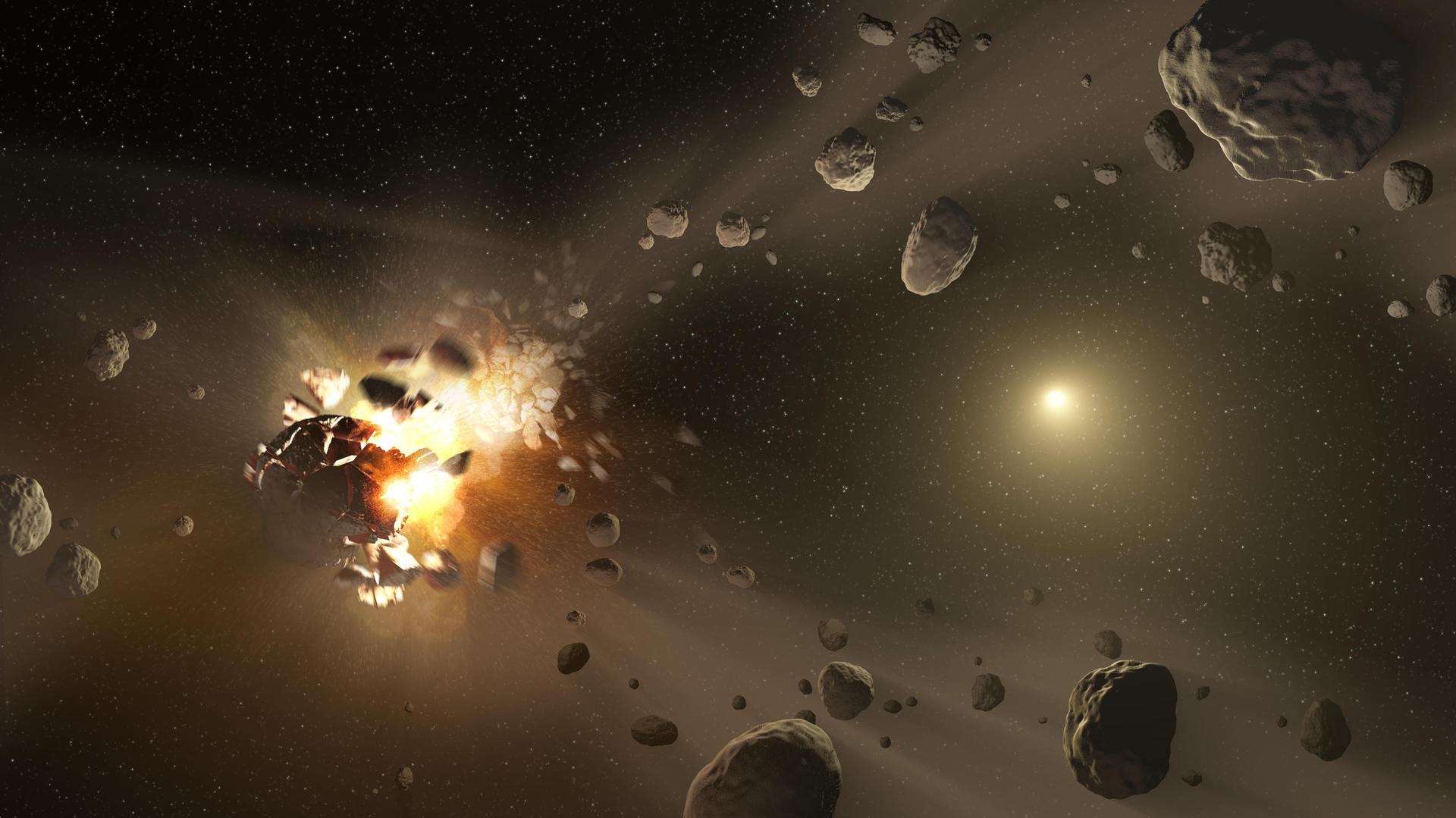 An illustration of two asteroids colliding in space. New research hints that some forms of extreme bacteria could survive crashes like these, sending them on an interplanetary journey.
(Image credit: NASA/JPL-Caltech)
An illustration of two asteroids colliding in space. New research hints that some forms of extreme bacteria could survive crashes like these, sending them on an interplanetary journey.
(Image credit: NASA/JPL-Caltech)
- Copy link
- X
Get the world’s most fascinating discoveries delivered straight to your inbox.
Become a Member in Seconds
Unlock instant access to exclusive member features.
Contact me with news and offers from other Future brands Receive email from us on behalf of our trusted partners or sponsors By submitting your information you agree to the Terms & Conditions and Privacy Policy and are aged 16 or over.You are now subscribed
Your newsletter sign-up was successful
Want to add more newsletters?

Delivered Daily
Daily Newsletter
Sign up for the latest discoveries, groundbreaking research and fascinating breakthroughs that impact you and the wider world direct to your inbox.
Signup +
Once a week
Life's Little Mysteries
Feed your curiosity with an exclusive mystery every week, solved with science and delivered direct to your inbox before it's seen anywhere else.
Signup +
Once a week
How It Works
Sign up to our free science & technology newsletter for your weekly fix of fascinating articles, quick quizzes, amazing images, and more
Signup +
Delivered daily
Space.com Newsletter
Breaking space news, the latest updates on rocket launches, skywatching events and more!
Signup +
Once a month
Watch This Space
Sign up to our monthly entertainment newsletter to keep up with all our coverage of the latest sci-fi and space movies, tv shows, games and books.
Signup +
Once a week
Night Sky This Week
Discover this week's must-see night sky events, moon phases, and stunning astrophotos. Sign up for our skywatching newsletter and explore the universe with us!
Signup +Join the club
Get full access to premium articles, exclusive features and a growing list of member rewards.
Explore An account already exists for this email address, please log in. Subscribe to our newsletter"Extremophile" bacteria could survive asteroid impacts strong enough to launch them into space, a new lab experiment shows — hinting that these space-rock crashes could spread any potential alien life between worlds.
In the new study, published March 3 in the journal PNAS Nexus, researchers sandwiched Deinococcus radiodurans, a type of bacteria that has been shown to survive in space for years, between two steel plates. Then, they squished the "sandwich" very hard and fast to simulate asteroids slamming into a planet, and measured how many of the microbes survived.
The sandwich-squishing pressures were chosen based on what it would take for asteroids striking Mars to launch microbes and bits of planet into space. The team tested pressures from 1.4 to 2.9 gigapascals (GPa) — about 14,000 to 29,000 times the atmospheric pressure on Earth at sea level. Roughly 60% of the microbes survived being struck with 2.4 GPa, and up to 95% survived when the pressure was lowered to 1.4 GPa.
Article continues below You may like-
 New study of chemical reactions in space 'could impact the origin of life in ways we hadn't thought of'
-
 'Stop and re-check everything': Scientists discover 26 new bacterial species in NASA's cleanrooms
-
 Viruses that evolved on the space station and were sent back to Earth were more effective at killing bacteria
In most previous studies that tested such scenarios, the survival rates of the microbes were orders of magnitude lower. The study authors theorized that this may be because the microbes tested in the new study were different: stronger; more resilient; and able to withstand extreme radiation exposure, desiccation (getting extremely dried out) and high temperatures.
An extreme form of life
The researchers chose to test D. radiodurans because it can endure the cold, empty vacuum of space. A 2020 study found that D. radiodurans survived being exposed to space for three years while attached to the exterior of the International Space Station, which is not a friendly place for life. (Moss doesn't seem to mind it, though.)
The team also looked at how the microbes recovered after the impacts by incubating the cells at 98.6 degrees Fahrenheit (37 degrees Celsius) for a few hours and measuring which genes the microbes expressed. They found that, after being hit with higher-pressure impacts (hard enough to damage cell membranes), the microbes prioritized genes related to repairing cell damage rather than creating new cells. They also ate more iron and repaired their DNA.

—NASA rover discovers out-of-place 'skull' on Mars, and scientists are baffled
—Odd-looking rock on Mars is totally alien to the Red Planet, rover finds
—NASA rover spots bizarre 'turtle' poking its head out on Mars
An understanding of how life might travel between planetary bodies is important for sample-return missions, the study authors noted in the paper. For example, samples returned from Mars must go through rigorous procedures to prevent possible Martian microbes from hitching a ride to Earth and possibly contaminating our planet. If asteroid impacts could transport microbes elsewhere in the solar system, samples returned from other places might need additional precautions to prevent contamination as well.
Sign up for the Live Science daily newsletter nowContact me with news and offers from other Future brandsReceive email from us on behalf of our trusted partners or sponsorsBy submitting your information you agree to the Terms & Conditions and Privacy Policy and are aged 16 or over.Beyond that, the study shows that certain forms of life can survive being hurled violently into space. This may affect how and where we might look for life in the solar system.
Article SourcesKawaguchi, Y., Shibuya, M., Kinoshita, I., Yatabe, J., Narumi, I., Shibata, H., Hayashi, R., Fujiwara, D., Murano, Y., Hashimoto, H., Imai, E., Kodaira, S., Uchihori, Y., Nakagawa, K., Mita, H., Yokobori, S., & Yamagishi, A. (2020). DNA damage and survival time course of deinococcal cell pellets during 3 years of exposure to outer space. Frontiers in Microbiology, 11, 2050. https://doi.org/10.3389/fmicb.2020.02050
Extraterrestrials quiz: Are you an alien expert, or has your brain been abducted?
 Damien PineLive Science contributor
Damien Pine (he/him) is a freelance writer, artist, and former NASA engineer. He writes about science, physics, tech, art, and other topics with a focus on making complicated ideas accessible. He has a degree in mechanical engineering from the University of Connecticut, and he gets really excited every time he sees a cat.
View MoreYou must confirm your public display name before commenting
Please logout and then login again, you will then be prompted to enter your display name.
Logout Read more
New study of chemical reactions in space 'could impact the origin of life in ways we hadn't thought of'
'Stop and re-check everything': Scientists discover 26 new bacterial species in NASA's cleanrooms
Viruses that evolved on the space station and were sent back to Earth were more effective at killing bacteria
 NASA telescope spots the building blocks for life spewing out of comet 3I/ATLAS
 Life may have rebounded 'ridiculously fast' after the dinosaur-killing asteroid impact
 Scientist accidentally stumbles across bizarre ancient ‘wrinkle structures’ in Morocco that shouldn't be there
Latest in Extraterrestrial Life
Scientist accidentally stumbles across bizarre ancient ‘wrinkle structures’ in Morocco that shouldn't be there
Latest in Extraterrestrial Life
 SETI scientists reveal 100 'signals of interest' from collapsed Arecibo Observatory
 Advanced alien civilizations could be communicating 'like fireflies' in plain sight, researchers suggest
 Scientists are debating a 70-year-old UFO mystery as new images come to light
 Is it aliens? Here's why that's the least important question about 3I/ATLAS.
 Chinese scientists hunt for alien radio signals in 'potentially habitable' TRAPPIST-1 system
 Camera trap in Chile detects strange lights blazing through the wilderness. Researchers are scrambling to explain them.
Latest in News
Camera trap in Chile detects strange lights blazing through the wilderness. Researchers are scrambling to explain them.
Latest in News
 Russian Revolution gold coin hoard worth over $500,000 discovered during house construction
 'Rectal garlic insertion for immune support': Medical chatbots confidently give disastrously misguided advice, experts say
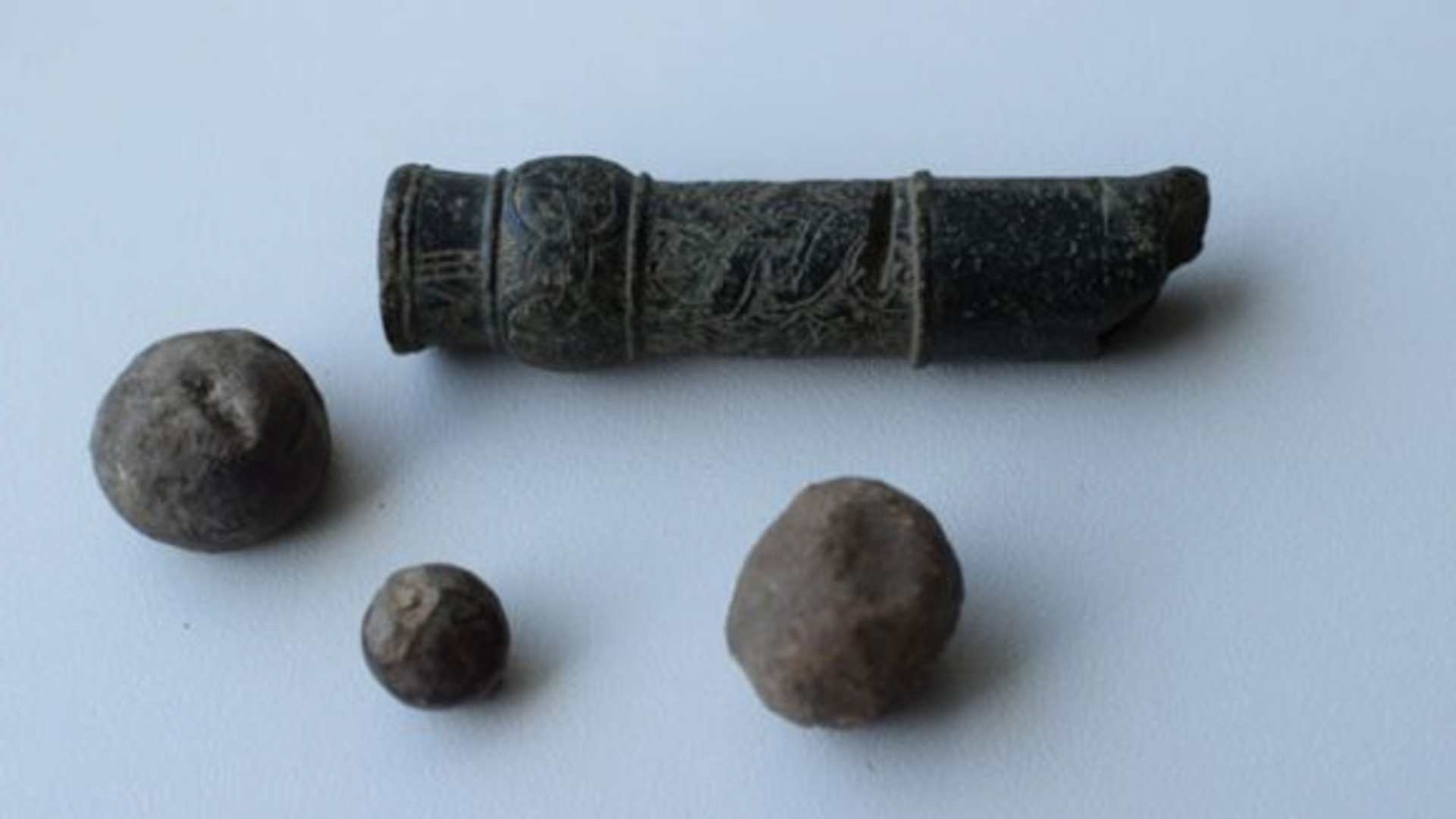 Europe's oldest handgun may date to 14th-century siege at German castle
 Man in Czech Republic accidentally finds Bronze Age spearhead mold in his backyard
 Universe-shaking collision of black hole and neutron star could upend our understanding of monster cosmic mergers
 Vernal equinox 2026: When is the first day of spring?
LATEST ARTICLES
Vernal equinox 2026: When is the first day of spring?
LATEST ARTICLES- 1'Rectal garlic insertion for immune support': Medical chatbots confidently give disastrously misguided advice, experts say
- 2Russian Revolution gold coin hoard worth over $500,000 discovered during house construction
- 3The world is being held hostage by its reliance on oil. How can we break free from the fossil fuel?
- 4Europe's oldest handgun may date to 14th-century siege at German castle
- 5Scientists squished microbes into a steel 'sandwich' — and made a profound discovery about life in space