- Planet Earth
- Rivers & Oceans
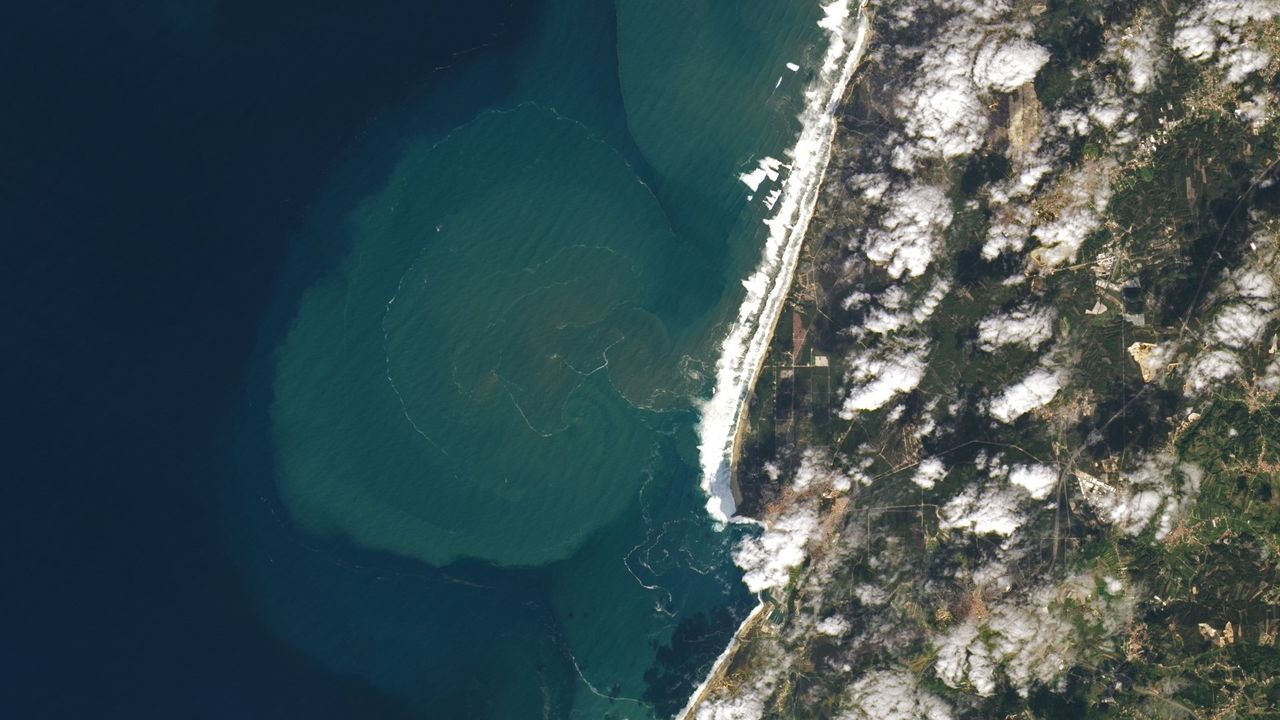
A 2020 satellite photo shows the immense power of 7-story waves crashing along the Portuguese coast. Later the same day, a surfer rode a 101-foot-tall wave at Nazaré, setting a new world record.
When you purchase through links on our site, we may earn an affiliate commission. Here’s how it works.
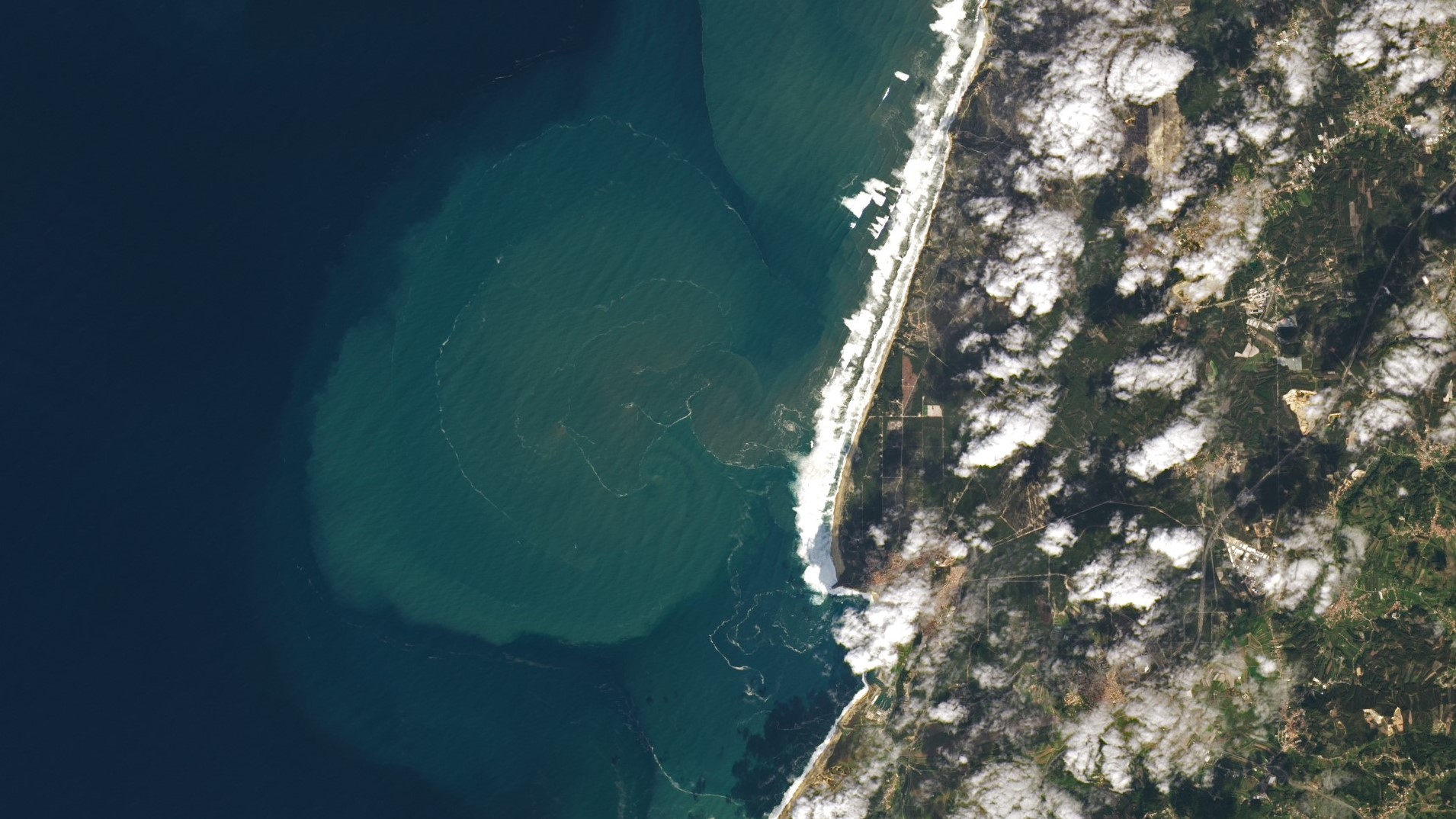 The Portuguese coast surrounding the town of Nazaré is famous for its giant waves, which also unleash giant underwater plumes as they crash along the shore.
(Image credit: Lauren Dauphin/NASA Earth Observatory/Landsat 8)
Share
Share by:
The Portuguese coast surrounding the town of Nazaré is famous for its giant waves, which also unleash giant underwater plumes as they crash along the shore.
(Image credit: Lauren Dauphin/NASA Earth Observatory/Landsat 8)
Share
Share by:
- Copy link
- X
Where is it? Nazaré, Portugal [39.60478265, -9.071984267]
What's in the photo? Massive 7-story waves crashing along the coast, creating giant underwater sediment plumes
Which satellite took the photo? Landsat 8
When was it taken? Oct. 29, 2020
This striking satellite snap highlights the immense power of 7-story waves crashing along the Portuguese coast and ejecting massive sediment plumes under the sea. The same day this photo was taken, a local 18-year-old surfer set a new world record by riding one of the colossal crests.
The Landsat 8 satellite captured this epic scene near the town of Nazaré in western Portugal, a region famous for having some of the tallest waves on Earth. Nazaré is home to around 15,000 people and regularly hosts "big-wave" surfing competitions, which attract surfers from around the world. The swells there are so big that surfers often have to be towed into the breaking waves with a jet ski.
The monster waves in the image likely reached heights of around 80 feet (24 meters), which is roughly equivalent to a 7-story building. This is exceptionally tall — even for Nazaré, where waves usually peak up to 50 feet (15m) at this time of year — and would usually be considered too dangerous to surf.
You may like-
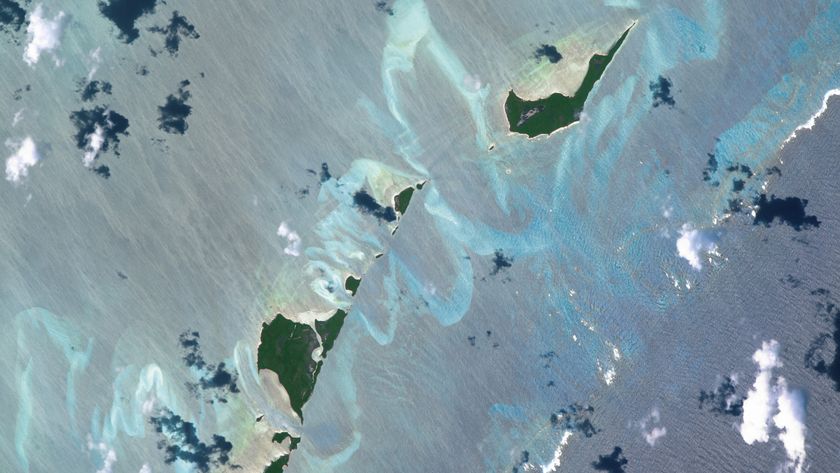 Submerged sandbanks shine like underwater auroras in astronaut's view of the Bahamas
-
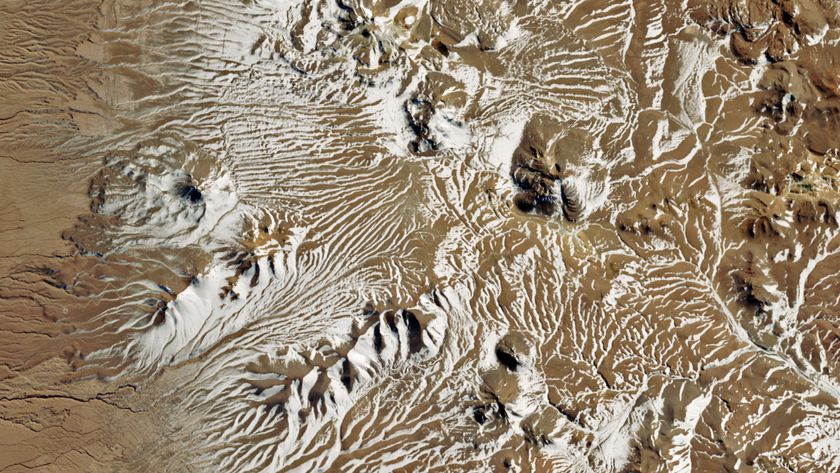 Rare dusting of snow covers one of the driest place on Earth and shuts down massive radio telescope
-
 See the exact point where a glacier, a lake and a river 'touch' in Argentina
As these waves broke along the shore, their powerful undercurrents ripped up sand and other sediments from the seafloor and spat them out in the opposite direction to the waves, creating murky underwater clouds that could be seen from space.
The plumes in this photo extend up to 6 miles (10 kilometers) from the coastline, according to NASA's Earth Observatory.
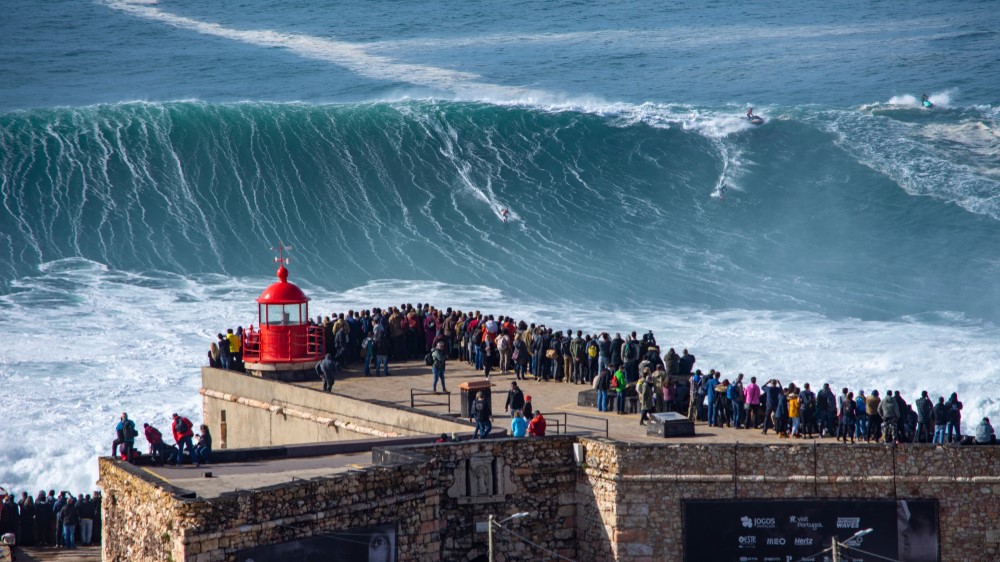
Later the same day, local surfer António Laureano rode an even loftier wave, estimated to be approximately 101.4 feet (30.9 m) tall — the largest wave ever surfed by a human.
This record is not officially recognized by the World Surf League (WSL) because the organization's representatives did not calculate the wave's height. Instead, the height was determined by oceanographers at the University of Lisbon, who analyzed a video of the wave sent to them by Laureano, surfing news site Surfer Today reported at the time.
Sign up for the Live Science daily newsletter nowContact me with news and offers from other Future brandsReceive email from us on behalf of our trusted partners or sponsorsBy submitting your information you agree to the Terms & Conditions and Privacy Policy and are aged 16 or over.The current WSL record for the tallest wave ever surfed belongs to German surfer Sebastian Steudtner, who rode a 93.7-foot (28.6 m) wave, also at Nazaré, on Feb. 24, 2024, according to Surfer.com.
In total, seven of the official top 10 largest waves ever surfed have occurred at Nazaré, according to Red Bull.
"Big-wave" hotspot
The secret behind Nazaré's giant waves is the Nazaré Canyon just southwest of the town. It is the largest submarine canyon in Europe, stretching 130 miles (210 kilometers) long and roughly 3 miles (4.8 km) deep into the Atlantic Ocean.
You may like-
Rare dusting of snow covers one of the driest place on Earth and shuts down massive radio telescope
-
See the exact point where a glacier, a lake and a river 'touch' in Argentina
-
 Trio of 'black mesas' leftover from Paleozoic era spawn rare sand dunes in the Sahara
Water inside the canyon travels faster than shallower water, forming large waves at depth that are "bent" in the direction of Nazaré. As they approach the coast, these large waves collide with other waves coming from the northwest, which further amplifies their speed and allows them to quickly rise when they approach the shore.
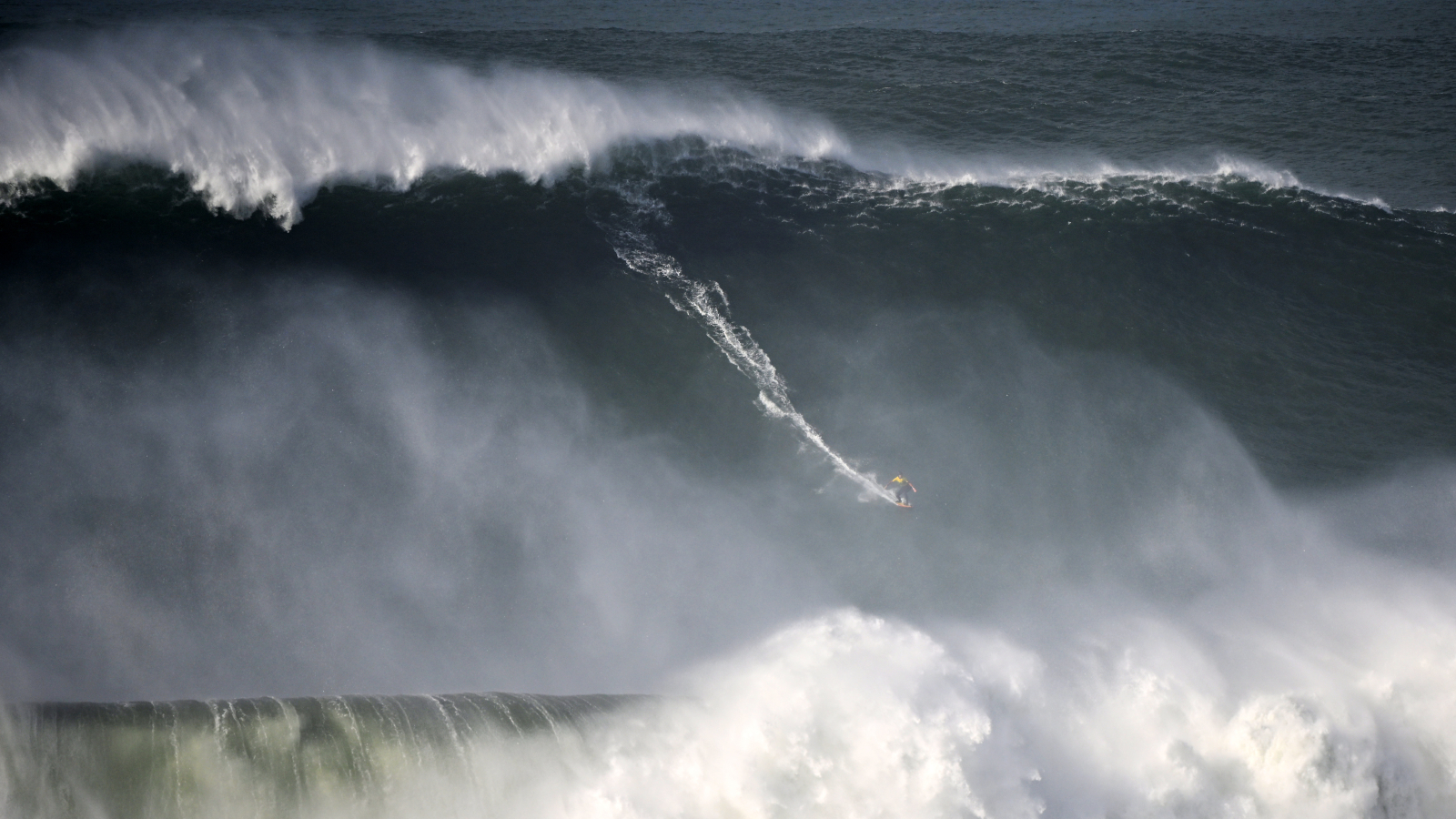
Occasionally, the waves can be further amplified by strong offshore winds. This was the case with the supercharged swells in the satellite photo, which were partially fueled by the remnants of Hurricane Epsilon, according to the Earth Observatory.
MORE EARTH FROM SPACE—Submerged sandbanks shine like underwater auroras in astronaut's view of the Bahamas
—The whale-shaped island in Belize with a 'great blue blowhole'
—'Ghost island' appears after underwater eruption, then vanishes into the Caspian Sea
Nazaré's big wave phenomenon is highly seasonal, with the largest waves typically occuring between November and February. In the summer months, the waves almost completely disappear, allowing tourists to flock back to the beaches and swim in the sea. However, even then, disaster can still strike.
In August 2012, for example, a five-year-old girl and her 66-year-old grandfather, both British nationals, were killed after being dragged out to sea by a massive "rogue wave" as they were walking on a nearby beach, according to the BBC.
For more incredible satellite photos and astronaut images, check out our Earth from space archives.
TOPICS Earth from space Harry BakerSocial Links NavigationSenior Staff Writer
Harry is a U.K.-based senior staff writer at Live Science. He studied marine biology at the University of Exeter before training to become a journalist. He covers a wide range of topics including space exploration, planetary science, space weather, climate change, animal behavior and paleontology. His recent work on the solar maximum won "best space submission" at the 2024 Aerospace Media Awards and was shortlisted in the "top scoop" category at the NCTJ Awards for Excellence in 2023. He also writes Live Science's weekly Earth from space series.
Show More CommentsYou must confirm your public display name before commenting
Please logout and then login again, you will then be prompted to enter your display name.
Logout Read more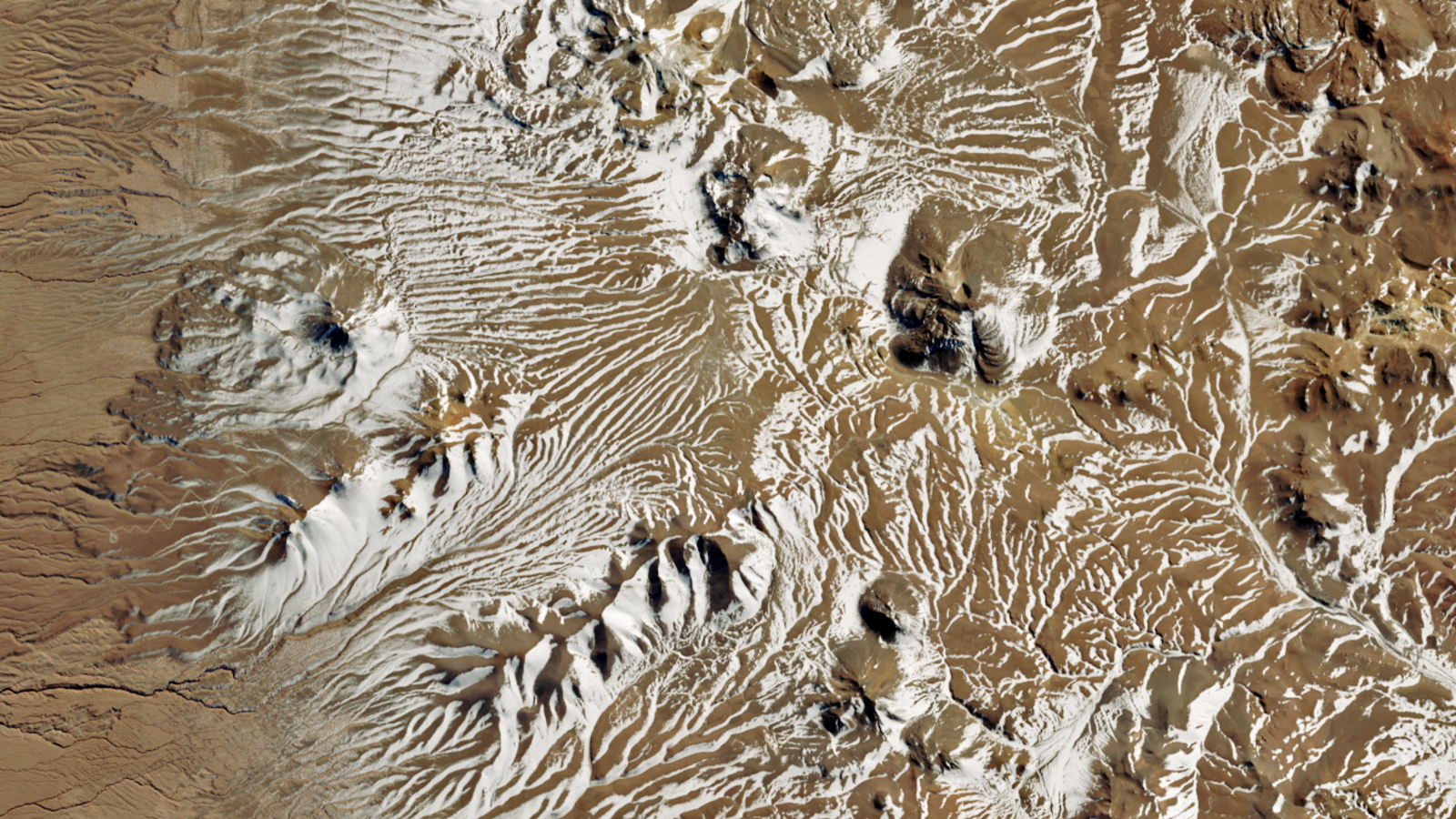 Rare dusting of snow covers one of the driest place on Earth and shuts down massive radio telescope
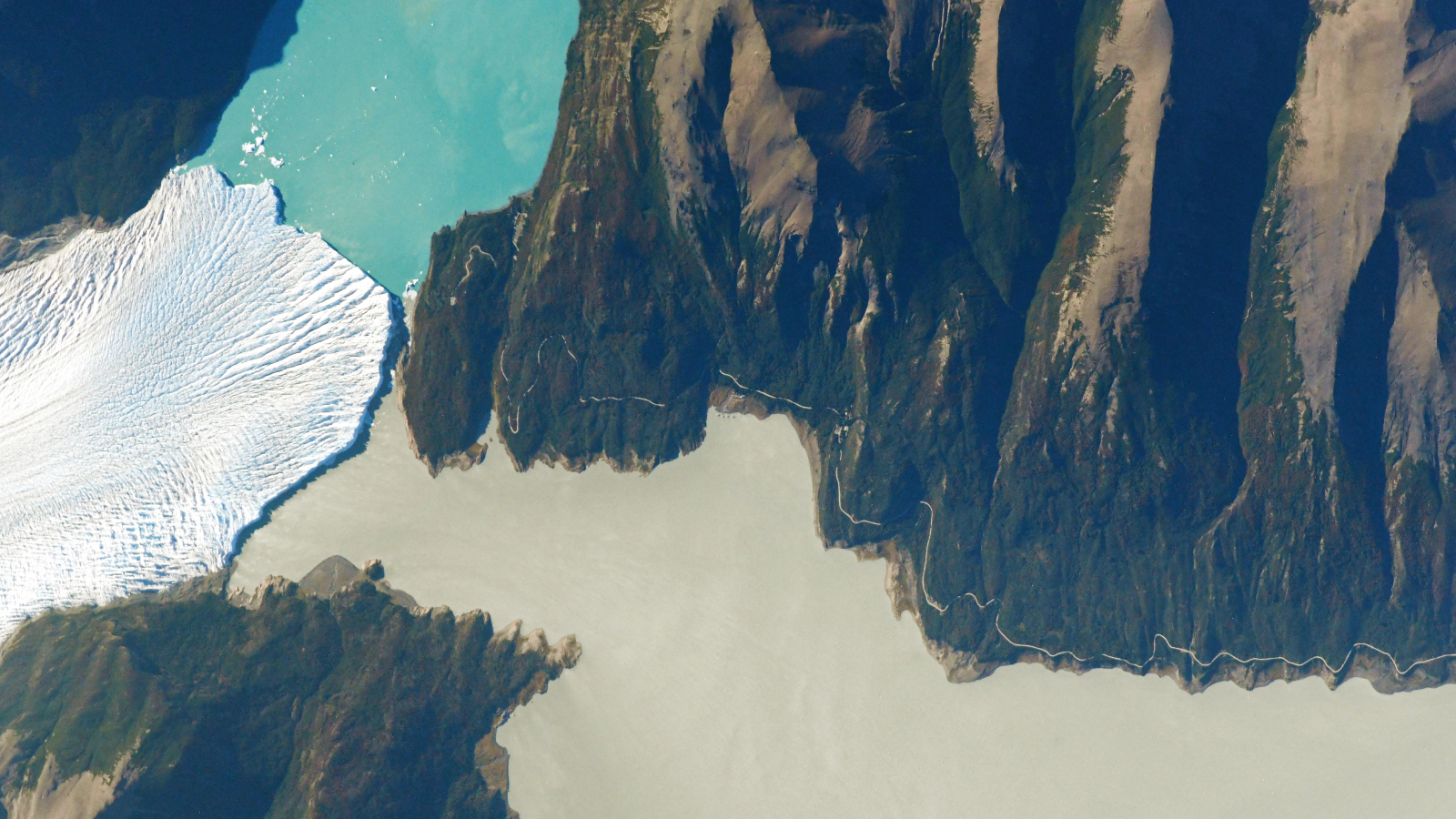 See the exact point where a glacier, a lake and a river 'touch' in Argentina
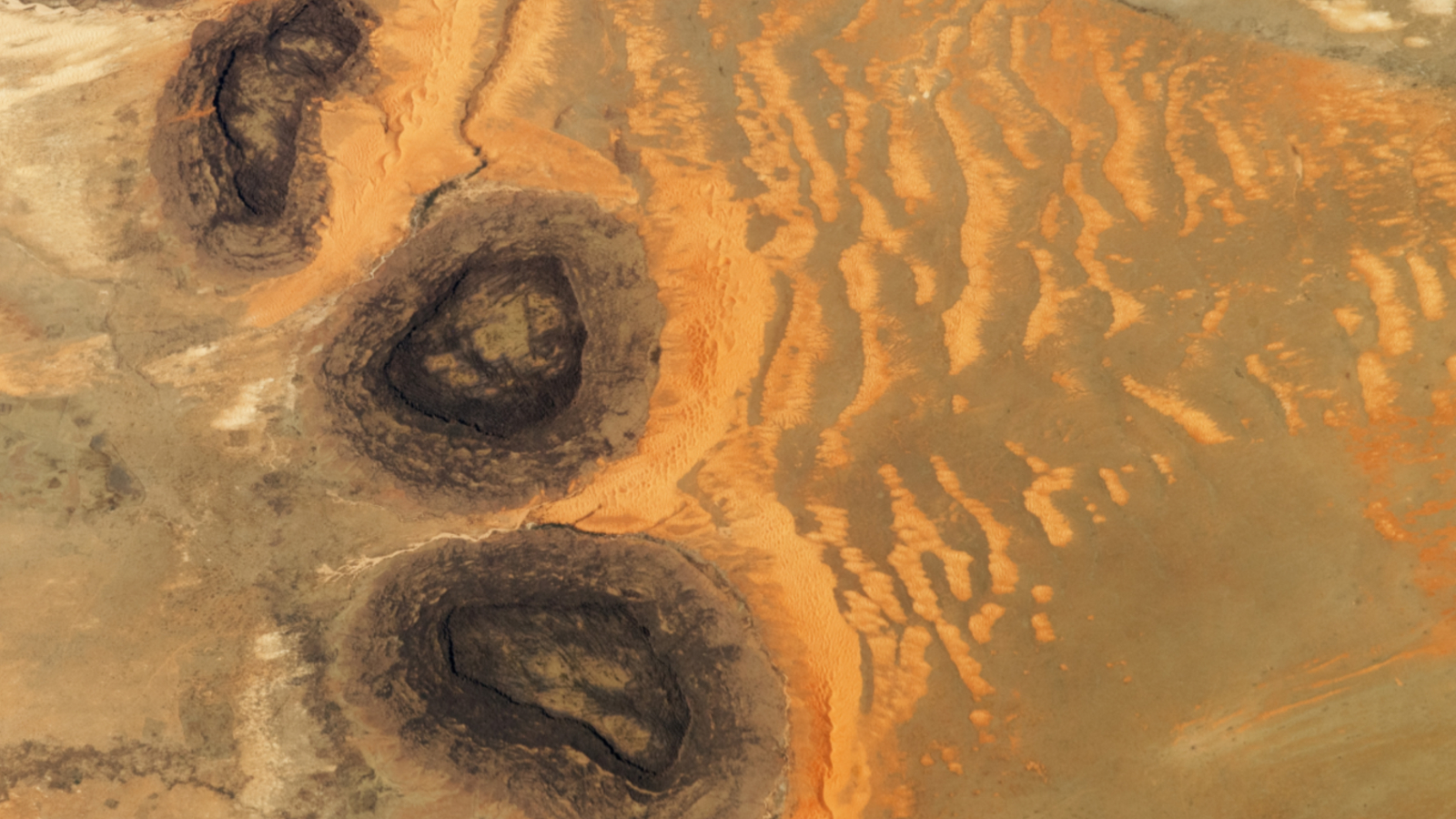 Trio of 'black mesas' leftover from Paleozoic era spawn rare sand dunes in the Sahara
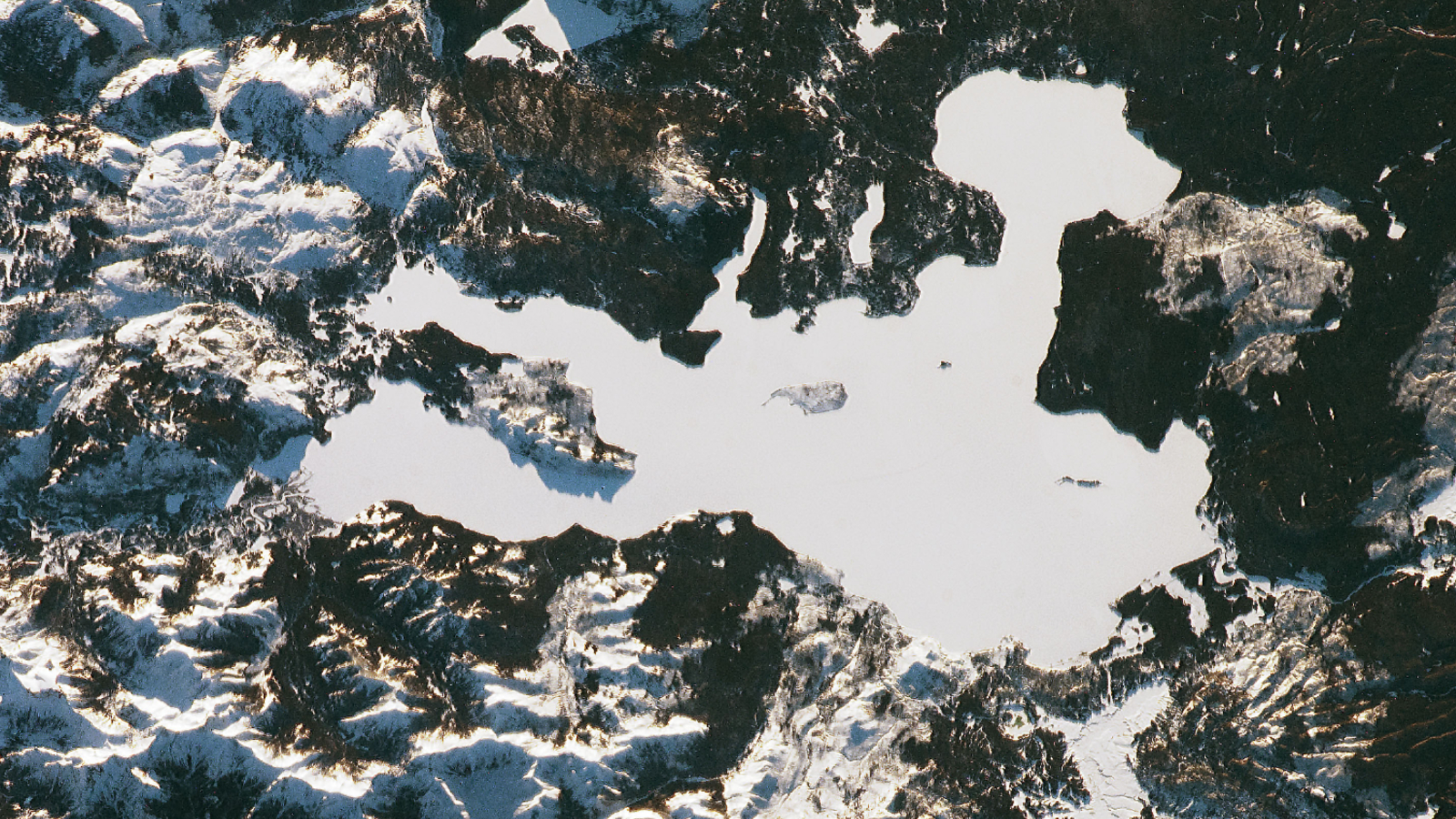 Deep snow blanket transforms Yellowstone Lake into a giant white void
 Extreme 'paradise' volcano in Costa Rica is like a piece of ancient Mars on our doorstep
 Ethereal ice structures swirl alongside Chicago during extreme cold snap fueled by polar vortex
Latest in Rivers & Oceans
Ethereal ice structures swirl alongside Chicago during extreme cold snap fueled by polar vortex
Latest in Rivers & Oceans
 Enormous freshwater reservoir discovered off the East Coast may be 20,000 years old and big enough to supply NYC for 800 years
 Last year, the oceans absorbed a record-breaking amount of heat — equivalent to 12 Hiroshima bombs exploding every second
 18 of Earth's biggest river deltas — including the Nile and Amazon — are sinking faster than global sea levels are rising
 What's the oldest river in the world?
 Submerged sandbanks shine like underwater auroras in astronaut's view of the Bahamas
See the exact point where a glacier, a lake and a river 'touch' in Argentina
Latest in Features
Giant underwater plumes triggered by 7-story waves at Nazaré captured off Portuguese coast
Submerged sandbanks shine like underwater auroras in astronaut's view of the Bahamas
See the exact point where a glacier, a lake and a river 'touch' in Argentina
Latest in Features
Giant underwater plumes triggered by 7-story waves at Nazaré captured off Portuguese coast
 Could there ever be a worldwide internet outage?
 How much of your body could you lose — and still survive?
 Parkfield, San Andreas, and the quest for a 'crystal ball' for predicting earthquakes before they happen
 How to watch 'Pole to Pole with Will Smith' — TV and streaming details as Oscar-winning actor blends adventure and scientific discovery
 Nebra Sky Disc: The world's oldest depiction of astronomical phenomena — and it may depict the Pleiades
LATEST ARTICLES
Nebra Sky Disc: The world's oldest depiction of astronomical phenomena — and it may depict the Pleiades
LATEST ARTICLES 1Lab mice that 'touch grass' are less anxious — and that highlights a big problem in rodent research
- 22,400-year-old Hercules shrine and elite tombs discovered outside ancient Rome's walls
- 3Coyote scrambles onto Alcatraz Island after perilous, never-before-seen swim
- 4Stunning time-lapse video captured using 'artificial eclipse' shows 3 massive eruptions on the sun
- 5Enormous freshwater reservoir discovered off the East Coast may be 20,000 years old and big enough to supply NYC for 800 years