- Health
- Medicine & Drugs
Scientists are developing a microneedle patch that they hope could someday simplify IVF hormone delivery. They've tested it in animals.
When you purchase through links on our site, we may earn an affiliate commission. Here’s how it works.
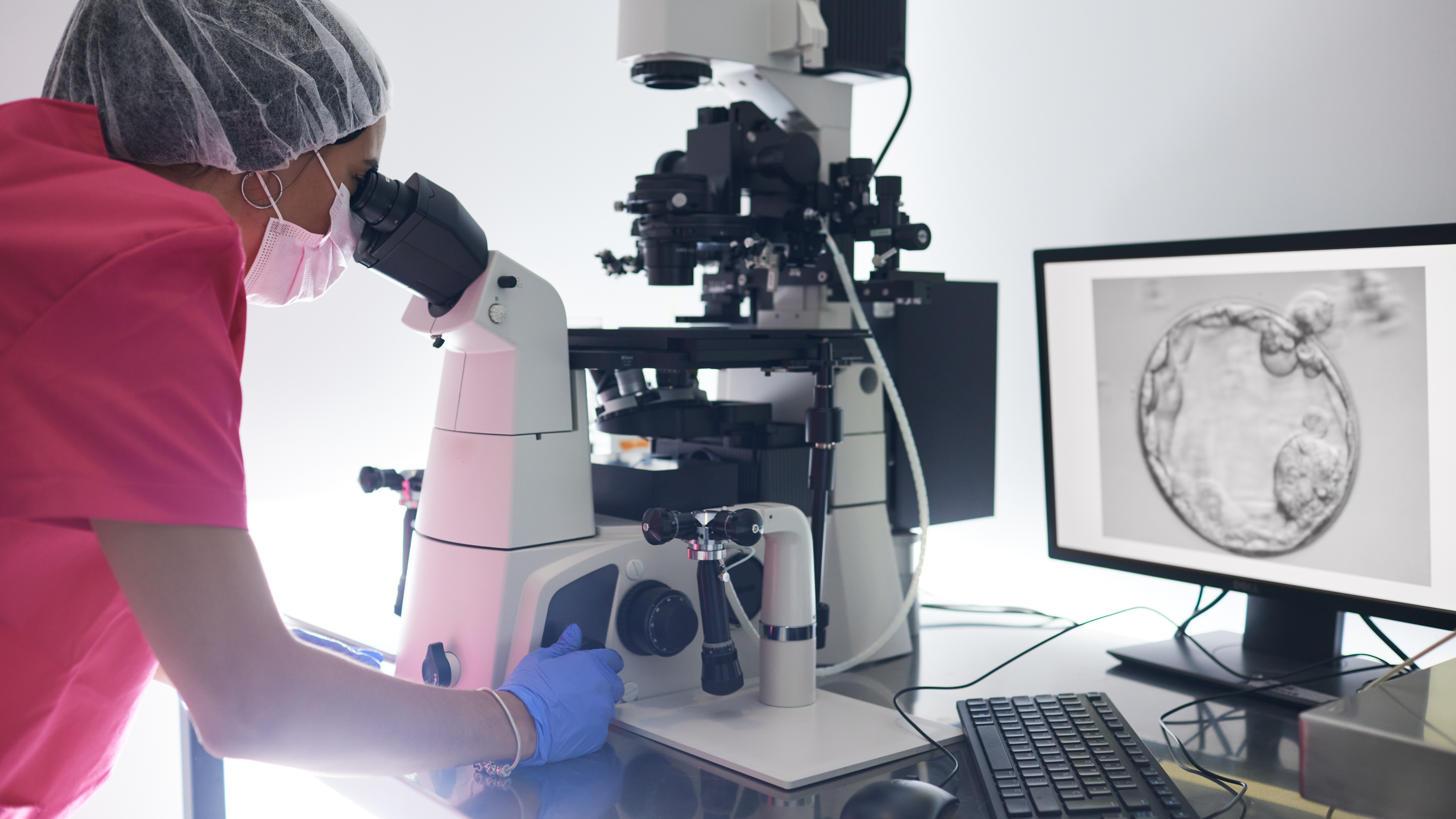 A new microneedle patch could someday help patients undergoing IVF treatment do so without painful hormone shots.
(Image credit: Tempura via Getty Images)
Share
Share by:
A new microneedle patch could someday help patients undergoing IVF treatment do so without painful hormone shots.
(Image credit: Tempura via Getty Images)
Share
Share by:
- Copy link
- X
Patients undergoing in vitro fertilization (IVF) must give themselves daily hormone shots in weeks leading up to having eggs collected for the procedure. Now, a research team has developed what it calls a painless, automated way to deliver these hormones using a light-activated microneedle patch.
A preliminary study conducted in rats has shown that delivering the hormone leuprolide from a patch could be done painlessly and without releasing foreign substances into the body. A light can be preprogrammed to turn on at specific times, such that the patch releases the hormone at the correct cadence.
You may like-
 Could aging eggs be 'rejuvenated'? New tool may help pave the way to fertility-extending treatments
-
 'Pain sponge' derived from stem cells could soak up pain signals before they reach the brain
-
 A fentanyl vaccine enters human trials in 2026 — here's how it works
Vivienne Tam, who was a doctoral student at the time of the study, suggested the potential of their research for helping IVF patients, Cerruti said. The group had previously been thinking about using the patch for administering cancer drugs to patients, Cerruti said.
"From what we read, one of the main reasons for the failure of IVF is that the drug is not given consistently," she told Live Science. The hope is that, someday, the patch could solve that challenge.
Designing a hormone-delivery system
In the new study, the team incorporated prior discoveries made in two separate labs at McGill and the INRS research center in Quebec.
The patch is composed of tiny needles that contain nanoparticles, which are packed with the hormone leuprolide. The researchers had already developed a potential coating for the nanoparticles that breaks down when exposed to low-energy light, called near-infrared light (NIR). Upon NIR exposure, the nanoparticles then spill their contents.
Sign up for the Live Science daily newsletter nowContact me with news and offers from other Future brandsReceive email from us on behalf of our trusted partners or sponsorsBy submitting your information you agree to the Terms & Conditions and Privacy Policy and are aged 16 or over.How this works is that the NIR is converted to higher-energy ultraviolet (UV) light by the nanoparticle's core. This UV light can then break the bonds in the coating of the particle, releasing the molecules held inside. "We had this coating that we knew worked," Cerruti said.
The team had also shown that the nanoparticles, which are made of rare-earth materials, are nontoxic in animal tests. To then make their patch, they incorporated the nanoparticles into microneedles made of a nonsoluble, synthetic polymer, which should not degrade, Cerruti said.
The needles prick microscopic holes in the outer layer of the skin, called the stratum corneum, which is made up of dead skin cells. These pricks are painless because the needles do not penetrate deep enough to reach the sensory nerve endings housed in deeper layers of the skin, Tam said.
You may like-
Could aging eggs be 'rejuvenated'? New tool may help pave the way to fertility-extending treatments
-
'Pain sponge' derived from stem cells could soak up pain signals before they reach the brain
-
A fentanyl vaccine enters human trials in 2026 — here's how it works
In rats, the NIR successfully released the drug from the microneedles without releasing any foreign substances — namely, the nanoparticles themselves — into the body, Cerruti said. If the nanoparticles had entered the body along with the hormones, they would have accumulated in the liver and other organs, she said, but the team didn't observe that in tests.
One potential challenge of this method is that skin thickness and blood flow vary among patients, said Lifeng Kang, an associate professor at The University of Sydney School of Pharmacy who was not involved in the study. Ensuring that an NIR pulse releases the light needed across different body types may be more challenging than delivering the medicine with a standard shot, he wrote in an email to Live Science.
Although NIR penetrates skin better than visible light does, its efficiency decreases with increases in fat tissue, Kang added. "Since IVF injections are traditionally subcutaneous [delivered under the skin], the researchers have to ensure the microneedles and the light source can effectively communicate at the necessary depth to trigger the release," he explained.
The new findings show that the hormone went into the rats' circulatory system as intended, but researchers have yet to test whether this delivery method has the desired effect of encouraging egg maturation, Cerruti said.
RELATED STORIES—IVF may raise risk of certain disorders in babies — and epigenetic 'signatures' in the placenta could explain why
—Incredible, first-of-its-kind video shows human embryo implanting in real time
—World's first baby conceived with remotely operated, 'automated IVF' has been born
The biggest hurdle for any nanoparticle-based therapy is biocompatibility, Kang said, meaning the material must be compatible with living tissue and not cause toxic effects or harmful immune reactions. The researchers "must prove these nanoparticles are either safely excreted or remain inert in the skin without long-term toxicity," he said.
Although the microneedles should not degrade in the body proving their durability could be difficult, Cerruti said, since "polymers are made of hydrogen, carbon and oxygen — the same elements we're made of."
Before moving on to studies in larger animals, Cerruti said, the researchers want to conduct additional rat studies to determine the efficacy of this hormone-delivery system.
In their initial experiments, the team released only a small dose of the hormone. For the dose to be equivalent to that used in IVF, they would need to use more patches on a given mouse, or include more nanoparticles in a given patch, Cerruti said. They could also increase the size of the patch, so the number of nanoparticles scales up.
One of the "biggest barriers to overcome before eventual clinical translation is the limited dose of the drug available in the bloodstream," Cerruti said.
Article SourcesTam, V., Trana, R., Nieto‐Arguello, A., Olasubulumi, O., Babity, S., Skripka, A., Vetrone, F., Brambilla, D., & Cerruti, M. (2025). Upconverting nanoparticle‐Loaded Microneedles for near‐infrared responsive delivery of gonadotropins to increase success of in vitro fertilization. Small, 22(1). https://doi.org/10.1002/smll.202513138
 Theresa Sullivan BargerLive Science Contributor
Theresa Sullivan Barger is an award-winning freelance journalist who covers health, science, and the environment. Her stories have appeared in The New York Times, The Boston Globe, Los Angeles Times, AARP, CURE, Discover, Family Circle, Health Central, Next Avenue, IEEE Spectrum, Connecticut Magazine, CT Health Investigative Team, and more. Based in central Connecticut, she is an advanced master gardener who is passionate about gardening for wildlife, especially pollinators and songbirds.
Show More CommentsYou must confirm your public display name before commenting
Please logout and then login again, you will then be prompted to enter your display name.
Logout Read more Could aging eggs be 'rejuvenated'? New tool may help pave the way to fertility-extending treatments
 'Pain sponge' derived from stem cells could soak up pain signals before they reach the brain
 A fentanyl vaccine enters human trials in 2026 — here's how it works
 Study links GLP-1 use to some pregnancy risks — but the research has key caveats
 A 'functional cure' for HIV may be in reach, early trials suggest
 'Mitochondrial transfer' into nerves could relieve chronic pain, early study hints
Latest in Medicine & Drugs
'Mitochondrial transfer' into nerves could relieve chronic pain, early study hints
Latest in Medicine & Drugs
 Antibiotic resistance is the 'silent pandemic' — here are four steps to stop it
 Wegovy now comes in pill form — here's how it works
 Metal compounds identified as potential new antibiotics, thanks to robots doing 'click chemistry'
 US government overhauls the childhood vaccine schedule in unprecedented move
 New drug could prevent diabetes complications not fixed with blood sugar control, study hints
 New antivenom works against 17 dangerous African snake species, study suggests
Latest in News
New antivenom works against 17 dangerous African snake species, study suggests
Latest in News
 'Doomsday Clock' ticks 4 seconds closer to midnight
 Standard model of cosmology holds up in massive 6-year study of the universe
 Creepy humanoid robot face learned to move its lips more accurately by staring at itself in the mirror, then watching YouTube
 Shark attacks in Hawaii spike in October, and scientists think they know why
 Rock climbers in Italy accidentally discovered evidence of an 80 million-year-old sea turtle stampede
IVF hormones could be delivered with painless 'microneedle' patch someday, early study hints
LATEST ARTICLES
Rock climbers in Italy accidentally discovered evidence of an 80 million-year-old sea turtle stampede
IVF hormones could be delivered with painless 'microneedle' patch someday, early study hints
LATEST ARTICLES- 1'Doomsday Clock' ticks 4 seconds closer to midnight
- 2Standard model of cosmology holds up in massive 6-year study of the universe
- 3Creepy humanoid robot face learned to move its lips more accurately by staring at itself in the mirror, then watching YouTube
- 4160,000-year-old sophisticated stone tools discovered in China may not have been made by Homo sapiens
- 5Rock climbers in Italy accidentally discovered evidence of an 80 million-year-old sea turtle stampede